WHO SELLS JOSEPH? – Va’yeyshev – Gen. 37-40, by Rabbi Baruch Cohon

WHO SELLS JOSEPH? – Va’yeyshev – Gen. 37-40, by Rabbi Baruch Cohon

Among the world’s most famous stories, Joseph’s ranks high. Modern writers from Thomas Mann to Andrew Lloyd Weber based well known adaptations on this week’s Torah portion. A rather confused version of it found its way into the Koran. Surely as an allegory of sibling conflict, it cannot be equaled. From its point in history, some 39 centuries ago, through 4 centuries in Egypt, through 15 more mostly in the Land of Israel, another 18 in total exile, to our own current 68 years of life in and out of the restored Jewish state, Jacob’s descendants find themselves re-living parts of the story of Joseph.

One climactic event in the story takes place early on, when Joseph gets sold to a “caravan of Ishmaelites.” These descendants of Joseph’s great-uncle Ishmael, his grandfather Isaac’s lifelong enemy, were the ancestors of today’s Arabs. They proceeded to put their new slave to work tending the camels while they trekked their way to Egypt, where they re-sold him. That much is clear.

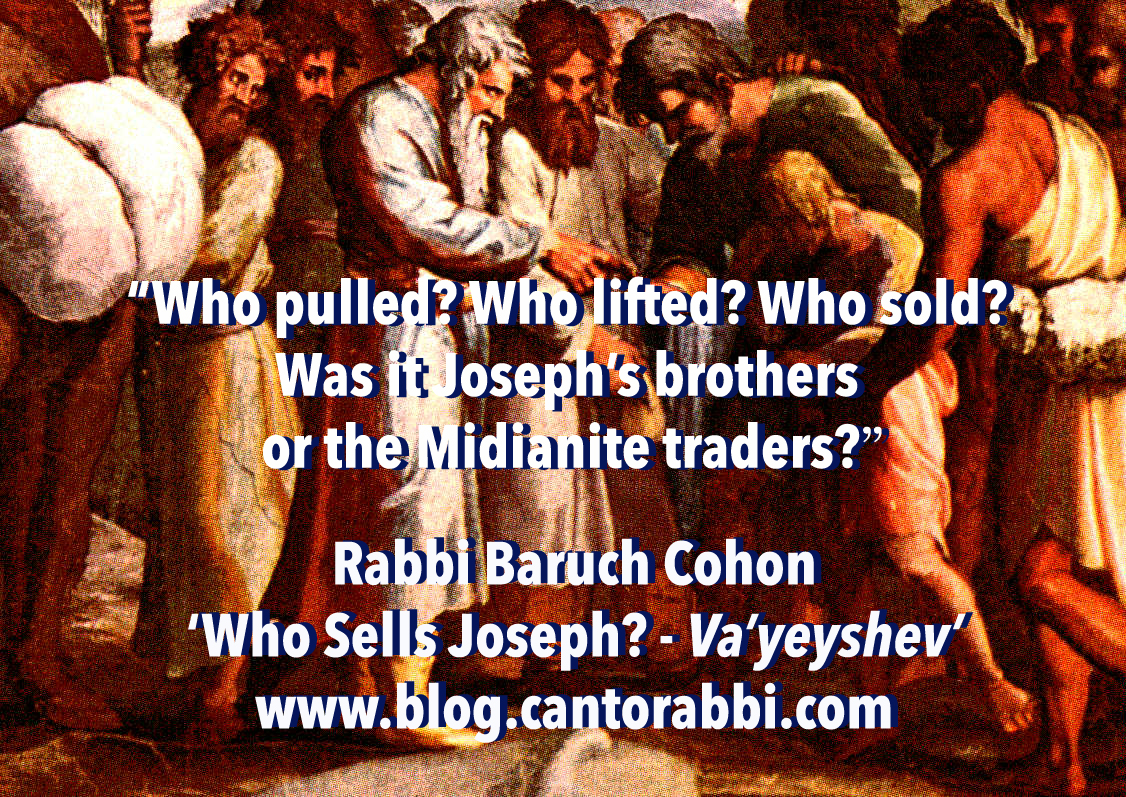
What stimulated some disagreement among our commentators is the Torah’s wording of this sale. First, we find Joseph joining his brothers who are tending the flocks, and they are anything but glad to welcome him. They strip off Joseph’s coat of many colors – symbol of his father’s favoritism that turned his brothers against him. Then they debate whether to kill him, and how. Reuben convinces them not to shed his blood themselves, but to drop him into a pit while they have lunch and debate what to do with him. Reuben apparently is not eating with them, but goes away – we don’t know where – and hopes to rescue Joseph and return him to their father. But Judah, the born leader among them, uses that lunch to convince them not to kill their brother – since his death would bring them no profit – but to sell him to those Ishmaelite traders whom they can see approaching from a distance. Meanwhile, another group shows up, from somewhere closer. These are described as Midyanim sokharim – Midianite merchants. The sentence continues: “They pulled Joseph and lifted him out of the pit, and they sold Joseph to the Ishmaelites for 20 silver coins.”

They? Who were they?

Who pulled? Who lifted? Who sold? Was it Joseph’s brothers or the Midianite traders? Rashi says that “they” refers to Joseph’s brothers. But Rashbam’s commentary states that it was the Midianites who passed the pit, heard human cries there, pulled Joseph to safety and sold him. All this during the brothers’ lunchtime debate.

Does Rashbam’s interpretation cancel the brothers’ guilt? Certainly they planned to sell Joseph. Did they or didn’t they? Could that lunchtime debate change their plans for betraying their brother?

Indeed this is a question that could be asked innumerable times over the past 3900 years. Who betrayed Jerusalem to the Roman legions – a Bar Kamtza who reportedly precipitated the attack out of revenge because he was rejected from a high class dinner? Or perhaps some false friend from the surrounding heathen tribes?

Daily news now underscores both answers. Selling out Jews and Israel by political leaders who benefitted from Jewish support? We see it happening over and again. Subsidize our enemies as they work up a nuclear bomb, for just one example.

And brother selling out brother can aggravate mass murder, as it did in World War 2 Budapest, where a young Jew reportedly identified other Jews to the Nazis for seizure, confiscation and dispatch to death camps – in exchange for cash fees which eventually he expanded to billions, and now finances efforts to destroy Israel.

George Soros, as he now calls himself, is hardly the only “brother” whose treason endangers us. People with much smaller fortunes, but with some political skill, mount various movements which can defeat Jewish goals and destroy the Jewish future.

What we need to remember is what Joseph achieved in spite of the damage his brothers did. He had nothing to work with but his faith in his heritage and in his own ability, but he rose to rule Egypt, and succeeded in rescuing his family – the very brothers who once hated him.

Like Joseph of old, we have many colors on our coat. We are all anything but identical. Yet we have common interests and a great shared heritage. We can fulfill that heritage if we work together.
Posted in Jewish Blogs | Tagged , , , , , , , , , , , , , , , , , , , | Comments Off on WHO SELLS JOSEPH? – Va’yeyshev – Gen. 37-40, by Rabbi Baruch Cohon

ETERNAL WRESTLING MATCH — Vayishlakh, Gen. 32:4–36, by Rabbi Baruch Cohon

ETERNAL WRESTLING MATCH — Vayishlakh, Gen. 32:4–36, by Rabbi Baruch Cohon

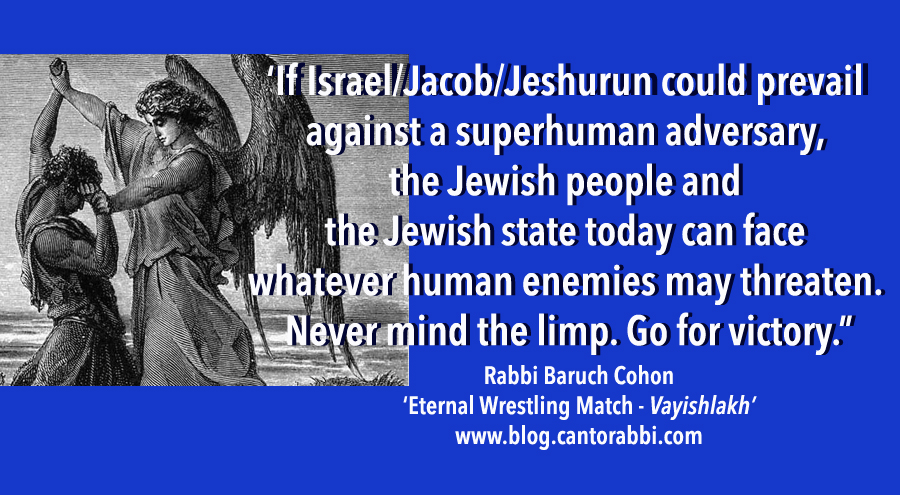
This week’s Torah section, Vayishlakh, includes a famous struggle. Genesis 32 recounts how Jacob, expecting to encounter his vengeful brother Esau, sets up a camp for his 4 wives and 11 children on the safe side of the river Jabbok while he himself camps on the other side. That night, “a man (ish) wrestled with him until the dawn rose.” Seeing that he could not beat Jacob, the stranger asks to be released before daylight. Jacob refuses to release him until the stranger blesses him. Then follows this conversation:

“What is your name?”

“Jacob.”

“No longer will your name be called Jacob, but Israel. For you have striven with G-d and with men and you have prevailed.”

Etymologically, the name Israel and the word for striven, sarita, come from the same root. The mysterious adversary, while he is called ish – a man – is understood to be an angel. He is even identified as the angel of Esau. He cannot stay and fight in daylight, and he will not give his name. He brushes the question aside, saying:

“Why do you ask for my name?” And he blesses Jacob there.

But during the fight he injures Jacob in the hollow of the thigh. As a memorial of that fight, the Torah states, “the descendants of Israel do not eat the sinew of the thigh vein.” So, long before receiving the Torah at Sinai, with its dietary laws, the custom started to abstain from eating the hind quarters of animals. The same hind quarters that kosher butchers still sell off to non-Jewish meat markets.

After the fight, the superhuman wrestler is gone. Israel, the winner, is limping.

This Sedrah also recounts Esau’s family history. One of his wives is Ishmael’s daughter. Another source of conflict. So the wrestling goes on. Jacob fought Esau in the womb. Israel fights Esau’s champion in the dark. Their descendants struggle against each other in the United Nations.

Ever since Jacob fought his way to becoming Israel, the wrestling match continues. Sometimes in one place, sometimes in another, we struggle with enemies who seem too strong to be human. Defeating them makes us Israel. We might limp for a while, but we survive.

If Israel/Jacob/Jeshurun could prevail against a superhuman adversary, the Jewish people and the Jewish state today can face whatever human enemies may threaten. Never mind the limp. Go for victory.


Posted in Jewish Blogs | Tagged , , , , , , , , , , , , , , , , , , | Comments Off on ETERNAL WRESTLING MATCH — Vayishlakh, Gen. 32:4–36, by Rabbi Baruch Cohon

GOODBYE AND HELLO — Vayeytzey – Gen. 28:11- 32:3 — by Rabbi Baruch Cohon

Screen Shot 2013-11-05 at 11.26.08 AM

GOODBYE AND HELLO — Vayeytzey – Gen. 28:11- 32:3 — by Rabbi Baruch Cohon

The very first word of this week’s Torah reading sparked a fascinating comment from Rashi. That word is vayeytzey, “he went out.” The Torah tells us that Jacob left Beer Sheba and went to Haran. Since the Torah does not waste words, Rashi points out that what needed to be written here was only “Jacob went to Haran.” To go to Haran he had to leave Beer Sheba, didn’t he? So why do we read “Jacob went out of Beer Sheba?”

Rashi’s answer teaches a lesson. Namely, ”when a righteous man lives in a city, he is its glory, he is its guiding light, he is its honor. Once he departs, glory departs, light departs, honor departs.”

Certainly a city will miss its most honored resident, male or female. Rashi compares Jacob’s exit to that of Naomi and Ruth, mentioned in the book of Ruth 1:7. To which the Midrash adds the comment of Rabbi Azariah: “The merit of one righteous person is incomparable to the merit of two righteous people.” Depending on the individual, our decision to stay where we live, or to go somewhere else, can affect not only us but the place itself. Moving has various results.

An old Jimmy Durante comedy number went like this: “Did ya ever have the feelin’ that ya wanted to go, and still had the feelin’ that ya wanted to stay?” I would guess that Jacob himself had both feeings. And perhaps some people in Beer Sheba missed him and some did not. But he had very little choice. If he stayed in Beer Sheba he was in mortal danger from his violent brother Esau. And while Haran was no bed of roses, given the machinations of his tricky prospective father-in-law Laban, it did offer opportunities.

So he went. And starting from that trip, he succeeded in building the future of our people. Later generations had equally momentous choices to make. The Immigrant Generation – our parents and grandparents – had to leave places where they lived much longer than Jacob lived in Beer Sheba, and take a much longer trip than the few days to Haran. They left countries where they lived for centuries and travelled by land and sea over half the world to America. Whether it was Beer Sheba or Bialystok, maybe the places they left missed them; maybe they missed those places. And maybe not. And whether in Haran or Hartford, like our father Jacob, they built a brighter future. For us.

vayeytzey

Posted in Jewish Blogs | Tagged , , , , , , , , , , , , , , | 1 Comment

BROTHER? BEWARE – Toldos –Gen. 25:19—28:9—by Rabbi Baruch Cohon

Screen Shot 2013-11-05 at 11.26.08 AM

BROTHER? BEWARE – Toldos –Gen. 25:19—28:9—by Rabbi Baruch Cohon

Rivalry among siblings is nothing new, as we all know. We find some classic examples of it in the Torah. Starting with two-son conflicts like Cain and Abel which leads to humanity’s first recorded murder, we proceed to those negative contacts that are only slightly more subtle. A few weeks ago we read about the birth of Ishmael who is described in advance as a “wild man, with his hand on all and every hand against him.” When his little half-brother Isaac is born, Ishmael can only laugh at him. Of course, it’s no joke when their father Abraham performs the first bris-milah – the ritual circumcision. Isaac is just 8 days old – the age at which Jewish boys still enter the covenant physically. But Ishmael is a maturing 13 years of age, and has to undergo the operation on the same day. Many of his descendants still do. (Could that be what makes them so mean?)

This week, another pair of brothers interacts. These are Isaac’s twin sons, Jacob and Esau. As described in the Book of Genesis, they fight their way into the world, as Esau manages to exit first from Rebecca’s womb with Jacob, still scrappy, holding onto his brother’s heel. Now those few seconds of seniority give Esau a distinct advantage, as the two brothers mature and their father is getting old. That advantage is the birthright, giving the first-born a double portion of the inheritance, and a special place of honor in the family. Throughout his life Esau is known as an outdoorsman and expert hunter, while Jacob is called “a simple man, dwelling in tents,” interested in farming and learning. Their climactic scene comes when Jacob has just prepared his own lunch – a reddish stew made of lentils – and in dashes Esau from the field, tired and hungry. Apparently he did not bag any game today. He takes one look at the pot on Jacob’s stove and says “Give me some of that red, red stuff. I’m about to pass out!” Jacob agrees — if Esau will trade his birthright for it.

“Here I am, dying of hunger,” says Esau. “What do I need with a birthright?” So he agrees.

Jacob serves him bread and a bowl of pottage. The next five words tell Esau’s action, and serve to give us what one rabbi called the portrait of a boor. Here are Esau’s five words:

Va-yo-khal – He ate.

Va-yeysht – He drank.

Vayokkom – He stood up.

Va-yey-lekh – He left.

Va-yi-vez – He despised [the birthright].

Hardly an example to look up to. Note what this compact narrative does NOT include: (1) Esau does not thank his brother for the meal; of course, why should he? He’s paying for it. (2) Esau also does not pronounce a blessing when he eats.

We know what he eats, but what does he drink? Well, a respectable host like Jacob can be assumed to provide a cup of wine with a meal, even though the Torah does not mention it.

He stands up and walks out and never even says goodbye. And he despises the birthright and the whole process because, as one commentator writes, he saw no wealth in his father’s house, so what does he care about an inheritance? Double portion, sure. Twice nothing? He got his lentil stew. Never mind the birthright.

Every father and mother from the time of Isaac and Rebecca onward can face similar problems. We would all choose to have children who get along well, help each other and hopefully like each other. It doesn’t always happen. In the case of the family in our Torah portion, the parents themselves took some steps that we might learn from.

Isaac preferred Esau who brought his father good venison. As his eyes dimmed, so did Isaac’s discretion about his two sons and their contrasting personalities.

Rebecca loved Jacob because he spent time with her in the tent. So, being somewhat of a super-mom, she insisted on Jacob disguising himself as Esau to fool his father into giving him the blessing of the firstborn. Then she bundled him up and sent him to her brother’s house to escape Esau’s threat, and incidentally to find two wives.

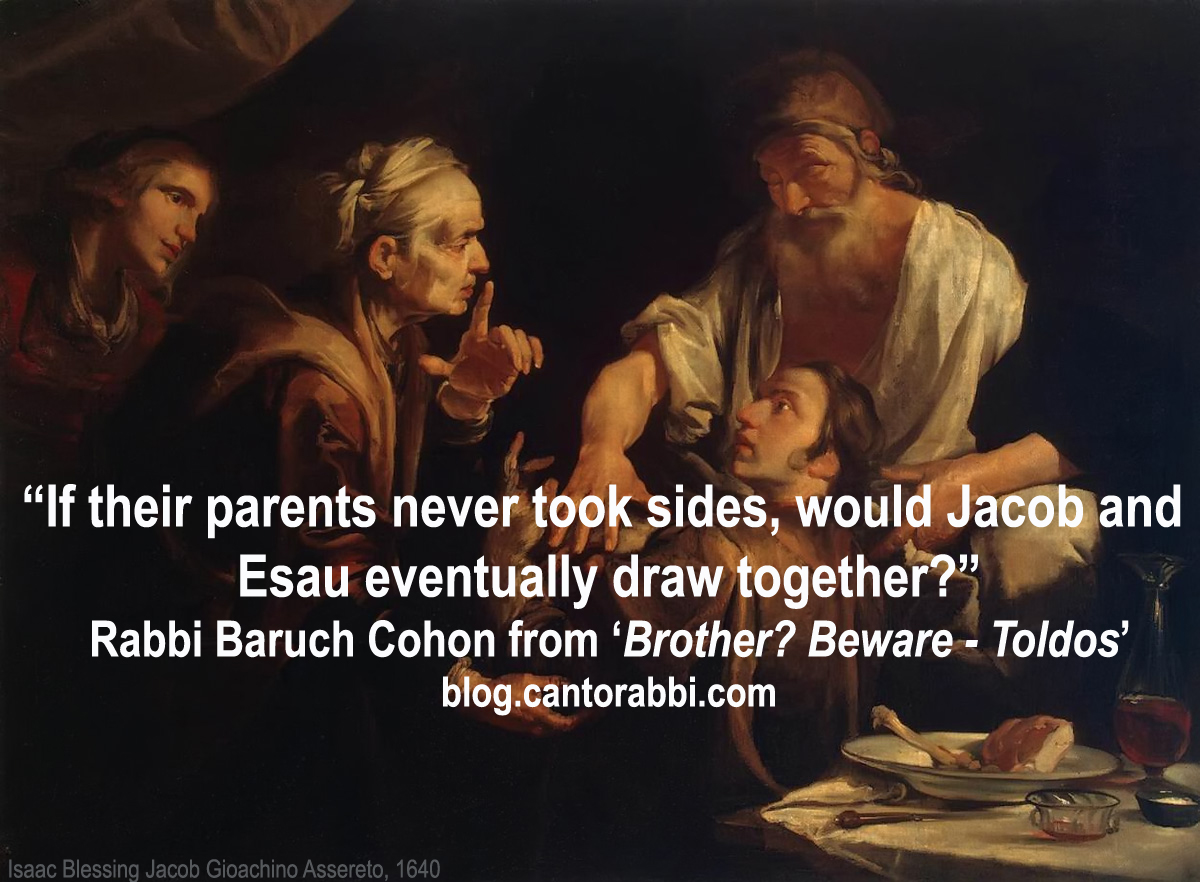
If their parents never took sides, would Jacob and Esau eventually draw together? The reality is, of course, that we’ll never know. Jealousy and conflict split families ever since those days. Blessed are the families that can avoid such a split. Blessed are the heirs who do not squabble over their inheritance. Blessed are the siblings who can accept each other for what they are, not what #1 thinks #2 ought to be. And blessed are the parents who have the good sense to treat their children equally.

Let’s try to make each of our families one of them.

Isaac Blessing Jacob Gioachino Assereto, 1640

Isaac Blessing Jacob
Gioachino Assereto, 1640

Posted in Jewish Blogs | Tagged , , , , , , , , , , , , , , , , , , , , , , , | Comments Off on BROTHER? BEWARE – Toldos –Gen. 25:19—28:9—by Rabbi Baruch Cohon

A HINT TO THE WISE – Khayey Sarah – Gen.23:1 – 25:18, by Rabbi Baruch Cohon

Screen Shot 2013-11-05 at 11.26.08 AM

A HINT TO THE WISE – Khayey Sarah – Gen.23:1 – 25:18, by Rabbi Baruch Cohon

Many and various comments circulate about this week’s reading. Called Khayey Sarah – “The life of Sarah” – it starts, not with the life of Sarah but with her death. Says the Torah, she lived “100 years, and 20 years and 7 years.” Why not just say 127 years? Because, says Rashi’s classic commentary, we learn hereby that she was as innocent at the age of 100 as she was at 20 (since Heavenly punishment is not meted before age 20), and as beautiful at 20 as she was at 7. In fact, she is the only woman whose age is recounted in the Torah. The mother of our people, she gave her name to countless girls of many nations ever since.

Final rites for someone as important as Sarah occupy a good section of this reading. Abraham owns no land. He needs to secure a gravesite. And to do so, he goes to Hebron and negotiates with the Hittites. The corner of the field he wants belongs to a man named Ephron. It contains the Cave of Machpelah, a dignified and appropriate gravesite. That cave is still a sacred location and burial place today. Our enemies destroyed the roadside graves of Rachel and Joseph. But they took over Machpelah. As far as we know, our patriarchs and our other matriarchs still lie there. But visiting that site now requires special arrangements.

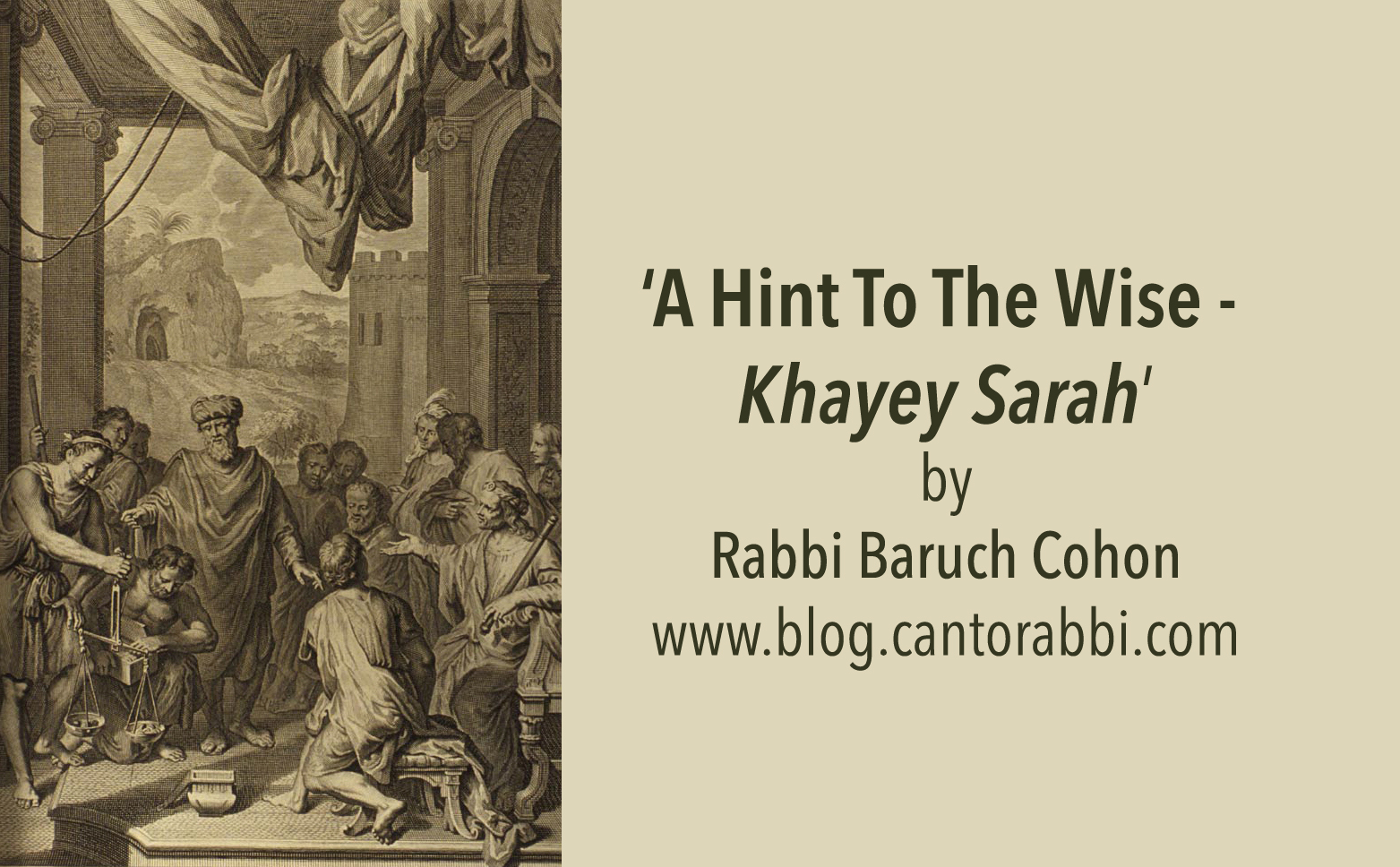
Our reading this week takes us to the day this cave was acquired. We witness Abraham and Ephron negotiating over the purchase.

Now this is the Middle East, and Abraham and Ephron are both described as economically successful. What kind of bargain will they strike? We know Abraham can bargain. He even bargained with the Almighty over the fate of Sodom and Gomorrah. How will he approach this deal?

He goes to the tribal chiefs, presumably assembled at the gate of the city. There he represents himself as a stranger and sojourner among the Hittites. He asks their understanding of his need to bury his wife. And he offers to buy a gravesite for cash. The tribal chiefs reply with flattery. They call him a prince, and invite him to select the choicest of their burial sites, free of charge. He insists that he will pay to purchase the land, and asks for a corner of Ephron’s field. For the full price.

At this point Ephron speaks up. “No, my lord, hear me out. I give you the field and the cave that is in it. In the sight of my people I give it to you. Bury your dead.”

This causes Abraham to rise and bow before the am ha-aretz, the people of the land. Again he declares he will pay for the field.

Ephron answers: “Listen, my lord. A piece of land worth 400 shekels – what is that between you and me? Bury your dead.”

The next sentence is, in more ways than one, the payoff. “Abraham heard Ephron.” And here we see Abraham the bargainer weighing out 400 shekels of silver, oveir lasokheir – merchants’ standard, acceptable tender. He doesn’t even offer 350, even though the “piece of land” is hardly worth the asking price. As the Hertz commentary points out, the contemporary Code of Hammurabi set the annual wages of a working man at 6 to 8 shekels, a long way from 400. All the high-toned Hittite declarations of respect and sympathy and generosity – forgotten. Pay up.

Of all the commentaries on this reading, perhaps the most telling is a 3-word statement by the Rashbam: Dai lakhakima bir’miza –“ To the wise, a hint is enough.” I heard you, Ephron; you said 400, right? Hold out your hand…

khayey-sarah

Posted in Jewish Blogs | Tagged , , , , , , , , , , , , , , , , , | Comments Off on A HINT TO THE WISE – Khayey Sarah – Gen.23:1 – 25:18, by Rabbi Baruch Cohon