HE LIVED, DO WE? – Va-y’khee – Gen. 47:28 – 50:26, by Rabbi Baruch Cohon

Screen Shot 2013-11-05 at 11.26.08 AM

HE LIVED, DO WE? – Va-y’khee – Gen. 47:28 – 50:26, by Rabbi Baruch Cohon

The final Torah reading in the Book of Genesis recounts the end of life for both Jacob and Joseph. Much is written about the name of this reading. Like Hayey Sarah – literally “the life of Sarah” — earlier in Genesis, it tells the death of patriarchal figures, but it is not called an obituary, but an acknowledgement of life. So this portion too is called Va-y’khee Yaakov – “Jacob lived.” In fact, Jacob lived a full and eventful life, as did Sarah in that other portion, and that is what we remember and honor, as we should, both for them and for our own loved ones. We ourselves would hope to be remembered that way too.

One striking difference in this week’s narratives is how much detail is devoted to Jacob’s passing, as compared with Joseph’s. A total of 72 verses tell of Jacob’s illness, his detailed parting messages to his children and grandchildren, his death, the mourning period which follows, and the trip to Canaan to bury him in the family gravesite, the Cave of Machpelah. Then come the last 12 verses of this book, covering Joseph’s return to Egypt, his final relationship with his brothers, the birth of his great-grandchildren, his farewell and embalming. 72 to 12! Quite a contrast.

Was Joseph so much less important than his father? We know that the rest of Jewish history was impossible without him. He forgave his brothers for their cruelty to him in his youth. He rescued the whole family from starvation. Why such a brief ending to such a heroic biography?

If we truly did read the preceding chapters, exploring the conditions leading to this conclusion, we know what happened. The Torah devotes many chapters to Joseph’s adventures. His messages to those around him were delivered in a variety of ways. Maybe we don’t need any more details of the end of his life. Some of our commentators zero in on the difference in the burial process for Joseph and Jacob. At his own last request, Jacob is not buried in Egypt but his body is transported with great ceremony to Canaan to be buried with his parents and his wife Leah. On the other hand Joseph is embalmed and his body placed in a coffin in Egypt where it will remain during his people’s slavery, to be taken with them when Moses will lead them to freedom. How long was that? Depending on which historians we follow, it might have been 300 years, or considerably less. Online historian Matthew McGee dates the death of Joseph in the Hebrew year 2310, corresponding to 1640 BCE, and the Exodus in 2454, corresponding to 1496 BCE. A period of 144 years. Still a long time for a body to remain unburied. Yet next month we will read how Moses will take Joseph’s bones with him, across the Red Sea and through the desert to be placed in a special tomb in the Promised Land – a tomb that our current enemies have virtually destroyed. Evil still attacks Joseph. Regarding disposal of his body, however, our commentators point out that while Jacob “went home” at the end of his life, Joseph wanted to stay with his people.

Both decisions have merit, both for the living and the dead. After lives of adventure and event, of victories and defeats, having greater effect than most of us, these patriarchs made their logical individual choices. Jacob elected to spend eternity as close as possible to his departed dear ones. Joseph would remain with the living Israelites as best he could.

We fulfill a precious Mitzvah when we visit the grave of a parent no matter where it is. And we treasure the memory of that parent wherever we are. Even if we don’t know the actual location of the loved one’s body, we can express our feelings for the n’shama, the spirit, the presence that memory preserves. Yizkor services and yortzite observances reinforce those feelings. Like Joseph, our loved ones stay with us.
VaykheeJoseph

Posted in Jewish Blogs | Tagged , , , , , , , , , , , , , , , , , , | Comments Off on HE LIVED, DO WE? – Va-y’khee – Gen. 47:28 – 50:26, by Rabbi Baruch Cohon

COURAGE AND CONSEQUENCES – Vayigash – Gen.44:18 – 47:27, by Rabbi Baruch Cohon

Screen Shot 2013-11-05 at 11.26.08 AM

COURAGE AND CONSEQUENCES – Vayigash – Gen.44:18 – 47:27, by Rabbi Baruch Cohon

Before going into the climactic chapter of the Joseph story, let me correct a mistake in last week’s blog. Its first paragraph mentioned “two Torah readings” last Shabat. It should say “three Torah readings.” One for the Sabbath, one for Hanukkah and one for Rosh Hodesh. I must say I was surprised to receive no emails about this. In fact, last Shabat was one of the very few occasions when we use three Torah scrolls in the same service, since we do not take the congregation’s time to wait while we roll one Sefer Torah from one reading to another. Please note!

This week, we will be reading the next chapters of the story, including where Joseph takes his needy family to the Land of Goshen, a safe section of Egypt. The Hebrew form of “to Goshen” is Goshnah, and a Lubavitcher Rebbe remarks that the four letters of Goshnah are the same four that appear on the four sides of the dreidel – so it’s very appropriate to read this story around Hanukkah time!

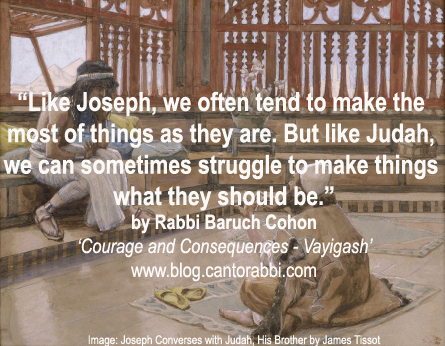
Now for Vayigash – literally, “he approached.” Judah is doing the approaching, and Joseph is the man he faces. As viceroy of Egypt, Joseph just “framed” Benjamin for stealing his goblet, so he decreed that Benjamin must remain as his slave while the rest of the brothers go back to Canaan. While not stated, we can assume this is Joseph’s trick to reunite with his kid brother.

But now Judah approaches him to plead for Benjamin’s release, even offering himself to take Benjamin’s place. In harsh dramatic tones he describes his father’s attachment to the youngest son – only survivor of his mother – and his bereavement, since he believed Joseph dead. And he predicts that if they don’t bring Benjamin home with them, Jacob will die of grief. “Therefore,” he urges, “let [me], your servant, stay as a slave instead of the boy. And let the boy go home with his brothers.”

What courage it took for Judah to approach this man who wields absolute authority. He even affirms “kamocha k’Pharaoh – you are like Pharaoh.” The Midrash tells us that at first Judah spoke softly and humbly, remembering his own crime against his brother Joseph when they sold him into slavery. But seeing punishment threatening to fall on the innocent Benjamin, he dropped all caution and spoke so loud that his voice resounded throughout Egypt!

All through the last visits of the brothers to Egypt, Joseph maintained his Egyptian front, speaking with them through interpreters, and wreaking his petty revenge for their crime against him some 22 years ago. But after Judah’s impassioned speech to him, we will read a total different reaction from Joseph. He sends out all the up-to men – – the interpreters, the nobles, the big shots – and in tears he addresses his brothers directly. In Hebrew! He tells them simply “I am Joseph. Is my father still alive?”

What their need could not do, what his authority prevented, what his vengeful urges caused – all those factors failed to reveal Joseph to his brothers. Only Judah’s courage and concern made the difference.

Like Joseph, we often tend to make the most of things as they are. But like Judah, we can sometimes struggle to make things what they should be. We might even succeed.

Tissot_Joseph_Converses_With_Judah,_His_Brother

Posted in Jewish Blogs | Tagged , , , , , , , , , , , , , , , | Comments Off on COURAGE AND CONSEQUENCES – Vayigash – Gen.44:18 – 47:27, by Rabbi Baruch Cohon

A TRIPLE CELEBRATION – Miketz, Hanukkah, Rosh Hodesh – by Rabbi Baruch Cohon

Screen Shot 2013-11-05 at 11.26.08 AM

A TRIPLE CELEBRATION – Miketz, Hanukkah, Rosh Hodesh – by Rabbi Baruch Cohon

This week gives us not one Torah reading and one from the prophets but two from Torah and three from prophets, because this week features three celebrations on the same day.

First, of course, is Shabat. The reading for this Shabat tells the story of Joseph and his brothers, as he plays cat-and-mouse with them in Egypt. He knows them but they don’t recognize him. All they know is that he is the Viceroy of Egypt and holds life-and-death power over them. He conducts himself with some of the willful eccentricities that such power makes possible, demanding that they bring their youngest brother to meet him. He holds Shimon hostage until they return with that boy, Benjamin, Joseph’s only full brother, the one he really wants to see. He then frames Benjamin for stealing, by having his servants plant his divination cup in Benjamin’s pack, and demands the brothers leave Benjamin to be his slave while they return to fetch their father. Moved by Judah’s pleas for Benjamin’s life, Joseph has to retreat to his private room to weep. But he manages to retain his official front throughout this week’s reading. So here we have some classic family drama. To be continued next week.

Second, this will be a Shabat during Hanukkah. And of course, the very word “Hanukkah” means “Dedication.” The Maccabees defeated the Greeks in order to free the Temple and rededicate it. And their ceremony followed the example Moses set when he dedicated the Tabernacle in the desert. This year, Shabat falls on the 6th day of Hanukkah. So this week the last Torah reading comes from a second scroll and describes the offering brought on the 6th day of the Tabernacle dedication, by a prince of the tribe of Gad. Worth noting, Moses held the dedication for 12 days, giving each tribe a day to celebrate. The Maccabees had only 8 days. But hey, Moses didn’t have a one-day supply of oil that burned for 8 days! A special feature of Shabat Hanukkah is its Haftorah – its prophetic reading. This one is from Zachariah who urges the Daughter of Zion to “sing and rejoice — Ra-nee v’sim-khee bat Tziyon”—because G-d will dwell with her and her people. Unlike other Haftoros, this one is chanted twice a year: once now and once with the Torah reading describing Aaron lighting the sacred flame, a section we will read next June. Also a tale of dedication. And Hanukkah still comes just once a year.

Third, this Shabat is Rosh Hodesh, beginning the new month of Teveth. So we are combining a weekly celebration with an annual one and a monthly one. To acknowledge this part of our triple day, we will add a short prophetic section from Isaiah envisioning a time when all humanity will observe New Months and Sabbaths by worshipping G-d, and a few sentences from the First book of Samuel where Jonathan reminds us that tomorrow is also Rosh Hodesh. Yes, Teveth is one of those months that has 2 semi-holidays to start it off.

Quite a challenging combination we have on this Triple Celebration. We learn a lot about sibling rivalry from Joseph and his brothers, we join in the spirit of dedication, and we welcome a new month in hope and faith that it will be a better one.

This week we should really greet each other Goot Shabos, Goot Yontov, Goot Yor!

triplecelebration

Posted in Jewish Blogs | Tagged , , , , , , , , , , , , , , , , , | Comments Off on A TRIPLE CELEBRATION – Miketz, Hanukkah, Rosh Hodesh – by Rabbi Baruch Cohon

DREAMS OF GLORY – “Vayeyshev” Gen. 37-40 by Rabbi Baruch Cohon

Screen Shot 2013-11-05 at 11.26.08 AM

DREAMS OF GLORY – “Vayeyshev” Gen. 37-40 by Rabbi Baruch Cohon

Of all the dreamers in human history, Joseph stands out. We meet him in this week’s Sedrah Vayeyshev, at age 17, telling his father and his older brothers about his dreams. One is a dream of physical glory, in which he sees his sheaf of grain stand up in the field while all their sheaves surround his and bow. The second dream is highly symbolic, with the sun and moon and 11 stars bowing down to him. Already unpopular with his brothers, since he was Jacob’s favorite son, these dreams earn him their mortal hatred. They refer to him as “baal hakhalomos – the dream-master.” They consider murdering him, and decide instead to sell him into servitude. His dreams of glory begin to turn into nightmares.

Yet, 20 years later those dreams come true.

What happens in between makes the story of Joseph not only a great classic biography, which inspired retelling it by writers from Thomas Mann to Andrew Lloyd Weber. It also gives us a unique lesson in how to make our dreams come true. Joseph’s character develops under all different kinds of pressure.

First come the Ishmaelites on the caravan, who buy him from his brothers for 20 silver coins. All of a sudden this spoiled kid becomes a slave. He is human merchandise that they will sell in Egypt for whatever they can get, and until they arrive there he will earn his meager meal by helping tend the camels. A boy who seldom even got a direct order from his indulgent father, now gets plenty of orders – and kicks and slaps — from heathen camel-drivers. He learns to take it. He has no choice.

Then comes Potiphar, the Egyptian aristocrat, captain of the guard. He puts Joseph to work in his house. By now Joseph knows enough about taking orders to anticipate what needs to be done, and with native intelligence and youthful energy he does it efficiently. So Potiphar makes him major domo. Bright and good-looking, he is soon running the whole estate.

Then comes Potiphar’s wife. She takes a look at this young man and decides she wants him. Her proposition is anything but subtle: “Lie with me!” Young as he is, Joseph senses the risks. And his home training warns him that this is wrong in the sight of G-d. So he turns her down. What might be going through the mind of this 18-year-old slave, we don’t know. Is he a virgin? Is the lady attractive? Could he really desire her? The Torah narrative ignores those questions. But the cantillation for the word va-y’ma-eyn (he refused) is a shalshelet, literally a “chain” – the rarest and most ornate of musical figures in Torah chant, reserved for important words. That refusal is very important.

Incidentally, Rashi quotes the Talmudic opinion that Potiphar himself had a homosexual desire for Joseph. Which might explain his wife’s eagerness for something she was not getting from her husband. The Torah identifies Potiphar as a saris, usually translated “officer” or “courtier” but literally meaning “eunuch,” as were many of ancient potentates’ courtiers, surgically emasculated to safeguard the king’s harem.

Indeed Mrs. P keeps tempting Joseph day after day without success, until one day when the other servants are not in the house she grabs his cloak to pull him into bed. He leaves the cloak in her hands and goes out. Frustrated and angry, she uses the cloak as evidence to frame him for attempted rape. So Joseph goes to prison.

Next come his jailer and his fellow prisoners. He impresses the jailer enough to become his right-hand man. And his fellow inmates come to him to interpret their dreams. In the following Torah portion we will read how Joseph’s interpretations lead Pharoah to release him and make him viceroy. Add some Divine inspiration, and Joseph is in position to receive his brothers and his father, and to save them from starvation.

How did he get there? It was no easy trip. The Ishmaelite caravan taught him to work. Servitude on Potiphar’s estate developed his ambition and enabled him to find ways to achieve it. Never forgetting his father’s teaching, he is able to weather his sexual trials and to make the best of an unjust punishment. By the time he meets Pharaoh at age 30, Joseph has all the qualifications to live out his boyhood dream. Running the country for the next seven years and controlling its economy to survive poverty, he earns the right to have “the sun and moon and 11 stars bow to him.” No, it wasn’t easy.

Fulfilling our dreams never is. Typically it involves hard work, strength to endure disappointments and rise above them, backbone to live by our principles, and enough imagination to preserve the vision we aim for. Like Joseph, we might have to spend 20 years getting there. Maybe less, like Mark Zuckerberg. Or maybe more, like most of us. But it is our challenge, a sacred journey that calls us to bring our vision to life.

Brakha v’hatzlakha – Have a successful trip!

Owen Jones - Joseph dreams of stars

Posted in Jewish Blogs | Tagged , , , , , , , , , , , , , , , , , , | Comments Off on DREAMS OF GLORY – “Vayeyshev” Gen. 37-40 by Rabbi Baruch Cohon

DOT’S DA DIFFERENCE – Vayishlakh – Gen. 32:4 – 36, by Rabbi Baruch Cohon

Screen Shot 2013-11-05 at 11.26.08 AM

DOT’S DA DIFFERENCE – Vayishlakh – Gen. 32:4 – 36, by Rabbi Baruch Cohon

Nowhere in the Torah do we find dental bridges mentioned. I mention them here because I happen to have one in my mouth, and this week’s reading reminds me of it every year. Why do I have a bridge between my teeth? It so happens that while eating dinner with guests in our Succah one year I bit down on a stainless steel fork and broke a tooth. Rather than make a scene, I just spit out half a tooth and finished my meal carefully. But other teeth later loosened around it, and my dentist fitted me with a bridge. No more problems. But what does this have to do with Torah?

Just this. This week’s reading includes the story of Jacob meeting his brother Esau for the first time in years, as Jacob returns from Haran. He now has a family, and flocks and herds and camels, hardly the same lone terrified Jacob who fled his brother’s anger. How will Esau react to him now? He sends messengers ahead, to Esau in Mount Seir in the place called Edom, with gifts, to announce his arrival. They report back, telling him that Esau is coming to meet him alright – with 400 armed men. So Jacob divides his followers into two camps, figuring that if Esau attacks one camp, the other camp can be saved. The night passes, with Jacob praying, and then struggling with a mysterious stranger – possibly an angel – but in the morning he manages to set out and meet Esau and his 400-man army. Jacob has his wives and children take turns approaching their dreaded uncle. Jacob himself goes ahead of them and bows seven times. And then, to our surprise, we read: “Esau ran to meet him, fell on his neck and kissed him, and they wept.” Is this the same man who wanted to kill him? What about the little army? And what about those dots over the word for “and kissed him?” Dots over words are rare in the Torah. What do they mean?

This is where the dental problem comes in. Commentators, from Rashi on, tell us that what Esau really intended to do was to bite Jacob’s neck. In fact, the 3-letter Hebrew root words for “bite” and “kiss” are quite similar. Nashak and nashach. Only one letter is different – kuf (the K-sound) in the word “kiss” and the guttural chaf in “bite.” To which one Midrash adds this explanation: Esau did bite Jacob’s neck, aiming for the jugular. But at that moment Jacob’s neck miraculously turned to iron. Esau broke all his teeth. No wonder he cried!

Maybe the Midrash has a message here for all of us, personally and nationally. The old stiff neck can protect us from false friends. All the bowing that Jacob and his wives and children did for Esau – no dots. It was sincere. Esau’s display of emotion remains questionable. The Torah’s dots pose that silent question. We might well dot various agreements made with questionable groups today, including some of Esau’s descendants.

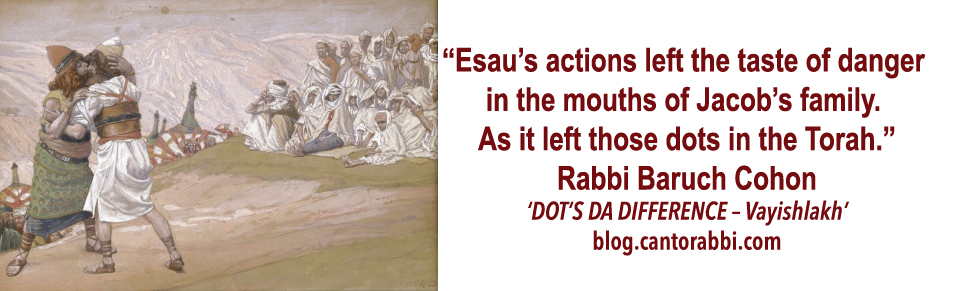
We notice that Esau proceeds to accept Jacob’s gifts, and invites him to bring his family to Edom. Jacob declines, citing the difficulty of travel for his children. Really, how does he know when to expect Esau’s next attempted attack? Better leave some space between them. Through the centuries after that, Israel and Edom remained enemies. Rabbis in the Talmud even refer to Rome, the enemy in their day, by the code name Edom. Esau’s actions left the taste of danger in the mouths of Jacob’s family. As it left those dots in the Torah.

Nobody dots nuclear treaties these days. Seems like the least we could do.

JacobEsau

Posted in Jewish Blogs | Tagged , , , , , , , , , , , , , , , , , , , , | 1 Comment