CREED OR DEED – Yisro – Ex. 18-20 – by Rabbi Baruch Cohon

Screen Shot 2013-11-05 at 11.26.08 AM

CREED OR DEED – Yisro – Ex. 18-20 – by Rabbi Baruch Cohon

As we read the one-and-only story of an entire nation getting certified by G-d Almighty, with Moses ascending Mount Sinai amid thunder, lightning and smoke, we might expect this week’s reading to be named for Moses. It is not. Instead, it bears the name of Moses’ father-in-law, Jethro, a heathen priest of Midian. When he heard about the miraculous events of the Exodus, he determined to cast his lot with his son-in-law and the people of Israel. At the beginning of this week’s reading, we find him giving Moses practical advice: Don’t wear yourself out judging all these people’s petty grievances – appoint some able G-d-fearing truthful men, men who hate unjust gain, and make them rulers of thousands, hundreds, fifties and tens. Let them bring you the hardest cases, and let them judge the rest. Moses gratefully takes the advice, and Jethro goes home. His vision, his wise counsel, qualifies him to give his name to this climactic Torah portion.

Now Israel arrives at Sinai. All through the centuries, thinkers wondered why this rather minor mountain became the place where mankind would meet G-d. Located in desert country, it is usually identified with Jebel Musa, where a wide plain spreads below it, offering enough space for the Israelite camp. Remember Moses led 600,000 men of military age, plus the women, children and old people – plus the eyrev rav, the hangers-on who left Egypt with them. Estimates of the total population number 2 to 2.5 million. And they had animals too, so they needed plenty of camping space. But more than that, they needed purpose.

Against all probabilities, they got out of Egypt safely. That purpose was physical freedom, and they accomplished it. What now?

Moses climbs the mountain and hears the Divine call: “Speak to beys Yaakov, the House of Jacob, and tell b’ney Yisroel, the sons of Israel..” Who were these two entities? Our commentators tell us that the House of Jacob refers to the women, and the Sons of Israel to the men. Indeed, today we frequently find schools for Jewish girls called Beys Yaakov. The message went to the women first, as they would teach it to their children and extend it into future generations.

What is the message Moses is charged with? “If you will listen, and keep My covenant, you will be My treasure among all nations, for all the earth is Mine.” And the people agree! For once, the answer is unanimous.

Now they are given time to prepare for the covenant that will make Israel a singular nation. “Sanctify yourselves today and tomorrow. Wash your clothes… Be ready for the third day. Don’t go near a woman.”

How’s that again? Is this an ancient “war on women?” Exactly the opposite, as Rashi explains quite graphically. Abstaining from sexual contact for those 3 days would ensure that the women would be ritually clean to receive the Torah.

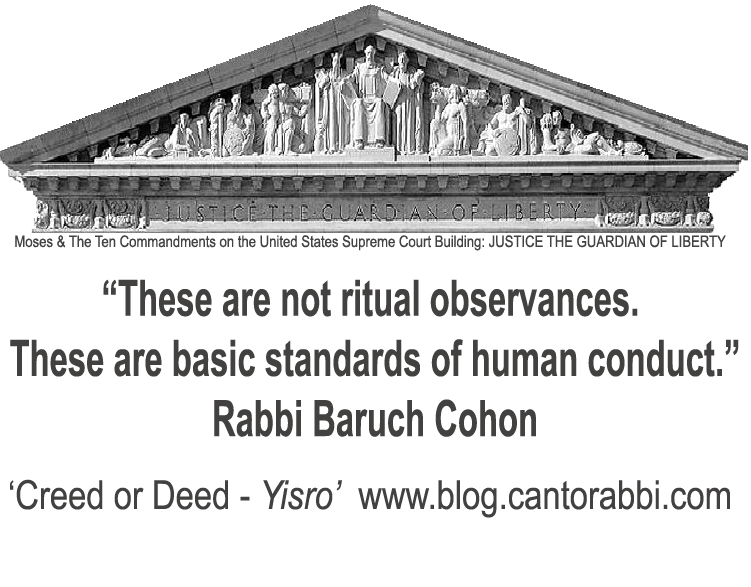
While tradition holds that all 613 Mitzvos were received on that third day, all the text gives us here are the “big 10.” Significantly, they are not called Commandments in Hebrew. They are called aseres hadibros, literally “ten statements.” These are principles of right and wrong, Divinely authorized in #1 and #2, and detailed in the other 8. Honoring your parents is right. So is resting one day a week. But murder is wrong – and the text definitely reads “thou shalt not murder,” not “thou shalt not kill.” Just as wrong are adultery, theft, false witnessing, and that puzzling word “covet,” the urge that comes from jealousy, the desire to have what someone else has, the obsession that leads to crime. These are not ritual observances. These are basic standards of human conduct. How can we justify removing Ten Commandments monuments from our courthouses today?

Next week Moses will receive the practical do’s and don’t’s, and their corresponding rewards and penalties, and we will read of some disturbing results among the people at the foot of the mountain. But for now, hearing the Big Ten in shul, let’s stand and receive these eternal principles once more, with respect and gratitude for our distant ancestors, just 3 months out of slavery, who could accept the role of teaching truth to the world.

Yisro

Posted in Jewish Blogs | Tagged , , , , , , , , , , , , , , , , , | Comments Off on CREED OR DEED – Yisro – Ex. 18-20 – by Rabbi Baruch Cohon

AGREEING TO ARGUE – B’shalakh – Ex. 13:17—17:16, by Rabbi Baruch Cohon

Screen Shot 2013-11-05 at 11.26.08 AM

AGREEING TO ARGUE – B’shalakh – Ex. 13:17—17:16, by Rabbi Baruch Cohon

This week we will read of an angel leading the Israelites out of Egyptian slavery. Reaching the Red Sea, the angel moved to a position behind them. And a pillar of cloud came between the camp of Israel and the camp of Egypt. The cloud thickened the darkness and cast a spell on the night. “One could not come near the other all night,” says the Torah.

Rashi explains this to mean that that the Egyptians and the Israelites could not come in contact with each other. But the Klee Yokor commentary suggests that this refers to the Israelites themselves. He cites the Talmudic statement in the tractate Taanis 2.5:

“There were four factions among our ancestors at the Sea. One faction said “Let’s jump in the sea.” One said “Let’s go back to Egypt.” One said “Let’s make war against them.” And one said “Let’s cry out to them.”

The Korban hoEydoh commentary identifies the first faction as completely righteous, the second as completely wicked, and the other two as in between.

To those who wanted to jump in the sea, Moses answered: “Stand and see the Divine deliverance.” To those who wanted to return to Egypt, he said: “The Egyptians you see today you will never see again.” To those who wanted to do battle, he said: “G-d will fight for you.” And to those who wanted to cry out, he said: “You keep silent.” They couldn’t agree, says Klee Yokor. They argued all night and couldn’t get together.

Our ancestors already had those problems. Sounds familiar? There they were, desperate slaves, on the run, facing a crisis of life or death. And they could spend a whole night arguing. Moses had to answer four factions at the same time. What even he couldn’t quite cope with was the sarcasm in their first question:

“Weren’t there enough graves in Egypt? You had to take us here to die in the desert?”

So even after answering the four factions, Moses still needed Divine help. He asked for that help. And what kind of answer did he get?

“The L-rd said to Moses: Why do you call out to Me? Tell the Israelites to go forward.” A famous Midrash tells us that the people still hesitated until one man, Nakhshon ben Aminodov, stepped into the water. Then the Sea divided. Then miracles took place – to such an extent that we are told: “What a slave girl saw at the Red Sea, the prophet Ezekiel could not see.”

One man’s courage galvanized a squabbling mob into unity. Result: “Israel saw the power that the L-rd wielded against the Egyptians. The people feared the L-rd; and they believed in the L-rd and in Moses His servant.” Who believed? The people. All the people.

And now? Four factions. At least. One wants to jump in. “Build another settlement; G-d will protect us.” Self-proclaimed Tzadikim, 101% righteous.

Another faction says we should go back to Egypt. “Make peace – at any price.” Appease your enemies — like Neville Chamberlain.

A third says “Make war on them.” A last resort, not to be chosen lightly.

And the fourth says “Cry out – talk – negotiate,” even with liars who will never recognize your rights.

One faction cannot come close to any other faction. All night long. Maybe we cannot hope for a Moses in our generation. But could we ever use a Nakhshon! Someone who would get his feet wet to lead the way. Someone who could galvanize the squabblers into some kind of unified vision. Someone who could bridge the gap – really a chasm – that divides secular from religious Jews in Israel. Break down the wall between right and left among the Jews of the world.That would be a miracle, wouldn’t it?

The great hope is that miracles still happen. The State of Israel itself is a modern miracle, just by its existence. It will need another miracle for its survival. What can we do to bring about this miracle? Individually, very little. But every little bit helps. The first and most important contribution we can make is to accept each other. Not to turn our backs on another Jew, whether we agree with him or not. The Talmud tells the story of a wealthy nobleman who was hosting a dinner in his Jerusalem mansion, at the time of the Roman invasion. He told his servant to invite his friend Kamtza to the dinner. By mistake the servant invited a man named Bar Kamtza whom his boss hated. When the wrong guest arrived, the host was furious and threw him out, even though he offered to pay for whatever he ate. Bar Kamtza was sufficiently insulted that he proceeded to betray his wealthy enemy to the Romans, thus starting the destruction of Jerusalem. “Because of Kamtza and Bar Kamtza,” says the Talmud, “Jerusalem was in ruins.”

That kind of infighting we can avoid. Miracles begin at home.

Personally I don’t hope to be a prophet like Ezekiel. But to see this miracle – this survival miracle – I would feel as privileged as the slave girl at the Red Sea. Come back, Nakhshon, wherever you are!

Nakhshon Nakhshon

Posted in Jewish Blogs | Tagged , , , , , , , , , , , , , , , , , | Comments Off on AGREEING TO ARGUE – B’shalakh – Ex. 13:17—17:16, by Rabbi Baruch Cohon

MIDNIGHT AT NOON – Bo – Ex. 10-13 – by Rabbi Baruch Cohon

Screen Shot 2013-11-05 at 11.26.08 AM

MIDNIGHT AT NOON – Bo – Ex. 10-13 – by Rabbi Baruch Cohon

This week we will read about plagues #8, 9 and 10. Of these, as well as the ones we read about last week, #9 has a unique quality. It afflicts the mind rather than the body. This time, no hailstones will pelt the Egyptians, no lice will bite them, no frogs will overrun their country. This time they will get a blackout. The Torah describes it as darkness so thick you could feel it. For three days and nights, people could not see each other. They were afraid to move.

How did Moses manage this? According to some historians, maybe he didn’t. They tell us this was an actual total eclipse of the sun which took place on March 13, 1335 BCE. Perhaps that’s why Moses didn’t warn Pharaoh in advance the way he did before some of the other plagues.

Our classic commentators offer other explanations. The Klee Yokor (Vessel of Value) observes that the pattern of creation gives human beings both day and night. So here the Creator borrowed night from the Israelite territory and added it to Egypt, turning the daytime into night. Thus the Egyptians had double darkness – all night and all day. Never saw the sun. Remember, the sun was the Egyptian chief god. No wonder they were scared. But, we are told, “the Israelite people had light, where they lived.” In fact, says Klee Yokor, they had light both by day and by night. To prove it, he points out that the last letters of the words “all the people of Israel had – l’khoL b’neY yisroeL hayaH –“ spell “LY’LaH – Night!”

The Or haHayyim (Light of Life) commentary takes a spiritual approach. Suppose a word is missing from the sentence about the Israelites having light. Just a little word, asher, translated “which, or who, or that,” as sometimes happens elsewhere in Scripture. Then the sentence would read: “The Israelites who had light were in the dwellings.” Meaning that those Israelites who went to Egyptian dwellings brought their light with them! Evil people cover themselves in darkness, as did the wicked Egyptians. But tzadikim — the righteous — experience Divine light “like the sun in all its power.” G-d loans them some of that light, so they can have light in their dwellings. And they can bring it with them to other dwellings. They had no Harry James to play it or Kitty Kallen to sing it, but some of the Egyptians that the Israelites visited in those days surely found themselves Beginning to See the Light! Had to. A couple of chapters further in this week’s reading, we will find out about the “mixed multitude – eyrev rav” who left Egypt with the Israelites. Who were they? Presumably dissatisfied Egyptians, glad to leave Pharaoh’s tyranny. No doubt some of them received light in their darkness from their slave neighbors, during the Blackout of the Ninth Plague.

Like the scholars and scientists and entrepreneurs in modern Israel, those ancient tzadikim brought their light to their neighbors. Even though they were working for the Egyptians – not providing jobs for today’s Arabs – the light of Truth was with them.

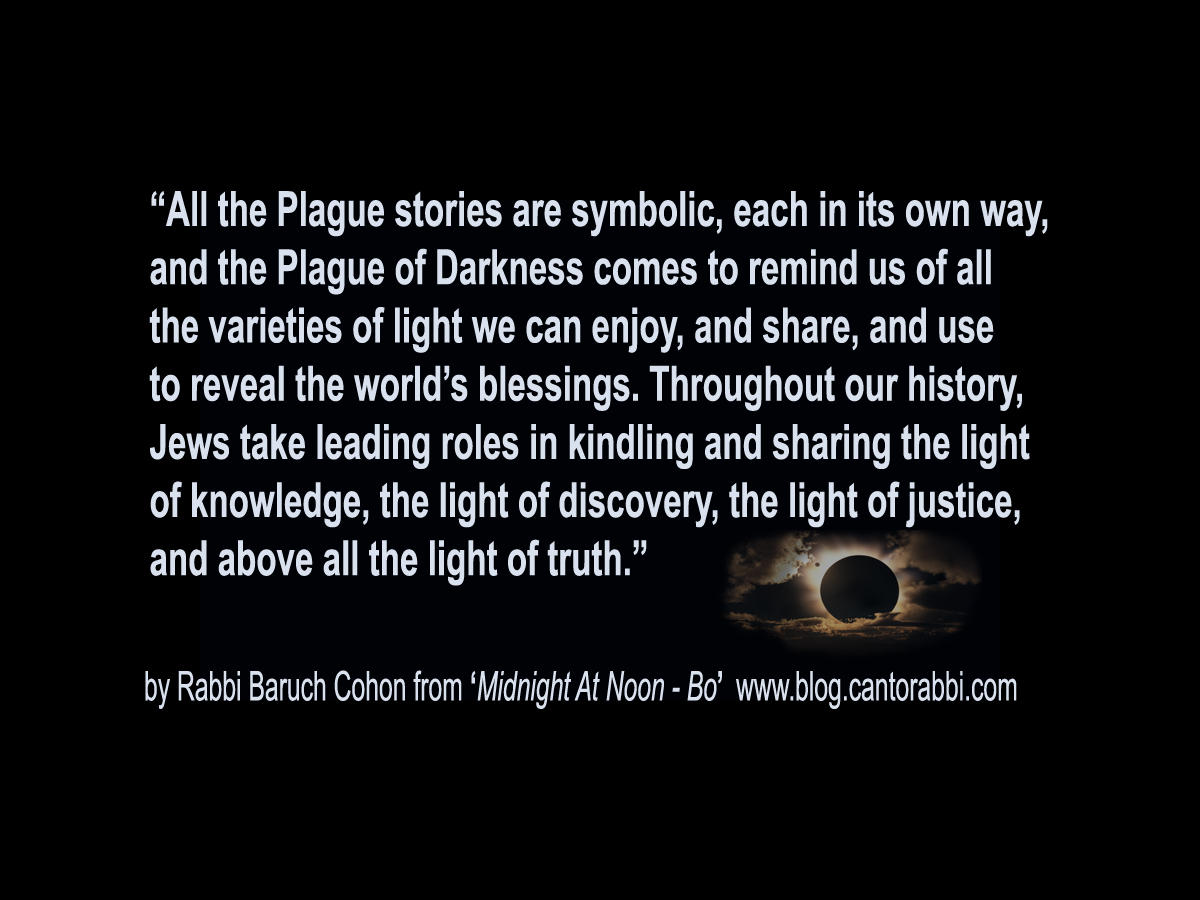
All the Plague stories are symbolic, each in its own way, and the Plague of Darkness comes to remind us of all the varieties of light we can enjoy, and share, and use to reveal the world’s blessings. Throughout our history, Jews take leading roles in kindling and sharing the light of knowledge, the light of discovery, the light of justice, and above all the light of truth.

Let’s hope we always will.

PlagueofdarknessBo

Posted in Jewish Blogs | Tagged , , , , , , , , , , , , , , , , , , , , | 1 Comment

ARE THEY LISTENING? – Va-eyra – Ex. 6 – 9, by Rabbi Baruch Cohon

Screen Shot 2013-11-05 at 11.26.08 AM

ARE THEY LISTENING? – Va-eyra – Ex. 6 – 9, by Rabbi Baruch Cohon

This week we will follow Moses on his challenging mission, and witness seven of the ten Plagues of Egypt. He does not seek this role, any more than he was seeking leadership in last week’s reading when he stood transfixed at the Burning Bush, heard the voice of G-d, and yet tried to decline the job, saying “Send any one You want to send.” Obviously Not Me. He even went so far as to question the Divine: “Lamah harey-ota –Why did You wrong this people?”

Now he is still protesting. Two sentences highlight the decision that Moses finds thrust on him. First, he brings the message to the Israelite slaves, repeating G-d’s promise to make them His people, taking them out of slavery and bringing them to the Land of their fathers, our Patriarchs, Abraham, Isaac and Jacob. But the people aren’t listening. “Lo shom’u el Moshe – They did not listen to Moses.” Why? The Torah gives two very good reasons: “Because of kotzer ruakh – literally, shortness of breath; and avodah kashah – hard labor.” Shortness of breath can be taken as a synonym for impatience. They couldn’t accept such a dream. It can also signify that they were so tired they were physically unable to speak, therefore they could not answer Moses. And the hard labor they were subjected to is the cause of both these reactions.

Sentence #2 comes just three lines later. When commanded to go to Pharaoh and tell him to send the Israelites out, Moses replies: “Here the people of Israel did not listen to me. How will Pharaoh hear me?” He even brings up his speech impediment to emphasize his point: “I have uncircumcised lips!” We know Moses stuttered, and this is a picturesque description.

Our commentators had a great deal to say about these two p’sukim. Rashi cites a Midrash that states that all this dialogue is in fact punishing Moses for his complaint against G-d (Why did You wrong this people?). And then Rashi rejects the Midrash analysis and writes that it should be considered alongside the literal text, rather than explaining it. Taking both opinions together, we read that the Patriarchs never objected to Divine action. Only Moses did. And here Rashi cites a Midrashic quotation from Jeremiah where G-d says “Is not My word like fire, and like a hammer that breaks a rock? It spreads many sparks.” Each spark contains light, and spreads that light in many directions. So both interpretations are appropriate. He also quotes a teaching of a certain Rabbi Baruch son of Eliezer, citing this passage as evidence of G-d’s power, and mourning the passing of the Patriarchs, who never asked for the Divine Name. Moses did.

The Klee Yokor commentary, by Rav Shlomo Ephraim of Lunchitz, treats Moses’ objection as one of the few Biblical instances of a technique called kal va-khomer, literally “light and heavy,” reasoning from the particular to the general, or from the simple to the powerful. If the weak and downtrodden Israelites don’t listen, how can Moses expect an absolute monarch like Pharaoh to listen?

The Lubavitcher Rebbe writes that the Patriarchs served G-d through emotion, while Moses served through intellect. Therefore, this whole exchange is a Divine call for Moses to add some emotion to his service.

And former Chief Rabbi of England Hertz zeroes in on the phrase “uncircumcised lips.” He points out that the same figure of speech is applied elsewhere to the ear and to the heart, and states that Moses had just one doubt, namely that he failed to convince his people because of his stuttering.

Let’s face facts. We all feel that way sometimes, don’t we? If my own family doesn’t listen to me, can I convince my boss?

Using both intellect and emotion, Moses expressed a universal frustration. Yet he succeeded in his mission. Even if our stuttering is mental rather than physical, we can do our best to follow his example. Accept the challenge!

Moses Vaeyra

Posted in Jewish Blogs | Tagged , , , , , , , , , , , , , , , | 2 Comments

MIDWIVES and STRAWBOSSES – Sh’mos – Exodus 1:1—6:1 by Rabbi Baruch Cohon

Screen Shot 2013-11-05 at 11.26.08 AM

MIDWIVES and STRAWBOSSES – Sh’mos – Exodus 1:1—6:1 by Rabbi Baruch Cohon

One underlying theme in this first section of the Book of Exodus is the Divine hand in the lives of the Israelite people. Prolific and resourceful, they alarm an insecure monarch, who proceeds to try squelching them. Over the few centuries since Jacob brought his family to Egypt, they increased from a total of 70 people to hundreds of thousands. Judging from the figures recorded in Exodus, their birthrate was astounding. No wonder the Pharoah who “did not know Joseph” got scared. He corrals their men to construct cities for him. Not just warehouses, these are entire towns built to store his nation’s products. To make sure the Israelite laborers get tired, he sets supervisors over them to overwork them, strawbosses who “afflicted them with their burdens.” They were not to build any ordinary city, but fortified structures, reinforced to hold Egypt’s wealth. After long days of heavy steady labor, these men could be expected to lose some of their strength. Result would be fewer Israelite babies. Right, Pharaoh?

Wrong again. The more they afflicted the Israelites, “embittering their lives with hard work in mortar and bricks and field labor,” the more prolific they became and the more they “spread abroad.” Seeing that he was not exhausting the men, Pharaoh decides to engage in violent birth control. He tries working through the midwives who deliver Israelite babies. “When you see the baby on the birth-stool, if it is a boy, kill him. But if it is a girl, let her live.” The midwives, however, answer to a Higher Power. They provide Pharaoh with even less success than the strawbosses did. When he calls them to account, they protest that the Israelite women are not like the Egyptians. “They are lively! They deliver, even before the midwife arrives.”

The Torah identifies just two midwives, Shifrah and Puah. Noting that two midwives could hardly attend such a population, our commentators, starting with Rashi, identify them with Yocheved and Miriam, Moses’ mother and sister, as if they were symbolic of all the Israelite midwives. Clearly, the Israelite birthrate is Pharoah’s chief worry. Of course, if those “lively women” were bearing children to Egyptian fathers, the birthrate would not be a problem to him. So he issues orders that bypass the midwives. He dictates mass infant murder. “He commands his people, saying, Every son that is born (to an Israelite) you shall throw him in the Nile, and every daughter you shall keep alive.” Did I hear you say Genocide?

No. Pharaoh had no gas chambers. He failed to halt the Israelite birthrate, or even reduce it. In fact, looking ahead to the generation of the Exodus, we find Moses leading some 600,000 men of military age, plus women, children and old people, plus a mixed multitude of non-Israelite followers – easily estimated at more than 2 million total who assembled at Mount Sinai to receive the Torah.

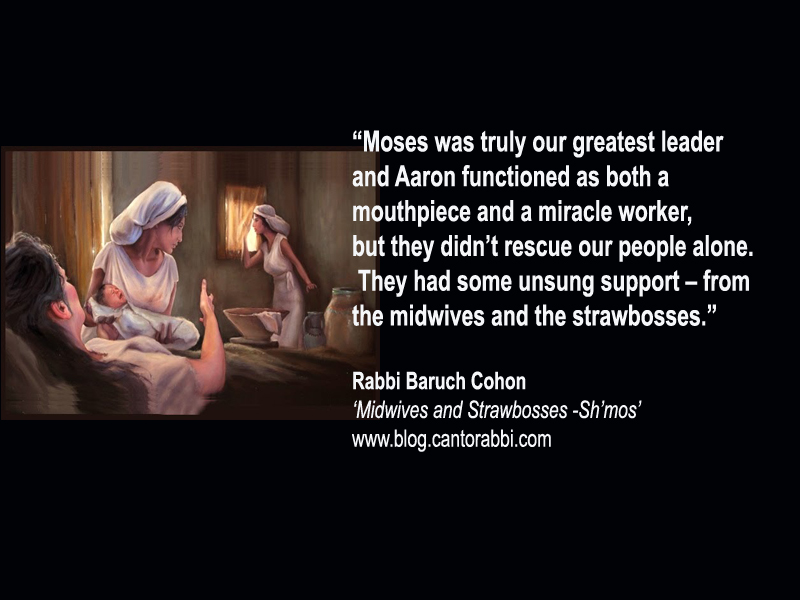
Let’s pause a minute and express our thanks for the courage of the midwives who kept those little boys alive, and for the inefficiency of the dreaded strawbosses who couldn’t wear the fathers out. Moses was truly our greatest leader and Aaron functioned as both a mouthpiece and a miracle worker, but they didn’t rescue our people alone. They had some unsung support – from the midwives and the strawbosses.

Sh'mos

Posted in Jewish Blogs | Tagged , , , , , , , , , , , , , , , , , | 1 Comment