ENOUGH ALREADY! – . – Ex. 35:1-38:20, by Rabbi Baruch Cohon

Screen Shot 2013-11-05 at 11.26.08 AM

ENOUGH ALREADY! – Vayak’hel – Ex. 35:1-38:20, by Rabbi Baruch Cohon

This week we will read the portion Vayak’hel – “Moses assembled the entire people.” Usually this section is joined with the next one, Pikudey – “the records of the Tabernacle.” But during a leap year like this one, the two sections occupy two weeks. So this week we can concentrate on Moses’ purpose in calling a super meeting.

As a nation, they are to embark on a super task. Still camped at Mount Sinai, this meeting takes place, as Rashi informs us, the day after Yom Kippur. Moses just obtained Divine forgiveness for the sin of the Golden Calf and received the second Tablets of the Law. Now he will lead his people to implement their connection to G-d by building a holy Tabernacle. This task is not limited to any chosen few, but must include the entire Israelite nation. Accordingly, Moses will call on all who are willing to donate t’rumah – an offering – consisting of the raw materials which will be used to create the Tabernacle. “Take from yourselves an offering for G-d,” he says. “All who are generous hearted, bring the offering… gold and silver and copper; blue and purple and scarlet linen, goat’s hair and red-dyed ramskins, sealskins, acacia wood. Oil and spices, and jewels for the sacred garments.” There’s more, of course. The women were to weave, and the men to transport, and all are called on to dedicate their possessions and their work. Because this travelling house of worship is to represent them all.

But this is not Moses’ first message to this super meeting. Before even starting on his list of raw materials, he instructs his people to work 6 days and rest on the sacred seventh, Shabat. “Anyone who works that day will die,” he says. Don’t even build a fire on the Sabbath day.

Nokhamol Shabbes? Again Shabos? This makes no less than 8 times it is discussed in the Torah so far. Not to mention at least an equal number coming up. Clearly our tradition spares no opportunity to state the importance of Sabbath observance. Keeping Shabos may not be easy, indeed it frequently causes serious problems, but the one situation where it may be annulled is pikuakh nefesh – saving a life. First comes human life. Observance, no matter how important, comes second. Still, a sacred structure like the Tabernacle should not be built on any sacred days.

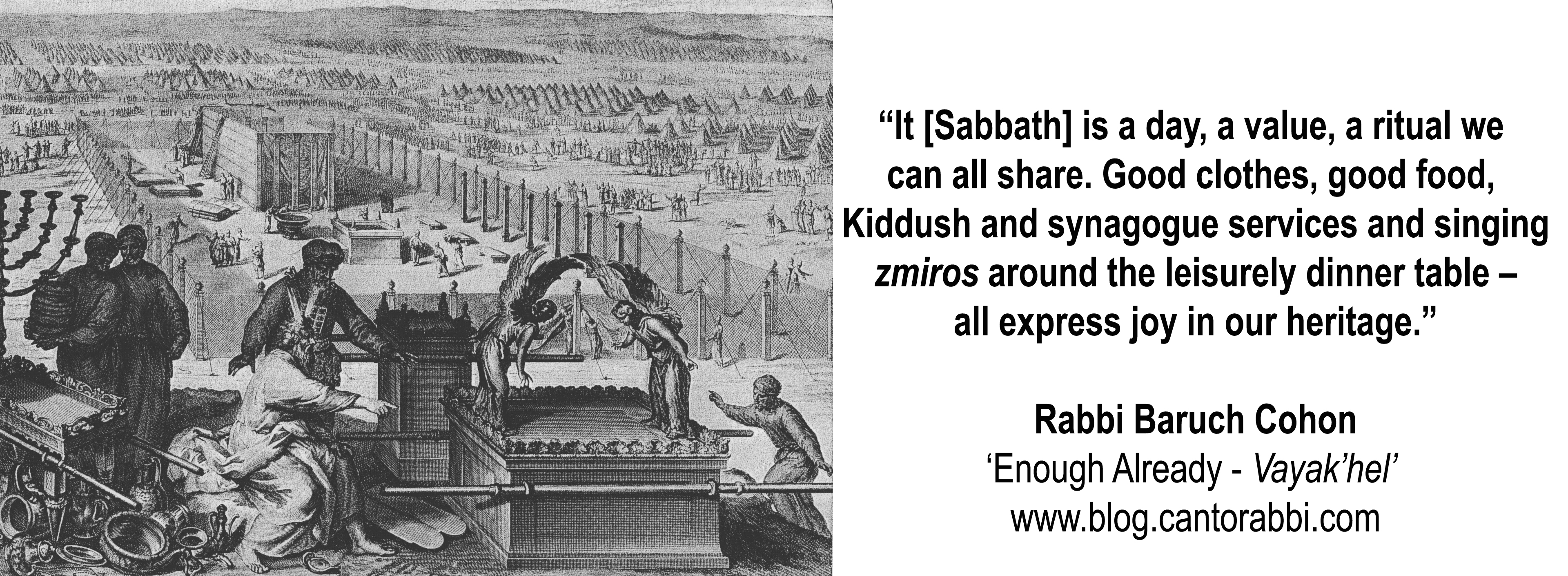
Of all the ideals and concepts and processes that Judaism created and gave to the world, perhaps nothing can compare with the weekly day of rest. As other societies observe it on different days – Sunday or Friday, as we know – the Jewish Sabbath can become a serious problem for those who try to observe it in non-Jewish countries. Yet rightly was it stated that “more than Israel kept the Sabbath, the Sabbath kept Israel.” It is a day, a value, a aritual we can all share. Good clothes, good food, Kiddush and synagogue services and singing zmiros around the leisurely dinner table – all express joy in our heritage. Whether our work involves building a Tabernacle or building an outhouse, it should not be done on the Sabbath.

But frequently it is. Strict Sabbath observance was long considered impossible in modern life. Today, some Jews are reviving Shabos with inventive skill. Take a day to unplug! Use Friday night for family visits. Join groups like National Jewish Outreach in a communal Shabat Across America. Creative people are coming up with various ways to be a little more Jewish once a week.

In our Torah portion, only after Moses reminds the nation of the importance of the Sabbath, does he call on them to contribute their offerings to the construction of the Mishkan, the Tabernacle. Betzalel and Oholiav, the master builders/architects/designers, take all this donated raw material and begin their work. Soon they realize they have more than they need. Enough already! Stop bringing! When they notify Moses of this surplus, he orders a loud proclamation: “Let no man or woman do any more!” Definitely the first and only time that a temple fundraising project had to be stopped for its success! And here Moses accomplished something even more important: national unity. How did this happen? They were working together, doing it themselves while sharing the Sabbath, and thus they developed a strong community.

By working together, joining in a common cause, and observing our Mitzvos as faithfully as possible, we can still produce results that outstrip our needs. Worth trying, isn’t it?
Vayak’hel enough already

Posted in Jewish Blogs | Tagged , , , , , , , , , , , , , , , , , | Comments Off on ENOUGH ALREADY! – . – Ex. 35:1-38:20, by Rabbi Baruch Cohon

BE COUNTED – Kee Tissa – Ex. 30:11—34:35, by Rabbi Baruch Cohon

Screen Shot 2013-11-05 at 11.26.08 AM

BE COUNTED – Kee Tissa – Ex. 30:11—34:35, by Rabbi Baruch Cohon

“When you count the sons of Israel,” Moses is told, “let each man give a ransom for his soul.” What goes without saying here is that it is not a direct count. Our commentators provide the explanation that counting people directly can activate the ayin hora – the Evil Eye. In the effort to avoid that mystic disaster, our people found various ways to count each other indirectly. The synagogue shamas must make sure a minyan of 10 qualified Jews is present for services, so he recites the Biblical verse that begins Hoshiah es amekha (Save Your people), which contains exactly 10 words, while visually indicating one man per word. And if Grandma wanted to know that all the children were assembled for dinner, she would talley them saying Nisht eyns, nisht tzvey… (Not one, not two, etc.).

So in this week’s reading, Moses must ask for half a shekel from each Jew as a kofer nafsho (a ransom for his soul), and by counting the coins he could arrive at a census. Just half a shekel. This is not a fund-raising effort. Specific orders demand that “the rich shall not increase [the amount] and the poor shall not reduce it.” This half-shekel coin is called “an offering to G-d” because, says the Klee Yokor, it makes rich and poor equal. A rich man cannot brag to his poor neighbor: “Look, I gave so much more than you did.” Implying, of course, that his gift makes him important. Like a PAC contribution.

Yes, this is a count. But we must note that it is not a national census. The population is numbered tribe by tribe elsewhere in the Torah. Here we see no total figure. Rather than a census, we should call this registering for the draft. Men 20 years old and up are the only ones included. These are the future soldiers who will fight to conquer the Promised Land. As the Hertz commentary points out, “this word ‘ransom’ occurs only three times in the Torah, and each time it refers to the money paid by one who is guilty of taking human life in circumstances that do not constitute murder. Thus, the owner of an ox who killed a man, after the owner was warned that his animal was dangerous, was held responsible; but as his crime was not intentional he was permitted to pay a ransom. Such a ransom was forbidden in the case of deliberate murder… The soldier who is ready to march into battle is in the eyes of Heaven a potential taker of life, though not a deliberate murderer. Hence he requires a ‘ransom’ for his life.”

What we may find odd in this situation is the use to which the ransom money is put. No weapons will be purchased with it, no intelligence operations financed, no military officers hired. This money will go toward the construction and care of the holy Tabernacle, led by the expert craftsmen Betzalel and Oholiav, as described in this reading. All the future draftees who just got counted will be expected to learn the Mitzvos, like Sabbath observance which is detailed later in this reading, and observe them, with just as much devotion as they will show by risking their lives for their G-d and their people in the battle for the Land.

Of course the most famous section of this reading is the story of the Golden Calf, which our sages tell us happened somewhat earlier. One minor episode in this story is worth our attention here. After Aaron capitulates to the people’s impatience and builds them an idol, then announces “a holiday tomorrow,” the people spend the next day bringing offerings to the Calf, and sitting down to eat. And to drink. Then vayakumu l’tzakhek – “they rose up to make merry!” Considering their inebriation, Rashi gives us some implied meanings for that word l’tzakhek: 1-sexual promiscuity, as Potiphar’s wife used the word when she accused Joseph of attempted rape; and 2- bloodshed, as brought on during the struggle between Saul and David when the corrupt generals Abner and Joab set up a supposed entertainment by the young recruits, which becomes a massacre. Comparisons like these illustrate the depraved nature of idolatry, and how it prompted Moses to shatter the tablets and to threaten the idolaters with death. Only after deep trouble, after the many casualties caused by the Levites’ attacks, after Aaron’s rehabilitation and Moses’ own soul searching, could he go back up the mountain and receive the second set of Tablets of the Law. This time, he achieved such close contact with the Divine that his face shown with a beacon of light, frightening those who saw him. We will read how Moses had to wear a veil in camp after that.

Among the profound and famous passages in this week’s reading, we must not overlook the Thirteen Attributes – sh’losh esreh meedos – which we repeat while facing the Ark on all major holidays: “The L-rd, the L-rd is G-d, gracious and merciful, patient, with great kindness and truth. He vouchsafes kindness to thousands [of generations], forgiving iniquity, transgression and sin. By no means clearing the guilty, He will visit the iniquity of the fathers upon the children and the children’s children to the third and fourth generations.” Note that in our prayers we never finish the passage. We express our hope by stopping before the punishment predicted in the last sentence.

Do we have that much hope? A quick look at Jewish history can confirm both the favor and the punishment we know. Maybe we just need to join equally in that half-shekel registration, and remove Moses’ veil.

BeCountedKeeTissa

Posted in Jewish Blogs | Tagged , , , , , , , , , , , , , , , , , | 1 Comment

BRINGING ME NEAR – T’tzaveh – Ex. 27:20-30:10, by Rabbi Baruch Cohon

Screen Shot 2013-11-05 at 11.26.08 AM

BRINGING ME NEAR – T’tzaveh – Ex. 27:20-30:10, by Rabbi Baruch Cohon

Most of this week’s Torah reading describes the vestments that Aaron wore as High Priest. Now that Israel had a Tabernacle dedicated to Divine worship, a head functionary had to take responsibility for that worship. Aaron was given that position. He would kindle the Eternal Light. He would offer his people’s sacred sacrifices. Why Aaron? Just being the brother of the national leader Moses would seem like plain old nepotism.

In fact, we learn of important situations that contributed to Aaron’s choice. First, he was chosen after Moses is commanded to “bring him near you” (in chapter 28:1) along with his four sons. The Ibn Ezra commentary explains that Moses himself was a priest, so Aaron becomes one by close association with Moses. After all, Moses led the people to receive the Torah; Moses accepts the commandments to build the house of worship; Moses teaches the people their relationship with G-d. So it is Moses who essentially ordains Aaron and his sons with hereditary priesthood.

That heredity, of course, continued throughout our history. The Malbim commentary deduces that G-d selected Aaron to function as an intermediary between the human and the divine, and that Aaron qualified because of his “unique soul,” a quality that his sons and their descendants would inherit. Does that mean that my sons and I have such great unique souls? After all, we are descendants of Aaron. The modern DNA Cohanim Project proved it scientifically. That’s why we carry the priestly name, however it is spelled. What about Mickey Cohen? Also a unique soul? Qualified to stand between G-d and man? True, none of us now need to consider ourselves intermediaries to G-d. That status ceased after the Destruction of the Temple. Modern Cohanim are limited to some ceremonial duties and privileges. But the word – and the name – cohen still implies definite religious distinction. So do some other Jewish names, like “Katz” – not meaning a cat, but derived from the initials for the Hebrew words Kohen TZedek, “A righteous priest.”

So why did Moses ordain Aaron? Did Aaron need to reaffirm his family connection to the national leader? According to our sages, it was the other way around. Rashi informs us that this story appears somewhat out of order in the Torah. Eyn mukdam um’ukhar baTorah, say our sages : “There is no before and after in the Torah.” And this choice of Aaron actually took place after the idolatry of the Golden Calf when the enraged Moses broke the first tablets and received the second set of Tablets of the Law. For committing that idolatry, Aaron deserved death, but as the Klee Yokor states, Moses prayed for the brother that he felt he could not live without, and so brought Aaron close to him and obtained for Aaron and his sons Divine forgiveness and a second chance.

We will soon be reading how two of Aaron’s sons violated that second chance by bringing “strange fire” to the altar, and got burned to death. Certainly priests can make mistakes, sometimes very serious ones. But if they don’t continue their mistakes, they can be restored to duty, as we all can.

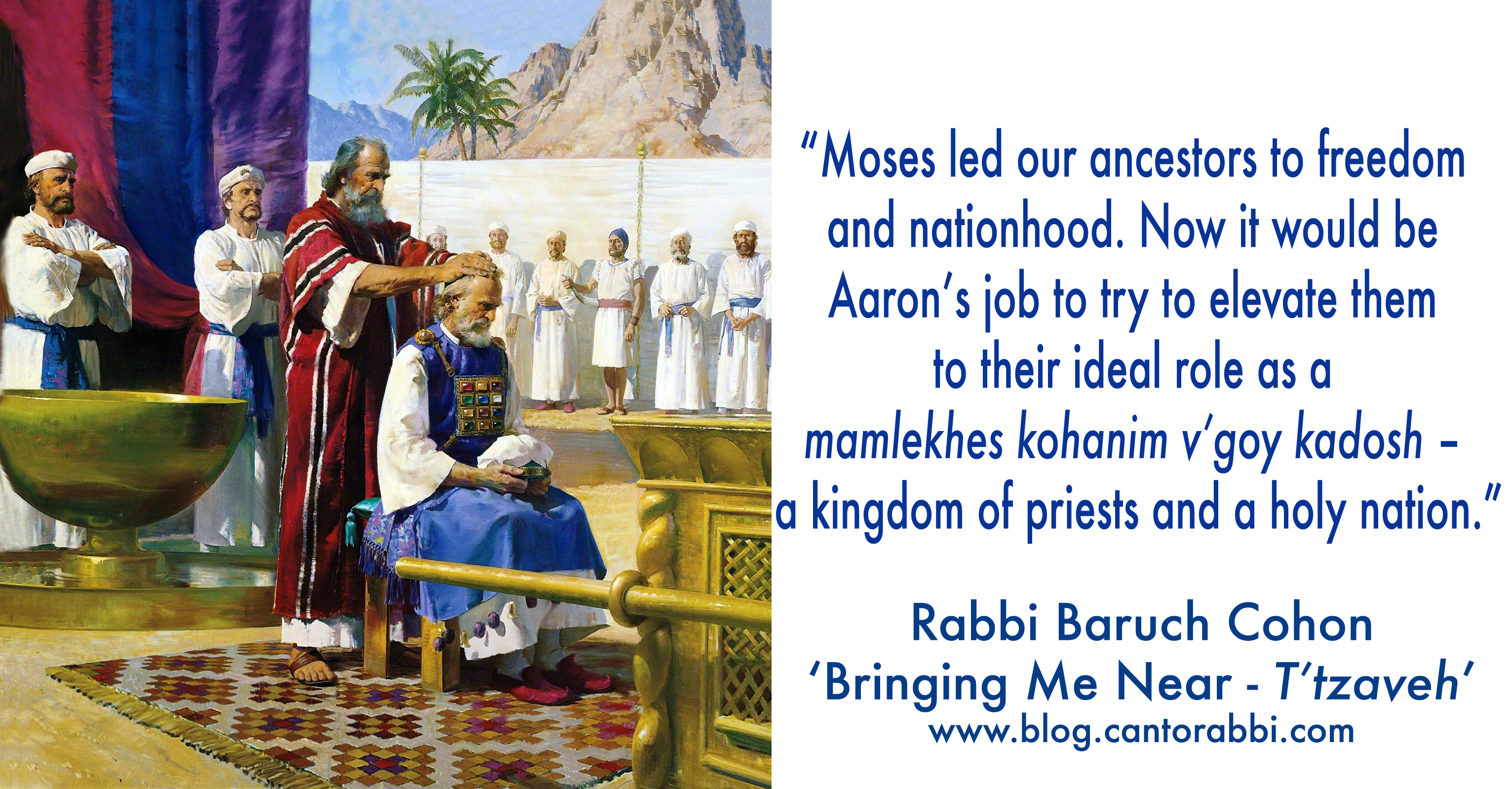
Perhaps there is another factor to be considered in this episode of Aaron’s selection as High Priest. Going back to Ibn Ezra’s opinion that Moses was also a priest, can we learn here that to serve as a head of state and to serve as a religious leader are two very different roles? We read of Aaron as Kohen godol – the High Priest. Moses is called Moshe rabbeynu – Moses our master. Even though Moses was a priest, he had different duties. Other human societies are known to combine the roles of king and prophet. Not Jews. Just think of King Saul’s relations with the prophet Samuel. Or David’s with Nathan. The prophet dared to function as the king’s conscience. When he succeeded, justice was done. Moses led our ancestors to freedom and nationhood. Now it would be Aaron’s job to try to elevate them to their ideal role as a mamlekhes kohanim v’goy kadosh – a kingdom of priests and a holy nation.

Today’s Kohanim no longer function as prophets, or sole religious leaders. But the goal is still there. Each in our own way, let’s do our best to lift the growing generations to a higher spiritual level.

ttzavehkohanim1


Posted in Jewish Blogs | Tagged , , , , , , , , , , , , , , , , | Comments Off on BRINGING ME NEAR – T’tzaveh – Ex. 27:20-30:10, by Rabbi Baruch Cohon

ADAR #1 – T’rumah – Ex. 25:1-27:19 by Rabbi Baruch Cohon

ADAR #1 – T’rumah – Ex. 25:1-27:19 by Rabbi Baruch Cohon

This week as we read the section that details all the various structures that filled the first Jewish house of worship, we will be observing the first Sabbath in the month of Adar. Actually in this leap year we have two months by that name, this one being Adar Rishon – Adar Number 1 and it begins this week. The Talmud teaches us: Mishe-nikhnas Adar marbim b’simkha – “When Adar enters, we increase joy.” Adar is the month of Purim, our happiest holiday. And as if to build that increased joy even more, we will celebrate Purim on the 14th of – not Adar #1 but Adar #2, which this year coincides with the 24th of March. So we have six weeks to get in the spirit. As the old pop tune put it:

Accentuate the positive,
Eliminate the negative, and
Latch on to the affirmative,
Don’t mess with Mr. In Between.
You gotta Spread joy up to the maximum
Bring gloom down to the minimum
And have faith, or pandemonium’s
Liable to walk upon the scene.
To illustrate my last remark,
Jonah in the whale,
Noah in the ark,
What did they do, just when everything looked so dark?…

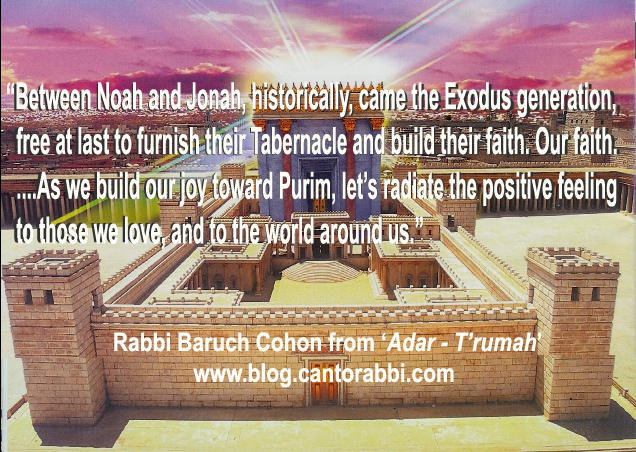
Of course they accentuated the positive! Between Noah and Jonah, historically, came the Exodus generation, free at last to furnish their Tabernacle and build their faith. Our faith.

No downtrodden slave group could create the portable splendor described in this Torah portion, and certainly no defeated invaders could construct the magnificence of Solomon’s Temple as told in the Haftorah. Our ancestors were expressing joy and gratitude for their victories. Particularly so in constructing the Bais haMikdosh – literally “home of holiness” — on Jerusalem’s Temple Mount. Let our enemies deny its existence, among the other lies they tell. Here is a detailed record of its construction, including the civilian draft that sent young woodcutters to Lebanon for a month at a time to work with the foresters of King Hiram whose treaty with King Solomon provided cedars for the sacred building. One month in Lebanon and two months at home, the draftees kept their schedule – some 30,000 of them, 10,000 at a time – in addition to 70,000 porters and 8,000 stone quarriers. This was a national undertaking in every sense.

As recounted in the First book of Kings, Solomon completed this magnificent structure, glorifying the Name of G-d, and received the Divine message reminding him that as great and beautiful as the Temple was, it just reinforced the Mitzvos, the commandments that set a standard for human conduct, for the ruler as well as for his people.

Symbolic of the Temple’s function were the windows. In the thick stone walls, those window openings were different from the ones in other buildings. Unlike windows built narrow on the outside to shield from bad weather, and wide on the inside to maximize light, the Temple windows were narrow inside and wide outside because G-d’s house would radiate light to the world around.

As we build our joy toward Purim, let’s radiate the positive feeling to those we love, and to the world around us. Happy Adar #1.

Adar

Posted in Jewish Blogs | Tagged , , , , , , , , , , , , , , | Comments Off on ADAR #1 – T’rumah – Ex. 25:1-27:19 by Rabbi Baruch Cohon

OUR RESPONSIBILITIES – Mishpatim – Ex. 21-24, by Rabbi Baruch Cohon

Screen Shot 2013-11-05 at 11.26.08 AM

OUR RESPONSIBILITIES – Mishpatim – Ex. 21-24, by Rabbi Baruch Cohon

All through the Torah we learn about our responsibilities – to G-d, to ourselves, to the land, to our work, and to each other. This week’s reading will include a detailed list of those responsibilities. We should keep in mind that this is not a complete list, but it’s a good start.

Included here we find both positive and negative commands. They range from capital offenses to calendar celebrations, from how to treat a slave to what to do with an ox that gores. The name of this reading is mishpatim, “Judgments.” And its basic theme is justice. Here we will find the famous rule of “an eye for an eye; a tooth for a tooth,” a rule that was always interpreted to mean the economic value of that body part. Inflicting identical damage on the guilty does the victim no good, but paying for the damage is only right. Here we also learn that if a master inflicts that kind of injury on a slave, that slave must go free. In Torah times slavery was a recognized reality. But unlike the attitude elsewhere – then and ever since then – that slaves are merely property, the Torah insists on treating slaves as human beings. And lest we deceive ourselves that this is all ancient history, shocking current statistics reveal a number of slaves in the world today in the millions.

Reading the penalties listed for violating these rules, we observe that in Torah times jail overcrowding was not a problem. No long prison terms. Generally punishment consisted of either economic penalties like fines and damage payments, or physical punishment – whippings or beatings, limited to 39 lashes – or banishment, or execution. In the case of lesser religious violations, the guilty party had to bring a sacrificial offering.

Some penalties do not appear here, but will show up in the Book of Leviticus. For example, here we find execution mandated for sorcery and for bestiality. Not for other offenses, such as those described in Leviticus, including adultery and homosexuality where both violators got the death penalty. Actually, fewer executions took place than we might expect, since the Torah requires two credible witnesses in order to convict and impose the death sentence. And this week’s reading includes strict standards for honest testimony.

Worshiping a false god is punished with “destruction,” which is understood as “death at the hands of Heaven” rather than execution by human methods. Those methods were stoning, burning, beheading and hanging. Violent action only, not poison or starvation. Today presumably, the Torah would favor the firing squad over the lethal injection. In murder cases, Torah justice recognizes the ancient practice of goel ha-dam – “the redeemer of blood” – closest relative of the victim, who had the right to avenge the death by killing the murderer. And here we find an immediate reference to the case of an accidental unpremeditated killing, where the innocent killer should have a place to go and be safe from the avenging relative. Cities of refuge were in fact established for this purpose both east and west of the Jordan, as detailed in later readings.

More outstanding than all the penalties are the moral imperatives set forth in this week’s reading. If someone digs a pit and a man or an animal falls into it, whoever dug that pit is responsible for the injuries. Give a tool or an animal to your neighbor for safekeeping, and that neighbor assumes responsibility to return your property intact. And “do not take a bribe, for a bribe will blind the sharp-eyed, and pervert the words of the righteous.” Practical rules to live by. Our sages never stopped exploring rules like these. The Talmud sets forth many imperatives that do not appear in the Torah at all, but became part of Jewish law, based on the principle of tikkun ha-olam–“repairing the world.”

Repeated several times in the Torah, including this week, is the message: “Consider the stranger, for you were strangers in Egypt.” Not stated but understood is the result: You know what happened to you –slavery and persecution; you didn’t deserve it; don’t do it to others.

Truly this is a section worth reading and learning. All four chapters.

waga__01

Posted in Jewish Blogs | Tagged , , , , , , , , , , , , , | Comments Off on OUR RESPONSIBILITIES – Mishpatim – Ex. 21-24, by Rabbi Baruch Cohon