OFF TO AZAZEL – Ah’rey Mos – Lev. 16-18, by Rabbi Baruch Cohon

Screen Shot 2013-11-05 at 11.26.08 AM

OFF TO AZAZEL – Ah’rey Mos – Lev. 16-18, by Rabbi Baruch Cohon

This week we will read some famous do’s and don’t’s that the Torah provides to enable us to elevate our lives. Given just “after the death of Aaron’s two sons – ah’rey mos shney b’ney Aharon” who lost their lives by bringing a “strange fire” into the Tabernacle, these laws created a structure designed to prevent such fatal errors in the future. That future is where we live now.

Opening with the Day of Atonement ritual, this week’s reading details rights and wrongs in food, worship, family and sexual relations, pointing out that wrong conduct in Egypt and among the previous residents of Canaan caused their defeat, and charging the Israelites to keep their Promised Land clean of moral violations.

Recognizing human weakness, the Torah sets up the famous ritual of the scapegoat, wherein the High Priest takes two goats, equal in lineage, and offers one as a sacrifice. The other one he symbolically loads with all the sins of his people – he knows he must expect them to sin. And he sends out the goat with an appointed messenger to a mysterious place in the desert called Azazel. Perhaps that was the name of a mountain from which the hapless goat got hurled. If so, we have no exact location for it. Definitely, whatever and wherever it was, Azazel was the destination for the sins we need to destroy. And the day of this ritual is the day we still observe by “afflicting our souls – v’inisem es nafshoseichem,” in other words fasting. Here the Torah sets the date, the 10th day of the 7th month, to atone for our sins. As our tradition stresses, fasting alone won’t do it. T’shuvah, t’filah u-tz’dokkoh – repentance, prayer and charity are required. By the end of that long Yom Kippur day in shul, we should be able to breathe free, to take that first bite and face the future with renewed strength.

Our Sedrah continues by discussing proper and improper ways to prepare meat. During Temple times, the fat was burned and the blood sprinkled on the altar. Blood is still not to be consumed. No steak juice. It was connected with idolatrous worship and therefore prohibited to Israel. Interestingly enough, this Sedrah does not discuss kosher and non-kosher meat. We read those laws elsewhere in the Torah. Here we are concerned with domestic animals: shor o kesev o eyz – ox, lamb or goat, all approved foods, slaughtered properly. We also recognize game animals and birds which are permissible food, and we learn than their blood should be poured on the ground like water, because “a creature’s life is in its blood.” By refraining from drinking the blood, we respect the life that we took by shooting that creature. Hunting is thereby a recognized action that humans take to provide themselves with food. But even then we remind ourselves that all life comes from G-d.

Our portion then discusses other censorable topics like incest, perversion, and assorted varieties of immorality. Some of these practices were associated with idolatrous worship by the Canaanite tribes. Others are just plain wrong. That is, they are against Torah law. Included is bestiality; no “pet sheep” for the Israelite farmer, and no carnal contact between his wife and their ox. Also included is homosexuality; “Do not lie with a male as with a female; it is an abomination.” Also lesbianism, called maasey eretz Mitzrayim – the actions of the land of Egypt, where female members of the royalty and aristocracy were known to keep concubines. If and when a modern society chooses to reverse those laws, an inevitable controversy with religious doctrine arises, as we see today. What effect will these controversies have on family structure?

When we can answer that question, maybe we will find out where Azazel is.

Scapegoat

Posted in Jewish Blogs | Tagged , , , , , , , , , , , , , | 1 Comment

IS G-D A MAN OF WAR? – “Song of the Sea” Ex.15 — by Rabbi Baruch Cohon

Screen Shot 2013-11-05 at 11.26.08 AM

IS G-D A MAN OF WAR? – “Song of the Sea” Ex.15 — by Rabbi Baruch Cohon

Of all the Torah portions assigned to Passover, perhaps the most dramatic is scheduled for the Seventh Day, this year Friday April 29th. Also probably the most familiar, since it is part of every morning’s prayers, it is the Song at the Sea – Shirat ha-yam – intoned by Moses and the Israelites on the shore of the Red Sea. That’s the far shore, the free shore, after they reach safety, and the pursuing Egyptian army doesn’t. As the Torah recounts, Moses split the sea, giving his people a path they could walk on.

However, the sea did not split so easily. Facing the danger of drowning, the people yelled at Moses: “Were there no graves in Egypt that you had to bring us here to die?” Desperate, Moses calls on G-d to help. He gets a curious answer: “Why do you cry to Me? Tell the people to go on!” Nobody moves, says our Midrash, until one man – Nachshon by name – sets foot in the water. He walks in, deeper and deeper, until the water reaches his chin and even wets his lips. And then suddenly the sea divides. The message? Take the lead, and with G-d’s help you can make things happen!

Once the people walk to freedom between walls of water, those walls then fall onto Pharaoh’s chariots and horsemen, submerging them. Impossible, you say? Just a few years ago, archeologists discovered something on the bottom of the Red Sea that added a new dimension to this miracle tale. They found the remains of gold covers from those ancient chariot wheels. The wooden wheels of the Egyptian chariots were long since decomposed, but the gold hubcaps survived.

Thrilled by their rescue, the men of Israel sang with Moses, and the women with Miriam, as we will hear this Friday: “I will sing to G-d for He triumphed gloriously!.. Horse and rider He threw in the sea… G-d is a man of war!”

Now wait a minute. We pray for peace in every service. The Priestly Benediction ends with the words “give you peace.” “Hello” in Hebrew is “shalom – peace.” How could Moses call G-d a man of war? Is that really what our faith is about?

Or do those words speak a warning? When a human force uses violence and perfidy to destroy selected victims, if that force cannot be contained or dealt with peacefully, will G-d inspire those potential victims to take action for themselves? Moses and Aaron tried negotiating with Pharaoh, time after time. Egypt had warnings, ten plagues in fact. But their policies did not change.

Why not? Maybe because Pharaoh saw how the Israelites multiplied. Arriving in Egypt with Jacob, they were 70 people. Over the course of 400 years of slavery, despite miserable living conditions, despite the royal order to the midwives to toss male Israelite babies in the Nile, by Moses’ time their birthrate produced 600,000 men of military age. Probably close to 2 million total population. Pharaoh’s answer? Genocide.

Facing genocide, whether from Pharaoh’s Egypt, Hitler’s Germany or – very possibly – Khamenei’s Iran, violent action may be a Divine imperative. Nachshon walked into the sea. Then G-d fought. Modern heroes dared danger to create the State of Israel which became a refuge for many Holocaust survivors. The name Nachshon became symbolic of one who dares to take chances.

We needed more Nachshons then, and we need them now. First comes victory. Then comes peace.

exodus15

Posted in Jewish Blogs | Tagged , , , , , , , , , , , , , , , , , | Comments Off on IS G-D A MAN OF WAR? – “Song of the Sea” Ex.15 — by Rabbi Baruch Cohon

ONE TORAH – First day Passover – by Rabbi Baruch Cohon

Screen Shot 2013-11-05 at 11.26.08 AM

ONE TORAH – First day Passover – by Rabbi Baruch Cohon

This year our great holiday of freedom begins on Shabbos, so we will read the special portion for the First Day of Passover, from Exodus chapter 12, describing the fateful night of the Exodus. From the preparation of the sacrificial lamb to marking the doorposts of the Hebrews’ homes, the narrative continues with the Tenth Plague – death of the firstborn, which struck the Egyptians but spared the Hebrew slaves. The avenging angel saw the blood on the doorposts and passed over – pasach. So here comes the commandment that the people must keep this festival in celebration of the great deliverance, even when they reach their homeland. Here we also read how the Egyptians, struck and bereaved and desperate, pushed the slaves to go – go free, get on your way! They even gave the Israelites valuable gifts, including gold and silver, to urge them out. Many Egyptians followed them, forming an eyrev rav – a mixed multitude. After 430 years in the country called bet avadim – the home of slaves, the people of Israel get their instructions for their free future:

It was a night of watching for G-d, bringing them out of the Land of Egypt; that is tonight, a night of watching for all generations. This is the law of the paschal sacrifice: no alien may eat any of it. … But if a proselyte lives with you and will offer a Passover sacrifice, let him and all the males in his household be circumcised; then they can eat. One Torah shall be for the native and the proselyte who lives among you (resident alien).

One Torah, one law. No penalties for aliens, and no special privileges for them either. Without doubt, circumcision represents sincere commitment. One holiday meal would hardly seem enough of an attraction to take that step. So we must recognize that some valuable converts entered our fold and were required to follow the same mitzvos as born Jews.

Elsewhere we learn about resident aliens, called literally ger toshav, who lived among the Israelites in their land and were not expected to keep the 613 commandments required of Jews. All they needed to observe were the 7 mitzvos b’ney Noakh – the commandments of the sons of Noah, given after the Flood: (1) establish courts of justice, (2) prohibit blasphemy, (3) prohibit idolatry, (4) prohibit incest, (5) prohibit bloodshed, (6) prohibit robbery, (7) do not eat flesh cut from a living animal. Not a word about observing the Sabbath, or keeping kosher, or celebrating any particular occasions. Not even about whom – or how many – to marry. Just everyday morality. Did the ger toshav just possibly have it easier than his Jewish neighbors?

Viewing today’s policy debates about resident aliens, their rights, liabilities and privileges as “refugees,” “illegal immigrants,” or “terrorists,” maybe we need to take another look at the principle of One Torah – one law for the native and the foreigner – and the difficulties in applying such an apparently just policy.

Ancient Israel, modern Israel, the United States or any other country, can face problems that come with a mixed population. In Torah times, most states assumed unanimity, and ruled their people accordingly, whether it suited facts or not. Israel already recognized differences in its inhabitants. In our high-tech, multi-ethnic world, we can do no less.

OneTorah

Posted in Jewish Blogs | Tagged , , , , , , , , , , , , , , , , , , | Comments Off on ONE TORAH – First day Passover – by Rabbi Baruch Cohon

CURING OUR ILLS – Metzora — Ex.14-15 — & Shabat haGadol – by Rabbi Baruch Cohon

Screen Shot 2013-11-05 at 11.26.08 AM

CURING OUR ILLS – Metzora — Ex.14-15 — & Shabat haGadol – by Rabbi Baruch Cohon

This week brings us a rather strange combination of texts. The Torah reading is named for a sufferer of a disease called tzaraas. The Haftorah reading in many congregations comes from the prophet Malachi predicting the arrival of Elijah, in observance of this “Great Sabbath,” Shabat haGadol which precedes Passover. Totally unrelated subjects, to be sure.

This Torah portion is a followup to last week’s, since both discuss the tzaraas disease, a cause of ritual contamination. In effect, last week’s portion dealt with diagnosing and isolating those who are infected, and this week’s reading is concerned more with curing them. The details are confusing, alien to modern minds. The sufferer sees symptoms, lesions on the skin, unnatural growth of hair, etc., and has to call in a cohen, a priest to identify the illness. Those who are diagnosed with tzaraas get quarantined outside the camp. After a given period of isolation – generally a week – the cohen re-examines the patient, confirms recovery, supervises cleanup and shaving of all the hair, and helps the patient offer sacrifices to express gratitude for recovery. Does that make the ancient cohen a medicine man?

Not really. Many editions of the Bible translate tzaraas as leprosy, certainly a dread disease throughout human history. Other authorities disagree. Citing the rabbinic comment about the word metzora, the name of this week’s reading, they identify the source of infection as more spiritual than physical. Metzora combines two words: motzi – to bring out – and ra – evil, indicating that circulating evil reports about other people can produce a plague. Loshon hora – badmouthing fellowmen – is the cause, therefore, of physical suffering. We might conclude that quarantine cures the disease by removing the evil speech from the camp.

The mystery expands, however. Not only human beings get tzaraas, their houses can get it too. So can their clothes. Dark red or green lesions in the cloth are described, and if they spread, the garment must be burned. Similar symptoms are described in the walls of a house, requiring that the bad sections of it be dumped in an impure area outside the camp, while new stone or lumber is brought in to replace them. What is going on here? Mold? Dry rot? Does the cohen become a rebuilder? Did the coat or the wall spread malicious gossip?

Possibly, this whole subject needs to be taken out of the physical realm. Granted, our ancestors very likely experienced different kinds of contamination that they had to deal with. And the Torah provided them with methods of removing the contamination from their bodies and their possessions. That was then. The Midrash states that tzaraas no longer exists. Today we have other cures for skin diseases, other remedies for mold and dry rot. What we still need, and don’t always have, is the remedy for Loshon hora, the evil tongue. And that definitely still exists. As for example, take political campaigns.

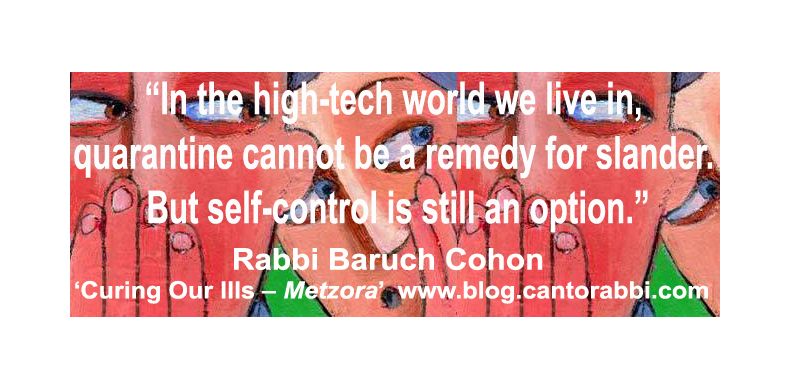
In the high-tech world we live in, quarantine cannot be a remedy for slander. But self-control is still an option. Let’s remove the evil tongue.

Then we can look forward to Malachi’s prophecy, and dramatize it at our Seder table next week: Elijah will “turn the hearts of parents to their children and the hearts of children to their parents,” and we will guard that full goblet of wine to welcome Elijah, treasuring the hope that this year at last Elijah will announce the Messiah’s arrival!

Thoughts and prayers for Shabat haGadol.

Metzra

Posted in Jewish Blogs | Tagged , , , , , , , , , , , , , , , , , | Comments Off on CURING OUR ILLS – Metzora — Ex.14-15 — & Shabat haGadol – by Rabbi Baruch Cohon

FREEDOM MONTH – Shabat Hakhodesh – Ex.12:1-20, by Rabbi Baruch Cohon

Screen Shot 2013-11-05 at 11.26.08 AM

FREEDOM MONTH – Shabat Hakhodesh – Ex.12:1-20, by Rabbi Baruch Cohon

Do you start naming the months of the year with July? Maybe you should. After all, July is the month of American freedom. We don’t change years in July, but the Founding Fathers changed a nation in that month.

Jewish custom, as every Hebrew school student knows, is to recite the months of the year as follows: Nisan, Iyar, Sivan, Tamuz, Av, Elul, Tishri, Kheshvan, Kislev, Teveth, Shvat, Adar. Since we start in Tishri, the month of Rosh Hashana when we change years, Nisan would be the seventh month. Just like July on the English calendar. And why not? Both of them qualify as the Month of Freedom.

Indeed, this week as we welcome the month of Nisan, we will read a special Maftir – a supplementary Torah section from a second scroll, in the book of Exodus – describing the preparations for the original Exodus when our ancestors left Egypt and became a free nation. “This month for you is the head of the months,” says the Torah. “First of the months of the year is it for you.”

How were we commanded to observe it? No dances, no New Years Eve parties, just take a lamb for a special dinner. One lamb per household. And not on Rosh Hodesh, but on the 10th of the month, giving us another four days to prepare. On the night of the 14th, slaughter the lamb at twilight, put the blood on the doorpost, and roast the lamb on an open fire to eat with Matzos and bitter herbs. Hardly an exciting event.

Further details limit the celebration still more. The lamb must be consumed that night, so the family must gauge each member’s appetite, and anticipate how much of that lamb they need. Because if they can’t reasonably expect to finish it, they must split it with another household. Any leftovers are to be burned in the morning.

No fancy clothes, either. “Your waist should be belted, your shoes on your feet and your staff in your hand.” Ready to travel, to a distant unknown land.

That was the original Seder. Not much like today’s family party. We don’t even eat lamb, in fact we stopped doing that when the Temple was destroyed and the Paschal sacrifice had to be discontinued. Not yet an occasion to express the pride and joy of a fulfilled heritage, the original Seder was a night to get ready for the fateful fight for freedom. Think about it. Was the spirit so different on the original Fourth of July?

Soldiers of the Revolutionary War certainly had to tighten their belts, keep their shoes on, and shoulder their guns. Declaring independence was only the beginning, and they knew it.

Since the days of Moses, we saw some 30 centuries combine to build desperate Hebrew slaves into a learned and accomplished nation. Just so, since the days of George Washington, a mere 24 decades built brave – and fearful – Revolutionary warriors into a proud world power.

We have some inspiring parallels in Jewish and American history, and we should consider Freedom Month among them. We don’t need to make it the first month of the year numerically, but #7 rates a special place in our lives.

FreedomMonth

Posted in Jewish Blogs | Tagged , , , , , , , , , , , , , | Comments Off on FREEDOM MONTH – Shabat Hakhodesh – Ex.12:1-20, by Rabbi Baruch Cohon