ARE WE QUALIFIED TO BUILD IT? – T’rumah – Ex. 25—28:19, by Rabbi Baruch Cohon

ARE WE QUALIFIED TO BUILD IT? – T’rumah – Ex. 25—28:19, by Rabbi Baruch Cohon

Bible commentators like the great Rashi taught that “there is no early and late in the Torah.” In other words, the order of events described in the Torah does not influence the importance of the laws derived from those events. Creation, Exodus, Mt. Sinai – all equally vital because all Divine origin.

And yet, we might consider the sequence of Mitzvos in the current 3 week cycle of readings. Just 2 weeks ago in the Sedrah called Yisro we reviewed the spectacular experience of receiving the Commandments at Sinai. That was followed by last week’s Mishpatim — ordinances detailing moral behavior and the punishments for violating them. And this week we begin to read the rules for constructing the first Jewish house of worship, the Tabernacle in the desert, the portable sanctuary that our ancestors carried with them for 40 years.

Who was qualified to build the first “house of G-d?” The people who witnessed the miracle of Sinai? The people who committed themselves to dealing justly with each other? Only they and no others? Here we will not find the airev rav – the Egyptian hangers-on who followed the Israelites across the Red Sea. Maybe some of them took Jethro’s example and accepted the Commandments, and maybe not, but we don’t find any role for them indicated in the sacred construction plans. Responsible leaders of the tribes of Israel are selected for this work.

In this week’s Haftorah we will also read about the construction of Solomon’s Temple, and the plans for cutting and importing the cedar trees from Lebanon for that job. Solomon and the king of Lebanon made a deal for those trees, and agreed that Israel would send the crews to cut them. Young men were assembled in 3 crews of 10,000 each, and spent a month at a time each on the job. Then another crew replaced them, so they could spend the next two months caring for their families. Moral obligations first, then work on the Temple.

Maybe we need to ask ourselves if that sequence of events – that “early and late” – applies to us now. Are we qualified to build a world, or a nation, or a community that can be a “house of G-d?” When we hear of religious figures convicted of moral and legal offenses, we have to ask if they really qualified to do sacred work.

Very likely, Rashi’s principle about “early and late” can be considered a literary observation, rather than a matter of principle. The Torah narrative sometimes includes a flashback. Historically, as many authorities recognize, we need to put those flashbacks in the order they occurred. But in the case of Mishpatim and T’rumah, we have a lesson to learn. Builders of G-d’s house have a moral standard that is required.

As we endeavor to build a future for ourselves, for our families, for our world, we should qualify for that sacred task, and our Torah guides us to that qualification. First, mishpatim – moral principles, how we deal with each other. Then t’rumah – sacred effort, how we strive to sanctify our lives and so improve our world. Each in our own way, let us qualify.
Posted in Jewish Blogs | Tagged , , , , , , , , , , , , , , , , , , , , | Comments Off on ARE WE QUALIFIED TO BUILD IT? – T’rumah – Ex. 25—28:19, by Rabbi Baruch Cohon

GETTING DOWN TO CASES – Mishpatim, Ex.21-24 By Rabbi Baruch Cohon

GETTING DOWN TO CASES – Mishpatim, Ex.21-24 By Rabbi Baruch Cohon

Last week the Torah gave us principles of conduct. General rights and wrongs. Now, reading Sedrah Mishpatim – “Judgments” — we get into some specifics. We know murder is wrong, but what actually constitutes murder? And what penalty should a human court impose? Questions like these get answered this week, some in remarkable ways.

These chapters detail laws about theft, seduction, injury, loans, idolatry, festivals, witchcraft, how to treat servants and when to rest the land. Most severe of the violations discussed here is murder, so let’s see how the Torah defines and punishes it.

In the days of the Torah revenge killing was acceptable. Like the Hatfields and McCoys of old Kentucky, the closest relative of a victim had the recognized right, even the duty, to kill the man who killed his brother. On the other hand, what if that original killing was not deliberate, if the man was swinging an axe to chop wood and the head of the axe flew off and killed the victim? Then the killer would have a place to take refuge. Elsewhere in the Torah we will read about cities of refuge where the avenging relative would not be allowed to enter. Interestingly, the practice of refuge for the inadvertent killer survived long after Torah times, and in unexpected places.

On our first visit to Hawaii my wife and I were taken on a sightseeing boat to a cave which was not accessible by land. There a diorama in the wall told how this cave was used. One who killed someone inadvertently could go there and remain safe until the death of the Big Kahuna. Exactly the same as the Cities of Refuge that Moses set up in ancient Israel. Even the word Kahuna (meaning priest) has a parallel sound and meaning to the Hebrew Kohen. A rabbi friend in Honolulu explained to me that when the Polynesians sailed across many miles of ocean to settle Hawaii they needed expert navigators, and at that time the best navigators in Asia were Jews. So apparently Hawaii got some Torah along with its pioneer population. A researcher at the University of Hawaii found a large number of Hawaiian words that have parallel meaning and sound to their Hebrew equivalents. Shaloha!

Now back to Exodus.

The ultimate refuge for a desperate fugitive was the holy altar. Even that, however, is not available to a real murderer. Here we learn that “if a man deliberately comes after his neighbor to kill him with guile” by deceit or by ambush, and then runs to the temple to save himself from justice, “from My altar you must take him to die.”

Among the most impressive of these many laws is the charge to judges: “Do not take a bribe, for a bribe will blind the clearest of eyes and subvert the words of the righteous.” We see frequent reports of bribery charges today, not confined to judges but challenging national officials too. Human beings are still subject to temptations that can “blind the eyes and subvert the words.”

Judges are further warned neither to oppress a poor litigant who is at their mercy nor to favor that poor litigant out of a sense of pity even though he is guilty. In a time and place known for corruption, the Torah denounces corruption. Rich in lessons for today, these chapters seem to anticipate democracy as we read: “Do not follow a majority to go astray.” Sometimes majorities can be wrong too.

Ideals are great. But they are merely slogans unless we can put them to work in our lives. That requires getting down to cases, as in Mishpatim.

Posted in Jewish Blogs | Tagged , , , , , , , , , , , , , , , , , , , , , | Comments Off on GETTING DOWN TO CASES – Mishpatim, Ex.21-24 By Rabbi Baruch Cohon

WHO IS JETHRO – Yisro, Ex. 18-20 – by Rabbi Baruch Cohon

WHO IS JETHRO – Yisro, Ex. 18-20 – by Rabbi Baruch Cohon

Of the five books of the Torah, the figure of Moses dominates four. His birth, his youth in the palace, his rediscovery of his people’s pain, and the hot temper that drove him to kill the brutal taskmaster – thus prompting his break with Pharaoh and his flight to the desert – all lead to his marriage to Zipporah, daughter of a man named Jethro, the heathen priest of Midian.

Yes, Moses married a heathen, a shiksa if you will. But remember, this “intermarriage” took place before Israel received the Torah.

Apparently drawn to Moses both for his physical strength – rolling the great rock off the well single handed – and for the power of his faith in the One G-d, Zipporah becomes a worthy and courageous wife. She is the one who circumcises her infant son when Moses misses the proper date. They have two sons, Gershom and Eliezer. Those Hebrew names remain popular among Jewish families ever since, but the original men do not figure in their people’s history. No books are named for them. They never lived in slavery, they did not experience the Exodus, and neither did their mother. Here we read of Eliezer’s birth, and a week later a crisis between his parents.

Was Moses angry with Zipporah for usurping his right of milah (bringing his son physically into the covenant)? Is that why Moses sent her and the boys to her father while he returned to Egypt? There’s that temper again.

Moses is called Moshe rabbeynu – Moses our teacher, our lawgiver, the man who brought us to Mount Sinai for the ultimate revelation. Rightly has it been observed that this revelation did not appear to one individual who then preached it to his people. It was revealed to the entire people – some two million of them. So far as we know, Judaism is the only one of all the world religions that proceeds from this kind of revelation. That is the scene that dramatizes this week’s Torah reading.

Of course every Torah reading – every Sedrah – has a Hebrew name. And what name does this week’s reading bear? Here we will read about the national preparations, the thunder and lightning on the mountain, the Voice of G-d communicating the Ten Commandments, which Moses then repeats. Is this reading named for Moses?

No, it is not. It bears the name Yisro – Yitro in Sephardic pronunciation – Jethro in English transliteration. Jethro, Moses’ father-in-law, the heathen priest of Midian! How does he rate?

Well, here we will learn that while he did not see the Exodus, Jethro heard about it, and took it to heart. He realized that not only was the Egyptian army submerged but the idols of Egypt were proven powerless. Only the One G-d inspired triumph. So here comes Jethro, bringing not only his newly acquired reverence for his son-in-law’s faith, but also the daughter and grandsons whom he has been sheltering, to reunite Moses’ family. As the story progresses, Jethro also offers Moses very practical advice. Watching Moses spend hours listening to tribesmen who come to him to settle quarrels, Jethro says: Don’t wear yourself out judging all these petty grievances. Appoint some able G-d-fearing truthful men, men who hate unjust gain, and make them rulers of thousands, hundreds, fifties and tens. Let them bring you the hardest cases, and let them judge the rest. Moses gratefully takes the advice, and then sends Jethro home. Why doesn’t he keep him in the camp? Rashi says Jethro was to go and bring the One G-d to the rest of his family.

So when Israel receives the Torah at Mount Sinai, Jethro is not there. Yet he gives his name to this momentous Sedrah, as a helper and motivator. And indeed that is how we remember him these thousands of years later – as a devoted family man, as a man with high intelligence and an open mind, as a man who did not hear the Ten Commandments spoken from On High, but could detail the difference between right and wrong. That’s what they are about, isn’t it? Right and wrong. Given their sacred origin, they are not about mystic truth. They set standards for life — not in heaven but right here on earth.

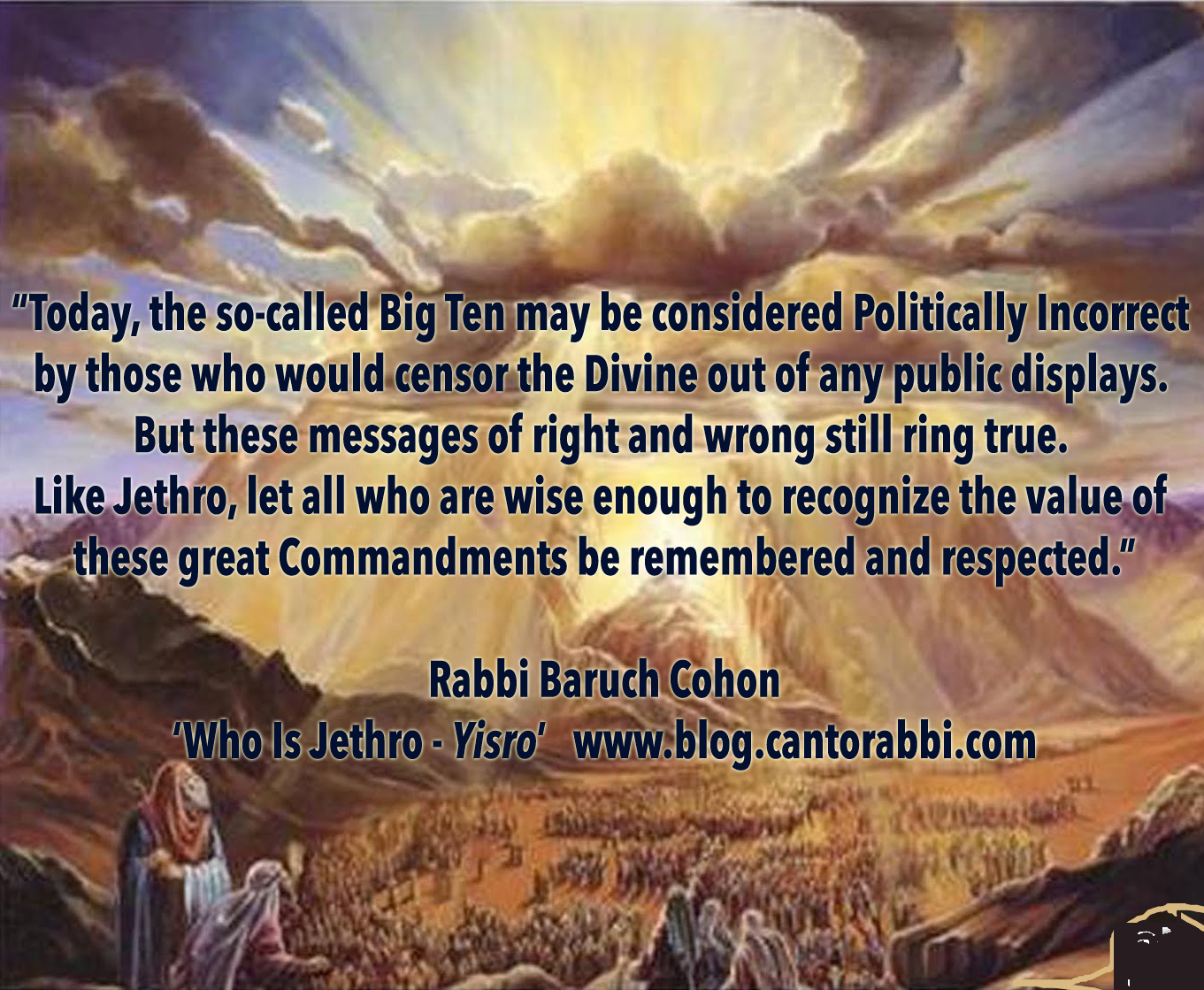
Today, the so-called Big Ten may be considered Politically Incorrect by those who would censor the Divine out of any public displays. But these messages of right and wrong still ring true. Like Jethro, let all who are wise enough to recognize the value of these great Commandments be remembered and respected.

Posted in Jewish Blogs | Tagged , , , , , , , , , , , , , , | Comments Off on WHO IS JETHRO – Yisro, Ex. 18-20 – by Rabbi Baruch Cohon

ISRAEL WILL SING – Ex.15, Shabat Shirah – by Rabbi Baruch Cohon

ISRAEL WILL SING – Ex.15, Shabat Shirah – by Rabbi Baruch Cohon

This week we observe the annual Sabbath of Song, when the Torah reader intones the jubilant Song of Moses with its special melody – a paean of gratitude and joy, celebrating the Israelites crossing the Red Sea on dry land, and reaching freedom after centuries of Egyptian slavery. Pursuing forces sank under the returning waves. Just a few years ago, modern archeologists discovered some gold wheel-covers of Pharaoh’s chariots in the Red Sea’s sands. Yes, it happened. Moses had plenty to sing about.

Shirat haYam – the Song of the Sea – prompts the name of this special Sabbath, called Shabat Shirah – the Sabbath of Song. This week many congregations will hold concerts of Jewish music, and feature musical services, encouraging and rewarding the work of contemporary Jewish composers. Like other colleagues, I relish the nakhes of attending a service or concert, perhaps led by a former student, that will feature a composition of mine. Indeed, music and song play a huge role in our lives. Biblically, this Song of Moses is just the first of the great songs. In the Book of Numbers we read the people’s song of elation at finding a well in the desert. In Deuteronomy, one of the last acts of Moses is to speak the verses of Haazinu, his testament, “in the ears of the whole community of Israel, the words of this song:

Listen, you heavens, and I will speak, and let the earth hear the utterance of my mouth…”

Prophets and kings continue the poetry and the music. Take Deborah’s song in the Book of Judges (this week’s Haftorah), others in Second Samuel, in Isaiah, and of course in the Psalms of David. The very last of those Psalms, #150 details a virtual catalogue of the musical instruments the Levites played in the Sanctuary, and adds dance and the human voice. Then Solomon gave us the Song of Songs, an ultimate love song, which our tradition takes symbolically as expressing the love of G-d and Israel.

So the power of song flavors our lives. The Mechilta counts 10 important songs, the first being the Song of the Sea, and the last being the song we will sing with the Messiah when he arrives. That will be the eternal song.

But before leaving those exultant ancestors on the east side of the Red Sea – Moses leading the men and Miriam leading the women – let’s look at one grammatic curiosity. The Torah does not say Az shar Moshe uv’ney Yisrael – “then Moses and the Israelites sang.” It says Az yashir Moshe – literally “then Moses and the Israelites will sing.” When all slaves will be freed, when hatred and oppression will be drowned, when human life will be fulfilled and not polluted – we will all sing. That is what we hope for. That is what we sing about. With the Messiah, with our neighbors, with each other.

Join the chorus!

Posted in Jewish Blogs | Tagged , , , , , , , , , , , , , , , , , , , | Comments Off on ISRAEL WILL SING – Ex.15, Shabat Shirah – by Rabbi Baruch Cohon

FINISH THE SENTENCE – Bo – Ex. 10-13, by Rabbi Baruch Cohon

FINISH THE SENTENCE – Bo – Ex. 10-13, by Rabbi Baruch Cohon

Quotations can be fascinating. We get hung up on them. They become clichés. They get twisted into jokes, song lyrics, book titles, slogans. And we never stop distorting them. Remember the old poem, “Blessings on thee, little man/ Barefoot boy with cheek of tan”? And then how it became the title of a hilarious and highly successful book by Max Shulman called “Barefoot Boy with Cheek?”

Or take Biblical quotations: “Voice of the Turtle,” “Darkness at Noon,” “Awake and Sing.” As play titles, they have little to do with their origin.

The famous story of the heathen challenging Hillel to teach him the whole Torah while he stands on one foot frequently gets truncated in quotation. As you may remember, when the heathen took his challenge to Shammai he got thrown out. So Hillel found a way to deal with him. While the heathen stood on one foot Hillel said “What is hateful to you, don’t do to your neighbor. That is the Torah. The rest is commentary.” Ah, but that’s not all he said. His last two words get lost too often. What were they? Zil g’mor – “Go and study!”

Case in point: this week’s Sedrah, Bo. Moses and Aaron bring Pharaoh their message, which all the world remembers as “Let my people go!” They compete with the Egyptian sorcerers in working wonders and inducing plagues, but they fail to convince the king. He seems to think they are playing a game with him, so he plays too. Like Arafat or Saddam or Khamenei – not to mention other well-known Middle Eastern negotiators – he agrees to whatever they ask for, until the plague stops. Then he breaks his word. After all, his magicians can do the same tricks.

Perhaps he misses the point. Perhaps we do too. Pharaoh fails to listen to the whole sentence. All he hears – all the world remembers – is Let My People Go. He doesn’t listen to the end of the sentence, where Moses says v’yaav-duni – “to serve G-d.” There is a purpose for freedom. Beyond removing chains. Beyond the end of whips and slave markets and Jim Crow. The purpose is to achieve a Divinely given identity. To serve the Divine image within us. To fulfill our destiny as human beings and as a nation.

Freedom is in the soul of the free. Once I remember writing, and later recording, a song on this text:

Shalakh amee v’yaav-duni…
Let my people go
Let my people go and serve the Lord
And get the Law
Because the Law
Will keep us free!

Sing it at your Seder. That song, and this Sedrah, recall a little scene many years ago at the Hollywood Palladium. Most of the people at the dance were middle-aged, but there was one young couple who seemed particularly interested in what the Jewish combo was playing. At the evening’s end, only the leader and the guitar player were still there wrapping up their gear – only they, and the young couple, still hanging around. Approaching the leader, the girl said: “You don’t know what you did to me tonight.”

Being a little surprised, he asked what it was that he did.

“Well,” she explained, “I’ve been through Zen and Yoga and all kinds of meditation…but tonight, listening to you and your music – it just made me glad to be Jewish.”

Wow! He thought, if he can give that feeling to her or any more like her, he did not live in vain. His music had helped liberate her to be herself! Now she needed to follow it through and learn. I hope she did.

The key is — finish the sentence. Follow the purpose.

Getting out of Egypt did not make Jews a nation. We just stopped being slaves. We were free but still did not know our purpose or our identity. What made us a nation? Sinai. Receiving the Torah, our constitution. Roadmap for serving the One G-d. That was why Moses was sent to defy Pharaoh. That was why the Red Sea had to be crossed.

“Let My People Go” – why? “To serve G-d.”

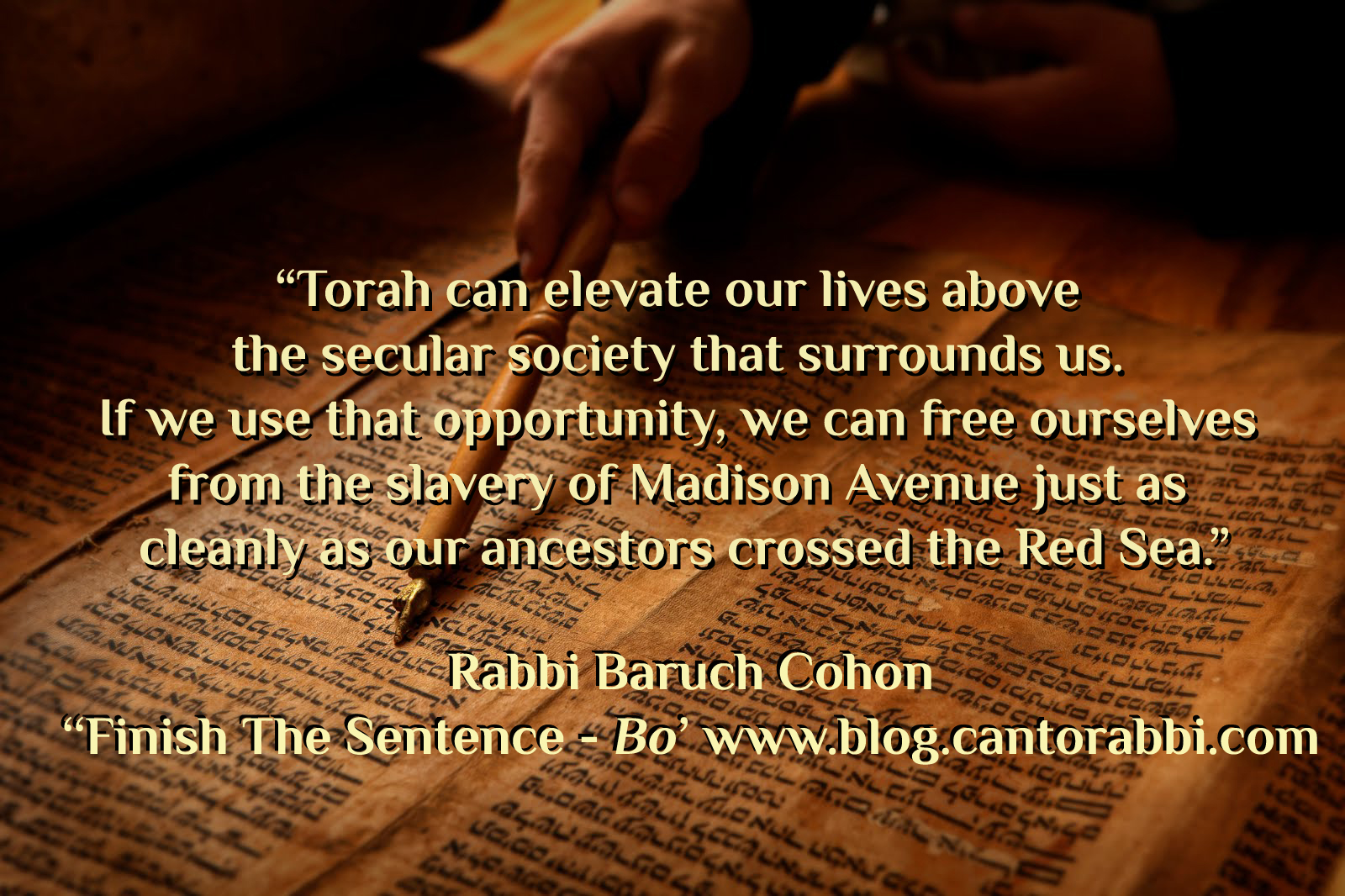
Torah can elevate our lives above the secular society that surrounds us. If we use that opportunity, we can free ourselves from the slavery of Madison Avenue just as cleanly as our ancestors crossed the Red Sea.

Not all those who left Egypt made it to Mount Sinai. But no Jew reached Sinai without leaving Egypt. That’s not just geography. That’s the whole lesson of Bo. Letting our spirits go, that’s the necessary first step. Breaking out of the pattern that may be enslaving us now. And if we can do that, keeping in mind the purpose of freedom, we have a chance to reach both our personal Sinai and our public Sinai. To learn Torah and implement it in our lives. To fulfill ourselves as people – and as a People. Our future could depend on it.

Shalakh amee v’yaav-duni – Let My People Go, to serve G-d!

Posted in Jewish Blogs | Tagged , , , , , , , , , , , , , | Comments Off on FINISH THE SENTENCE – Bo – Ex. 10-13, by Rabbi Baruch Cohon