354 DAYS AT A TIME – Emor – Lev.21-24, by Rabbi Baruch Cohon

354 DAYS AT A TIME – Emor – Lev.21-24, by Rabbi Baruch Cohon

You probably heard about the fellow who decided to become an atheist. He left his family’s house of worship and turned his back on religion. But then a few weeks later, he came back.

“You changed your mind? How come?”

“Atheists have no holidays.”

This week’s Torah reading outlines the Jewish calendar, which provides our annual cycle of holidays both serious and upbeat, and all sanctified by faith. Indeed, Judaism as a way of life is closely connected with the calendar. That connection goes back to our origins. Moses reminded us that we left Egypt in the spring month. Count 49 days – 7 weeks from the Exodus, and we reach Mt. Sinai to receive the Torah and become a nation. And here in Leviticus 23 we go on to detail the dates of Rosh Hashana, Yom Kippur and Succoth – New Year, Day of Atonement, and the Harvest festival, all in the fall.

So why is New Years Day celebrated on the first day of the seventh month? Precisely because Nisan, the month that includes Passover, is the month of freedom, and is specifically designated as the first month of the year in the very story of the Exodus. The Talmud (in tractate Rosh Hashana) lists four “new years days” every year: one for kings, one for numbering years, one for planting trees and one for tithes. In our urban culture, of course, we generally limit our ceremonial New Year to the 1st of Tishri. That is the day we change the number of the year.

As we all know, the Jewish calendar, like the Chinese, is based on the moon. 354 days on average, instead of the 365 of the solar calendar. That causes considerable variety in how Jewish holidays compare with those of our neighbors. In 2011, for example, Hanukkah coincided with Christmas. In 2013 it coincided with Thanksgiving. This year the 8th day of Hanukkah coincided with January 1st. And next year? Halloween maybe?

No way. Because, 7 times in every 19 years, the Jewish calendar adds a month during the spring, forming a leap year that resolves the lunar-solar difference. An ancient scholar named Shmuel who headed the academy in a Babylonian town called Nehardea was responsible for much of the development of the calendar used today. The Talmud describes him as a man who knew the orbits of the planets as well as he knew the streets of Nehardea. This self-taught astronomer laid the groundwork for a system that gives Jews the world over the opportunity to celebrate their holidays at the same time. In the days of much slower communication, they had to add a day to the holiday if they lived outside of Israel, in order to make sure they were all observing the occasion together. Hence we still have the Second Day of many festivals in traditional Diaspora communities but not in Israel. A notable exception to this rule is Rosh Hashana itself, the New Year, which is observed for two days in Israel too. It is not considered an “exile holiday” (yomtov sheyni shel goluyos) but the two days are called “one long day” (yoma arikhta). One more opportunity to hear the call of the Shofar!

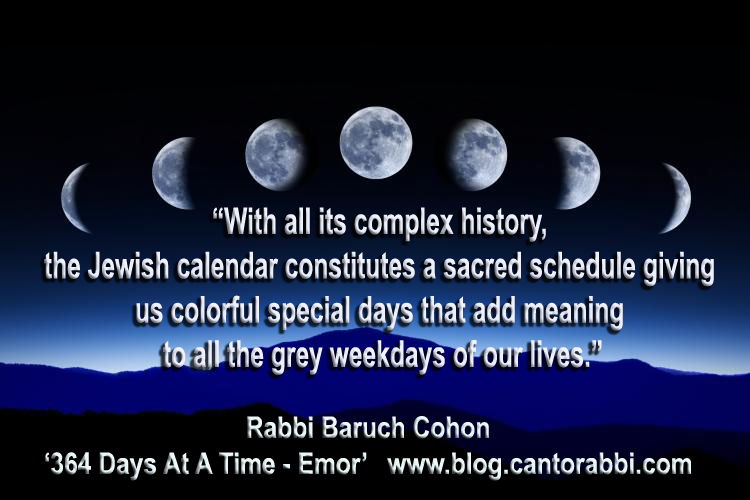
With all its complex history, the Jewish calendar constitutes a sacred schedule giving us colorful special days that add meaning to all the grey weekdays of our lives.
Posted in Jewish Blogs | Tagged , , , , , , , , , , , , , , , , , , , | Comments Off on 354 DAYS AT A TIME – Emor – Lev.21-24, by Rabbi Baruch Cohon

WHO’S HOLY? – Ahrey Mot-K’doshim Lev. 16-20 by Rabbi Baruch Cohon

WHO’S HOLY? – Ahrey Mot-K’doshim Lev. 16-20 by Rabbi Baruch Cohon

Just as they did last week, this week synagogue Torah readings cover two sections. They get combined except during leap years. In fact, they go together well. Last week’s double bill concentrated on the issues of purity and contamination. This week we read about laws and penalties.

First, however, the Torah lays out the conduct of the Yom Kippur service in the ancient sanctuary, including the sacrificial offerings, the conduct and clothing of the High Priest, and of course the scapegoat ritual.

Then come some detailed directions for slaughtering, preparing and eating meat. One outstanding provision is not to eat the blood. No “steak juice” cocktails allowed. Consuming an animal’s lifeblood had idolatrous associations, and we are told to pour it on the ground like water.

The remainder of the first section details actions to be avoided, citing them as typical of the corruption of Egypt. Included here are prohibited degrees of sexual contact, from incest to bestiality and, yes, homosexual relations. Polluting the Promised Land with such conduct would cause the land to “vomit you out, as it did the nation who was there before you.”

Warnings and prohibitions are not enough. The second section, called K’doshim – “Holy ones” – sets out penalties for violating these laws. We don’t find any prison time mentioned here. No fines, either. Minor infractions call for burnt offerings. Major violations incur execution or ostracism. Torah law may not be politically correct. Too bad. But what does all this strict punishment have to do with holiness?

In its very special way, the Torah defines Holiness before even going into detail about punishment. To be holy does not mean setting yourself apart from human society and its temptations. No ivory tower. Don’t try to be what’s called a “holy Joe.”

Just the opposite, in fact. Holiness requires that we deal justly and respectfully with each other. Honor your parents. Keep the Sabbath. Pay a day-worker before nightfall. Do not deceive your neighbor or lie, and never swear falsely because that is blasphemy. Do not curse the deaf, or place a stumbling block in the path of the blind.

Judges may well note the ruling: “Do not favor the person of the poor and do not glorify the person of the mighty. Judge your neighbor with justice.” Principles like those apply to non-court situations too, as we read about relations with someone whose actions you disapprove: “Do not hate your brother in your heart. Rebuke him, and do not bear sin because of him.”

Perhaps the most down-to-earth expression of holiness is this: “Do not take vengeance or bear a grudge against one of your people.” The classic examples of this disapproved conduct goes this way: Vengeance is when you ask to borrow your neighbor’s axe and he refuses; then next week he asks to borrow your ladder and you refuse, saying “You wouldn’t lend to me, so I’m not lending to you.” A grudge is when he refuses to lend you his axe, but when he comes to borrow your ladder you say: “Sure, here it is. You see? I’m not like you!”

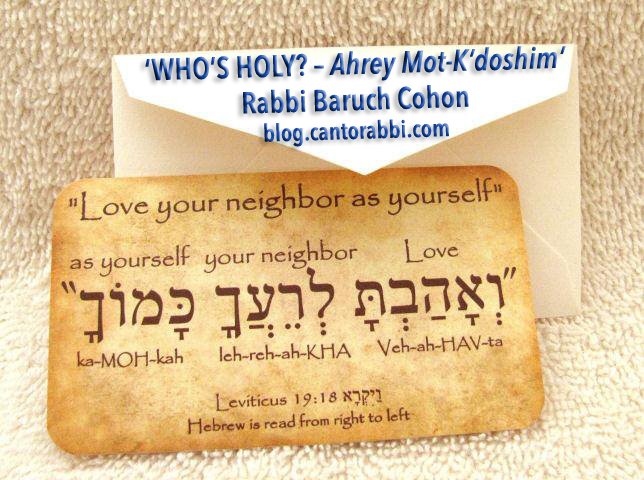
Most famous of all the holiness teachings is the line “Love your neighbor as yourself.” To me, this means that first you need some self-love. If I have no respect for myself , what value is my love for my neighbor? Of course, the process goes both ways. By building a habit of treating other people right, we can also take some pride in our own lives.

Who is holy? Potentially, you and I.

Posted in Jewish Blogs | Tagged , , , , , , , , , , , , , , | Comments Off on WHO’S HOLY? – Ahrey Mot-K’doshim Lev. 16-20 by Rabbi Baruch Cohon

CONTAMINATED — Lev. 12-15 Tazria-Metzora – by Rabbi Baruch Cohon

CONTAMINATED — Lev. 12-15 Tazria-Metzora – by Rabbi Baruch Cohon

Some tribal societies have medicine men who treat physical ailments with mystery cures. Ancient Israel left that function to the cohanim, the priests, Aaron and his descendants. The Book of Leviticus prescribes some treatments in three of the less pleasant chapters in the Torah. Most of these treatments involve declaring the patient to be taMEY – Contaminated. That condition could last a day, or could go on for months. Sometimes that condition just meant that the patient could not enter the sanctuary and was prevented from eating sacrificial meat.

Most dreaded of diseases was leprosy – tzaraas. Its treatment is the most extreme. One device used is familiar to us today as quarantine. The leper had to pitch his tent outside the main camp, must wear torn clothes, let his hair hang loose, and if anyone comes near him he must cover his upper lip and cry out taMEY taMEY – “Contaminated, contaminated!” – thus warning people to stay away from him.

Surprisingly enough, this entire double section that we will read this week starts with a law that is not about disease, but about childbirth. When a woman conceives and bears a son, we are told, she is considered to be contaminated by the blood she has shed. This condition lasts one week, the same length as her menstruation. Then she takes a ritual bath and her son gets circumcised. By most rabbinical opinions she now can and should resume relations with her husband. But she is not to enter the sanctuary for another 33 days, after which she brings an offering to the sanctuary and the cohen declares her pure.

When the baby is a girl, the length of the mother’s contamination is doubled – 14 days before the bath and 66 days thereafter. Theories about this difference are varied, but it would seem to place special importance on the birth of a female who will grow up to experience the monthly cycle, and some day may also bear a new life.

So how do we move from the joy of new life to the plague of leprosy? Contamination – tum’ah – is the key word. It can affect the healthy mother, or the suffering patient. It can even affect the house we live in and the clothes we wear. While the Torah’s remedies have no obvious connection to modern science, we get the definite message that sometimes we cause our own contamination. In fact, the rabbis note, the word for a leper – metzora – is a contraction of the words motzi shem ra, which means “bringing out a bad name.” In other words, slander.

Whether it starts as thoughtless gossip or as deliberate character assassination, loshon hora – the evil tongue – contaminates our lives. No cohen and no medicine man can cure it. It was the great Maimonides who wrote that the evil tongue destroys three people: the one who spreads the bad report, the one who is the subject of it, and the one who listens to it. The only antidote is prevention. If we fail to prevent it, if we participate, we might do well to cover our upper lip and cry “Contaminated!”

Throughout this week’s reading we learn how the cohen must search for the infection. He has specific ways to examine the patient, or the clothing, or the house. When he finds the plague cleaned up, he pronounces the verdict tahor – “pure.”

So let it be said of us.

Posted in Jewish Blogs | Tagged , , , , , , , , , , , , , , , , | Comments Off on CONTAMINATED — Lev. 12-15 Tazria-Metzora – by Rabbi Baruch Cohon

ALCOHOL AND TORAH – Sh’mini – Lev. 10 – by Rabbi Baruch Cohon

ALCOHOL AND TORAH – Sh’mini – Lev. 10 – by Rabbi Baruch Cohon

This week’s Torah reading includes the story of Aaron’s two oldest sons, Nadav and Avihu, and their tragic mistake. The words of the Torah tell a strange and supernatural story. On the eighth day (sh’mini) of the new Tabernacle, after a solid week of sanctifying Aaron and his sons as priests to conduct the sacrificial worship, the first two of those sons take their fire-pans, put fire and incense in them, and ”bring them before G-d.” But the fire they delivered was “strange fire,” not the consecrated fire from the altar. As a result, a punishing flame “came out from before G-d and consumed them, and they died.”

A challenging narrative, to say the least. Were Nadav and Avihu experimenting with explosives? Did the fire in their pans come from some polluted fuel? Indeed, taken literally, does this mean that changing any detail of the religious ritual is a capital offense?

Commentators faced this challenge in several ways. The most accepted interpretation is based on the very next message Aaron gets from On High. “Drink no wine or strong drink when you are coming into the Sanctuary, you or your sons.” This timing would indicate that Nadav and Avihu made their fatal mistake because they were DUI – delivering under the influence. Aaron and his remaining sons have to take this as a grim warning against drinking before officiating.

Do we learn from this story that the Torah is anti-alcohol? Should we only make Kiddush over grape juice? Not true. Wine and liquor are often mentioned in the Hebrew Bible, sometimes positively and sometimes conscious of their danger. In the Psalms, King David sings “wine makes a man’s heart glad.” On the other hand, when a Biblical man wanted to rise on the scale of holiness he took the Nazirite vow – no wine, no strong drinks. Being prized for its pleasure, alcohol is also plagued by its power.

How appropriate this subject appears to be for this season. Last month we celebrated Purim, the one holiday when a famous Talmudic statement tells us to drink until we can’t tell the difference between “blessed is Mordecai” and “cursed is Haman!” And just a few days later our Irish neighbors toasted St. Patrick. Is it the season?

Of course not. The bottom line in using alcohol, like the bottom line in other human activity, is balance. Know your limit. Know your body’s strengths and weaknesses. And use discretion. It’s pretty safe to say that most people can bring in the Sabbath or a holiday safely with a blessing over a cup of wine. One cup. But if you have any problem stopping at one, grape juice is just fine. Just don’t forget the bracha – the blessing of the day. No strange fire for us!

Posted in Jewish Blogs | Tagged , , , , , , , , , , , , | Comments Off on ALCOHOL AND TORAH – Sh’mini – Lev. 10 – by Rabbi Baruch Cohon

PROPHETS OF HOPE AND WISDOM – Tzav/Shabat hagadol – by Rabbi Baruch Cohon

PROPHETS OF HOPE AND WISDOM – Tzav/Shabat hagadol – by Rabbi Baruch Cohon

This week’s Torah portion, like most of the readings in Leviticus, details ancient ceremonial sacrifices. Every congregation will be able to review the sacrificial process at the initiation of Aaron and his sons into the priesthood in the Tabernacle. When that reading concludes, and the Haftorah follows it, however, not all synagogue attendees will hear the same message.

Chabad, and other Hassidic communities, will read Jeremiah’s stern pronouncement against leaders who violate G-d’s commandments, and he predicts dire results for them and those who follow them.

Many, if not most, congregations – the non-Hassidic ones — will read a special pre-Passover message from Malachi, declaring that the people have a chance for their hopes to be fulfilled – including the arrival of Eliyohu haNovi – Elijah the prophet, whose wine cup graces our Seder table. All this in observance of the “great Sabbath” (Shabat hagadol) that anticipates our festival of freedom.

Why the difference? Very simple, really. Hassidic tradition is far from being negative. It simply limits Shabat hagadol to those years when this Sabbath coincides with Erev Pesach. Predict Elijah’s arrival in the morning, and expect him that night. Other sacred traditions seem to acknowledge that we anticipate Passover for many days, not just one.

What distinguishes both of these Haftorah choices is the literary structure the prophets used in communicating their messages.

Jeremiah starts by denouncing the leaders for stressing the offering of sacrifices while they commit heinous sins in the name of the Almighty – even to the extreme of sacrificing their own children. He predicts Divine punishment for them, and destruction for those who follow them, even indicating special guilt of the evil royal family – “hamishpakhah hara-ah hazot!” And he leads into one of the prime sermons of all time:

Thus says the L-rd: Let not the wise man glory in his brain; let not the strong man glory in his brawn;

Let not the rich man glory in his gain;

Let anyone who glories, glory in the good sense to know Me, who makes kindness, justice and righteousness on earth, for those are what I desire, says G-d.

Certainly a powerful message for any Sabbath. Weekdays too. Jeremiah could stir his people, and his words still ring.

Now what about Malachi and the Shabat hagadol sermon? Malachi in fact stresses Divine patience. We do wrong, yet we get another chance, and another and another. He urges us to distinguish between tzadik and rasha – between those who do right and those who do evil. After predicting that a great fire will destroy the criminals, he recalls Moses and the Torah and the laws and judgments commanded to all Israel. Although Malachi does not mention the Exodus itself, the rabbis who scheduled this reading clearly connected that event with the trip to Sinai – here called Mr. Horeb – and our historical acceptance of those laws and judgments. And he climaxes his message with the famous promise:

Here I send you Elijah the Prophet, before the great and wonderful Day of G-d arrives. And he will return the hearts of parents to their children and the hearts of children to their parents. Lest I come and strike chaos on all the Earth.

After which we symbolically repeat: Here I send you Elijah the Prophet…

So on this Shabat Tzav, whichever Haftorah you listen to, you have great words to hear. Words of hope and words of wisdom. And a beautiful cup – Elijah’s cup — to sanctify your Seder table.

Posted in Jewish Blogs | Tagged , , , , , , , , , , , , , , , , , | Comments Off on PROPHETS OF HOPE AND WISDOM – Tzav/Shabat hagadol – by Rabbi Baruch Cohon