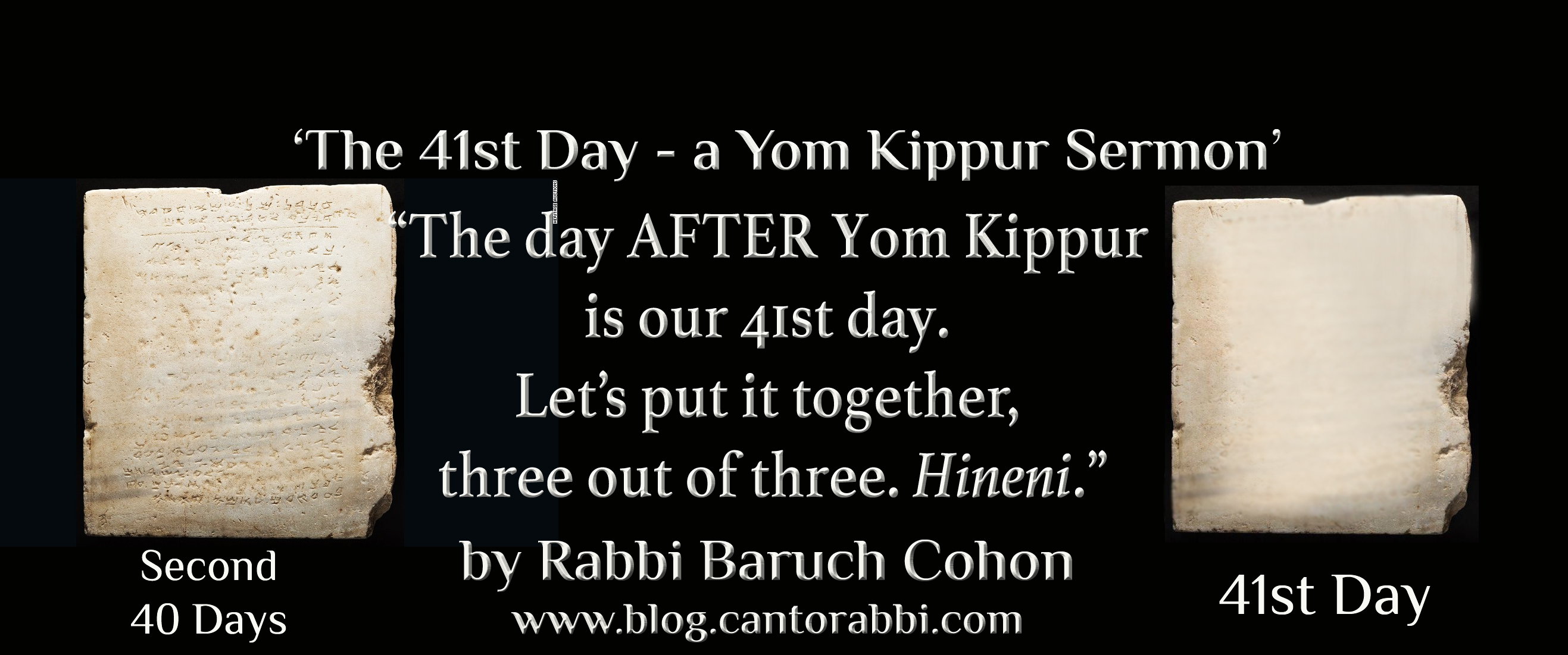
THE 41ST DAY – a Yom Kippur sermon by Rabbi Baruch Cohon

THE 41ST DAY – a Yom Kippur sermon by Rabbi Baruch Cohon

Forty days ago was the first of Elul – Elul, the month of preparation for the High Holidays. That makes tomorrow the 41st day. But wait a minute. We had just One Month to prepare ourselves for a new year. One month? Is that enough?

This year I’d like to offer an alternate view.

True, our tradition calls for the shofar to be sounded every morning from the first of Elul until Rosh HaShanah, to remind us of the coming Divine judgment. But that’s only the immediate alert – like the siren calling Israelis to the bomb shelters. From the viewpoint of biblical history, our days of preparation should last all summer. Let’s check the dates.

Shavuot, the Festival that comes seven weeks after the second Seder, commemorates receiving the Torah at Mount Sinai. It takes place on the 6th day in Sivan (this year May 31st). That was the beginning of the experience. First, our ancestors heard the thunder, saw the lightning, got the message of the Ten Commandments – and then Moses climbed the mountain. He stayed there for 40 days, came down with the two Tablets of the Law, saw the Jews dancing around the Golden Calf, and smashed the tablets. That tragic event took place on the eve of the 17th of Tamuz, and was only the first of several historic disasters associated with that date. Still observed as a fast day, the 17th of Tamuz this year coincided with July 11th. The following day, the 41st day after Shavuot, Moses offers a prayer of desperation and is invited back up the mountain.

Another 40 days pass. As Rabbi Yonason Goldson points out, this was a period of prayer. No tablets. Again Moses returns to report to the people that the Almighty accepted his prayer, and will forgive them. He returned on the last day of the month of Av (this year August 22nd).

Now Moses gets the message to carve out two new stone tablets, carry them up the mountain, and then G-d will inscribe them with the same words that were on the broken tablets. Moses does so. After a third stay of 40 days on Mount Sinai he brings down the tablets intact. Count 40 days from the first day of Elul, and you come to the 10th day in Tishri, otherwise known as Yom Kippur.

So our ancestors finally received – and accepted — the Torah, not on Shavuot but today – on Yom Kippur. And what does that signify for us?

We could sum up the answer in one word: Hineni. When summoned to duty, it is the reply of every faithful Jew from Abraham to Moses to the cantor at Musaf time, to the soldier on the West Bank: Hineni – one Hebrew word that combines three concepts, and is accordingly translated by three English words: Here I am. Here is the place. I am the one. Now is the time.

We face these challenges in our daily lives. All three of them.

Yes, we should learn Torah. We should bring our heritage into our family life. Yes, opportunities are available to do that, right here where we live. But not right now… I’m busy… maybe later after I retire.

Two out of three doesn’t make it.

Yes, we get appeals from good causes that need our help – from food banks to war relief to medical research to education to congregational programs. We see opportunities for service, and yes, we write a check. But put in some time right here? Maybe not.

Again it’s two out of three.

Other challenges face us, in the community and in the world at large. How do we use energy? Do we identify the source of merchandise before we buy? Do we take the trouble to think about those daily decisions, or do we leave them to other people? Here and now, but not me. Reminds us of some national policies: yes, al Qaeda should be stopped; yes, Hizbollah should be disarmed – by someone else…

Two out of three.

Those same three components of Hineni show up in the 120-day buildup to the New Year. Apply them to Moses at Mount Sinai:

The first 40 days encouraged the Here. Here is the place. Sinai was the place for revelation. Look what the Almighty is giving us! But the people couldn’t see the top of the mountain. They missed the Here. They were afraid Moses would not come back, so they turned to idolatry. Came the 41st day, and disaster.

The second 40 days expressed the Now. Now is the time. “This is Your people whom You freed from Egypt,” Moses prayed. “Don’t destroy them now! Forgive them, now!” And he brought back the assurance of Divine compassion in the 13 attributes of G-d, to give the people back their courage: “The Lord, the Lord is a G-d merciful and gracious, long-suffering and abundant in kindness…” This time, the 41st day brought a challenge: You want the Torah? Carve your own tablets.

Only then did the third and final preparation period begin. Human effort brought cosmic fulfillment. I am the one. Even if it means hard work. Even if it means spending Rosh HaShanah on the mountain top. Maybe Moses heard the shofar sounded in the valley below, maybe not. But on that first Yom Kippur he brought us the visible, tangible presence of our heritage.

That Yom Kippur, as every Yom Kippur, was the 40th day. Moses rose to his challenge and won his reward. Each one of us faces a similar challenge. Here is the place. Now is the time. I am the one.

The day AFTER Yom Kippur is our 41st day. Let’s put it together, three out of three. Hineni.

Ken y’hi ratzon.
Posted in Jewish Blogs | Tagged , , , , , , , , , , , , , , , , , , | Comments Off on THE 41ST DAY – a Yom Kippur sermon by Rabbi Baruch Cohon

GOODBYE and HELLO – Nitzavim/Vayeylekh – Deut. 29-31, by Rabbi Baruch Cohon

GOODBYE and HELLO – Nitzavim/Vayeylekh – Deut. 29-31, by Rabbi Baruch Cohon

Last week’s reading concluded the second of Moses’ Final Discourses and began his third and last public message to the Jewish People. Since we will read two sections this week, we will also read the end of his public orations, and his personal instructions to Joshua who will soon take his place as the people’s leader.

Often we reserve special respect for an elder’s last words. Rightly so, particularly in Moses’ case. Speaking of the Mitzvos – the Commandments that he delivered, of the rewards for following them, and the punishments for violating them that he already predicted quite graphically, he reminds his people:

“This Mitzva that I command you today, it is not too mysterious for you, nor is it far away. It is not in heaven, that you should say: Who will go up in the sky and get it for us and tell it to us so we can do it? And it is not overseas, that you should say: Who will cross the ocean and get it for us and tell it to us so we can do it? For the word is very close to you – in your own mouth and your own heart. Just do it. …

“I call Heaven and Earth to witness against you today! I set before you life and death. Choose life, so that you may live, you and your descendants. Love G-d, listen to His words and cleave to Him, for He is your life and the length of your days, to dwell on the land that G-d swore to Abraham, Isaac and Jacob to give them.”

So the land is part of the blessing. Life, the word of G-d, and the ancestral home. All go together for a nation that observes Mitzvot.

No wonder that in the very next chapter Moses charges Joshua to lead the conquest of the Promised Land with supreme courage, and he pronounces this charge in the presence of all the people.

Then he writes a Sefer Torah – not a quick job, even if the writer is not 120 years old. So maybe he wrote it earlier? But Moses himself wrote it. Now he gives it to the Cohanim to be placed in the Ark with the Tablets of the Law. Allowing 7 years for the war of conquest, he then instructs Joshua and the priests on the Mitzvah of Hak-hel – “Gather the People” – to take place at Succos time. Now we celebrate Simchas Torah that week. But Hak-hel had a different theme. What was it? A victory bash? No, the purpose of this national gathering is to read the Torah. To learn the Mitzvot. To make the Holy Land holy. This gathering is not for the elite, it is for all the people – “the men, the women, the children, and the stranger within your gates. Let them listen and learn, and revere the L-rd your G-d, to guard the words of this Torah and to activate them.”

Facing the end of his life, Moses predicts that his people will go wrong after he is gone. And he calls on his followers to write down the song that he will sing – his last song, a stirring verse of faith, that can bring them away from their error. Next week we will read it.

For now, maybe we should just recall a ditty from the early days of modern Israel:

Eretz Yisrael b’lee Torah,
hee k’guf b’lee n’shamah.
“The land of Israel without the scroll
Is like a body without a soul.”

Just as Moses charged Joshua, we may well remind our people today: Courage and faith go together.

Posted in Jewish Blogs | Tagged , , , , , , , , , | Comments Off on GOODBYE and HELLO – Nitzavim/Vayeylekh – Deut. 29-31, by Rabbi Baruch Cohon

98 WORDS TO THE WISE – Kee tavo, Deut.26-29:8 – by Rabbi Baruch Cohon

98 WORDS TO THE WISE – Kee tavo, Deut.26-29:8 – by Rabbi Baruch Cohon

This week’s Torah reading includes Moses’ Third Discourse, and the famous lists of blessings and curses – blessings earned by carrying out the Divine commandments, and curses incurred by violating them. When reading this section in traditional Sabbath services, either the rabbi or the Torah reader himself is called to recite the blessings before and after the section is read.

The reader starts chanting the words in full voice, detailing the blessings we can expect from right conduct. For example, “G-d will make you the head and not the tail. You will always be above and never below, when you listen to G-d’s commandments that I give you today.”

And then the reader drops his pitch and his volume, and launches into a list of warnings – disasters we can bring on ourselves. A hush falls on the congregation. Quiet though the reader’s voice may be, the tokhakha – the Warning – rings out. “You will be cursed in the city and cursed in the field… cursed in the fruit of your body and in the fruit of your land… G-d will cause you to be struck by your enemies. You will go out against them on one road, and flee from them by seven roads. You will become a horror to all the kingdoms of the earth… You will betroth a woman and another man will lie with her, you will build a house and you will not dwell there, plant a vineyard and not use its fruit… Your sons and daughters will be given to another people and your eyes will see, and you will ache from losing them but will have no power in your hand… You will become insane from what your eyes will see.” And on and on. Diseases brought on by perversion; defeat resulting from false pride. The last verses sum up the feeling of the sufferer: “You will not believe in your life. In the morning you will say ‘if night will only come’ and in the evening you will say ‘when will it be morning?’… G-d will return you to Egypt in ships and you will offer yourselves for sale as servants and maids and no one will buy.”

As many commentators observed, the only worse predictions possible would be to describe what really happened in Jewish history.

This is not the only list of warnings in the Torah. The first one comes in the reading called Behukotai at the end of the Book of Leviticus, in preparation for receiving the Law on Mount Sinai. Also quite dramatic, it is expressed differently. The Lubavitcher Rebbe points out that here in Deuteronomy we have twice as many warnings as in Leviticus. There we had 49. Here are 98. Why is this text double length? His answer is fascinating. He says since Behukotai is read before the holiday of Shavuot (Feast of Weeks, or Pentecost) it commemorates receiving the Torah, when the Jewish People were on the level of tzadikim, the righteous. Here in Kee Tavo we are preparing for the High Holidays when the goal is teshuvah, repentance or return. The Talmud teaches that the true returnee, the baal teshuvah, occupies a moral position higher even than the most complete tzadik. Therefore when preparing for that kind of return, we need more warnings.

As if welcoming all of us potential New Year returnees, this week’s Haftorah from chapter 60 of the prophet Isaiah starts with the great words: “Kumi ori – Rise and shine, for your light has arrived, and G-d’s glory shines on you!” So may it be this year.

Posted in Jewish Blogs | Tagged , , , , , , , , , , , , , , , , , , , , , , | Comments Off on 98 WORDS TO THE WISE – Kee tavo, Deut.26-29:8 – by Rabbi Baruch Cohon

AMMON, MOAB and US – Kee seytzey – Deut. 21:10 – 25 by Rabbi Baruch Cohon

AMMON, MOAB and US – Kee seytzey – Deut. 21:10 – 25 by Rabbi Baruch Cohon

Among the 70-odd Mitzvos detailed in this week’s Torah reading, we find one that echoes strangely against today’s discussions of intergroup relations.

Deep in this section’s third Aliyah, Chapter 23 has Moses cautioning the people: “No Ammonite or Moabite shall enter the assembly of G-d, even to the tenth generation.” Why? “Because they did not meet you with bread and water when you came out of Egypt.” No refugee status. No public handouts. In fact, they “hired Bilaam ben Beor…to bring a curse upon you.”

True, Ammon and Moab did not build any walls to keep Israel out, but they did not welcome us either. We didn’t speak their language. Maybe our eyes were a different shape? Or our skin a different shade?

By the standards of that day, Ammon and Moab had well established monarchies, and represented prosperous nations. They did not need an influx of ex-slaves, speaking a foreign language (Hebrew, that is, not Spanish).

Presumably they didn’t want immigrant kids in their schools earning all the highest grades, even if they didn’t calculate in Chinese.

Could we in our time possibly be duplicating the ancient offense of Ammon and Moab?

Or were they just typical of their time, treating any other nation as an enemy?

But wait. In our Torah reading, a contrasting rule follows immediately: “Do not despise an Edomite; he is your brother.” Edom opposed Israel, but the ancestor of their nation was Esau, Jacob’s brother. Likewise, “Do not despise an Egyptian; you were a stranger in his land.” As the rabbis explain, enslaving the Israelites was the work of the tyrannous Pharaohs, not of the people. In fact many Egyptian commoners followed their Israelite neighbors in the Exodus.

So for our ancestors, relations between national populations grew complicated. Moses attempted to put some ideals to work in forming those relations. It was difficult for him, and that difficulty extended into the following centuries.

In the case of Ammon and Moab, for example, the ban applied to men, but a woman could become a giyores – a convert – and be totally accepted. The prime example of that process was the young lady who gave her name to a particularly beloved book of the Bible, namely Ruth. Moabite though she was, she married Boaz and became the ancestress of no less than King David.

Maybe we in the United States are not consistent in our attitude toward the “stranger,” the refugee, the unfortunates who seek a better life. We don’t always meet them with “bread and water.”

Still, our country has a better record on immigration than many other nations. Certainly a large majority of us became American Jews by moving here from oppressive foreign shores. Many of us, or our parents or grandparents, had to travel halfway around the world, with no money, no connections, no language to greet their new countrymen. I will never cease admiring the courage of our Immigrant Generation. Much of that kind of courage can be seen in the faces of the young people who throng U.S. borders now.

No, we are not encouraging our government to admit criminals, and definitely not terrorists. But we have some power to check an immigrant’s record. And we can still move away from the offensive stance of Ammon and Moab. Even some bread and water can help.

Posted in Jewish Blogs | Tagged , , , , , , , , , , , , , , , , , , , , , , , , , | Comments Off on AMMON, MOAB and US – Kee seytzey – Deut. 21:10 – 25 by Rabbi Baruch Cohon

HOW SACRED IS HUMAN LIFE? – Shoftim, Deut. 16:18 – 21:9 by Rabbi Baruch Cohon

HOW SACRED IS HUMAN LIFE? – Shoftim, Deut. 16:18 – 21:9
by Rabbi Baruch Cohon

Appropriately named Shoftim – Judges, this week’s reading deals with principles and practices Moses teaches us about what is justice and how to enforce it.

One theme that gets repeated in this section says: “Expunge the evil from your midst.—uviarta haRa mi-kir-bekha.” That is not just the theme of his teaching, it is the motivation behind all of it. If someone is convicted of a capital offence – including murder, rape, leading others into idolatry, or presenting false evidence to get someone else punished – and the offender is found guilty, then that offender, whether male or female, must be executed. Why?

Doesn’t every human being contain the Divine image? How does a violent death cancel out an offense, even if that offense was equally violent?

True, killing the criminal makes him unable to repeat his crime. But that’s not enough. Not for Moses, and not for Judaism.

If Hatfield kills McCoy, and McCoy Jr. kills Hatfield in return, that’s not justice. That’s revenge. And Torah law went into considerable detail in the last couple of weeks to limit the power of revenge. In Moses’ time, the accepted practice was for the next-of-kin to have the right and the duty to hunt down his kinsman’s killer and take his life. Revenge killing. But Torah law limited that right to very specific circumstances. Above all, it limits the valid motivation for the return killing. Not revenge, now. But “Expunging the evil.”

Take the case of a criminal who plotted to get his neighbor in trouble.

“As he plotted to have done to his brother, so let it be done to him,” says Moses.

“On the word of two witnesses or three witnesses shall the condemned be executed. He shall not die on the word of one witness.”

“And all the people shall see, and they will not presume [to violate] again.”

Never mind the fact that we all have sacred souls. By our own violations, and by credible eye-witness testimony of our fellows, we can desecrate those souls, and bring on the violent punishments described in this reading. Not because society is taking revenge on us, but in order to expunge the evil.

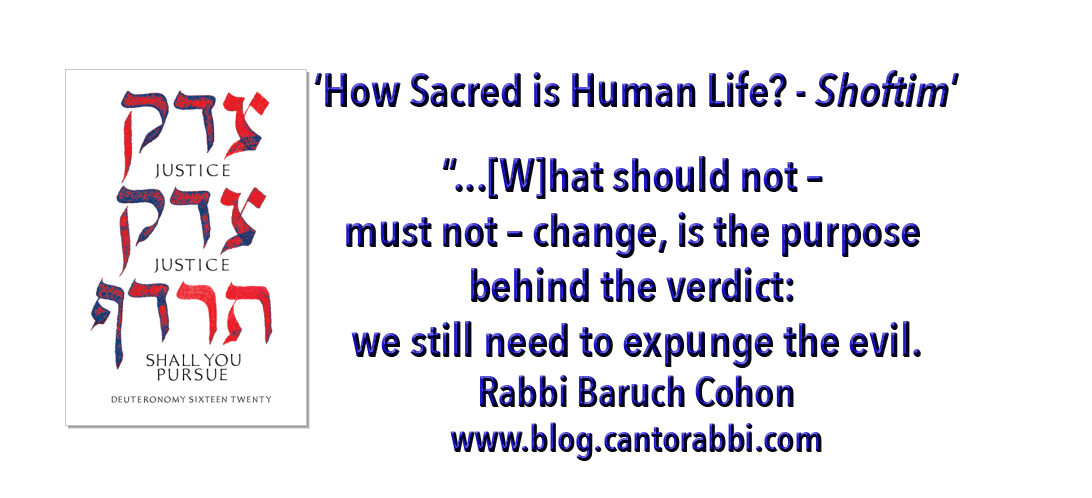
Execution methods in many parts of the world have become much milder than they were in Torah times. No longer do they consist of just stoning, burning, beheading or hanging. And long years on death row were certainly unknown to Moses. But what should not – must not – change, is the purpose behind the verdict: we still need to expunge the evil.

Evil is there. It is our job – all of us – to get rid of it.

Posted in Jewish Blogs | Tagged , , , , , , , , , , , , , | Comments Off on HOW SACRED IS HUMAN LIFE? – Shoftim, Deut. 16:18 – 21:9 by Rabbi Baruch Cohon