HOW MUCH TO SACRIFICE – Vayikra – Leviticus 1-5, by Rabbi Baruch Cohon

HOW MUCH TO SACRIFICE – Vayikra – Leviticus 1-5, by Rabbi Baruch Cohon

The Book of Leviticus – called in Hebrew “Vayikra” – begins with the call to Moses, written with a small letter “aleph” at the end of the first word. Various commentators ancient and modern go through some literary contortions to explain that little “aleph,” but let’s not get into that right now.

Bigger fish to fry. Or rather, bigger animals, birds, fine flour – bigger sacrifices. Kind of hard to relate to the procedure of animal sacrifice as the expression of religion, these days, but let’s try. Starting here, Leviticus spells out all the rules for bringing and offering different animal sacrifices, as was done in the Tabernacle in the desert, and later in the Temple in Jerusalem. Sacrifices celebrated holidays. They also expressed guilt.

Most of this middle book of the Torah describes and proscribes the sacrificial cult. Why should we continue reading these details every year? For nearly 2,000 years, since the destruction of the Temple, we have not offered animal sacrifices. The rabbis decreed “t’filah bimkom korban – prayer replaces sacrifice.” But we still review the process in our Torah reading. Let’s see what we can learn from it.

If the anointed kohen – the officiating son or descendant of Aaron – committed a violation (and the text names a few, from becoming ritually contaminated to misappropriating a dedicated object) he had to bring a young bull. If a tribal chief – a nasi, a “prince” – was the violator, he had to bring a sheep. An ordinary Israelite brought a goat. And that only if he could afford it. The Torah specifically provides a way to pay for a mistake without taking food from the family’s mouths. “If he cannot afford (literally if his hand does not reach the value of) a sheep, he brings two doves or two pigeons, one for a sin offering and one for a burnt offering.” Further, if birds are out of his “reach,” let him bring an offering of fine flour.

Clearly, the value of the sacrifice is not the vital factor. It is the action. Once you acknowledge your mistake, you express your regret through a sacrifice. That’s how they did it in the time of Moses and for many following generations. This kind of payment for violating a negative commandment applied to business dealings as well as to relations with the Divine. If an Israelite cheated his neighbor by denying an obligation – “a deposit? What deposit?” – or by not returning a pledge (security for a loan) or by finding something his neighbor lost and not returning it, or by theft, or by not paying wages and then lying about it – he must return what he had no right to keep, and must add a fifth of its value as a penalty. Then he must still bring his guilt sacrifice. Only then can the kohen help him to atone for his violation. Only then will he be forgiven.

In later days, as prayer replaced sacrifice, each Jew had to take on more responsibility. We can’t pay for our mistakes with pigeons any more. But we can still return a lost article. We can still acknowledge our debts and pay them. And we can still atone – not just once a year on Yom Kippur but every day in our prayers. And in our attitude.

That is our sacrifice. Admit we did wrong, and do what we can to correct it. How about it? Would it be easier to slaughter a goat?

Posted in Jewish Blogs | Tagged , , , , , , , , , , , , , , , | Comments Off on HOW MUCH TO SACRIFICE – Vayikra – Leviticus 1-5, by Rabbi Baruch Cohon

FREEDOM MONTH – Shabat Hakhodesh – Ex.12:1-20, by Rabbi Baruch Cohon

FREEDOM MONTH – Shabat Hakhodesh – Ex.12:1-20, by Rabbi Baruch Cohon

Do you start naming the months of the year with July? Maybe you should. After all, July is the month of American freedom. We don’t change years in July, but the Founding Fathers changed a nation in that month.

Jewish custom, as every Hebrew school student knows, is to recite the months of the year as follows: Nisan, Iyar, Sivan, Tamuz, Av, Elul, Tishri, Kheshvan, Kislev, Teveth, Shvat, Adar. Since we start in Tishri, the month of Rosh Hashana when we change years, Nisan would be the seventh month. Just like July on the English calendar. And why not? Considered this way, each of them can qualify as the Month of Freedom.

Indeed, this week as we welcome the month of Nisan, we will read a special Maftir – a supplementary Torah section from a second scroll, in the book of Exodus – describing the preparations for the original Exodus when our ancestors left Egypt and became a free nation. “This month for you is the head of the months,” says the Torah. “First of the months of the year is it for you.”

How were we commanded to observe it? No dances, no New Years Eve parties, just take a lamb for a special dinner. One lamb per household. And not on Rosh Hodesh, but on the 10th of the month, giving us another four days to prepare. On the night of the 14th, slaughter the lamb at twilight, smear some of its blood on the doorpost, and roast the lamb on an open fire to eat with Matzos and bitter herbs. Hardly an exciting event.

Further details limit the celebration still more. The lamb must be consumed that night, so the family must gauge each member’s appetite, and anticipate how much of that lamb they need. Because if they can’t reasonably expect to finish it, they must split it with another household. Any leftovers are to be burned in the morning.

No fancy clothes, either. “Your waist should be belted, your shoes on your feet and your staff in your hand.” Ready to travel, to a distant unknown land.

That was the original Seder. Not much like today’s family party. We don’t even eat lamb, in fact we stopped doing that when the Temple was destroyed and the Paschal sacrifice had to be discontinued. Not yet an occasion to express the pride and joy of a fulfilled heritage, the original Seder was a night to get ready for the fateful fight for freedom. Think about it. Was the spirit so different on the original Fourth of July?

Soldiers of the Revolutionary War certainly had to tighten their belts, keep their shoes on, and shoulder their guns. Declaring independence was only the beginning, and they knew it.

Since the days of Moses, we saw some 30 centuries combine to build desperate Hebrew slaves into a learned and accomplished nation. Just so, since the days of George Washington, a mere 24 decades built brave – and fearful – Revolutionary warriors into a proud world power. Just as we need to champion our people in Israel to build their power nationally, and scientifically and religiously and economically – so we here in the United States must remember to rebuild American power, and to rally around the ideals and the freedoms of the country we call home.

We have some inspiring parallels in Jewish and American history, and we should consider Freedom Month among them. We don’t need to make it numerically the first month of the year, but #7 rates a special place in our lives.

Posted in Jewish Blogs | Tagged , , , , , , , , , , , , , , | Comments Off on FREEDOM MONTH – Shabat Hakhodesh – Ex.12:1-20, by Rabbi Baruch Cohon

CALL HIM INDISPENSABLE – “Vayak-hel Pikudey” – Ex. 35-40 – by Rabbi Baruch Cohon

CALL HIM INDISPENSABLE – “Vayak-hel Pikudey” – Ex. 35-40 – by Rabbi Baruch Cohon

Constructing the first Jewish house of worship called for special attention, special materials and special skills. Also, special design. Remember, this has to a portable sanctuary, carried on the priests’ shoulders all the way to the Promised Land. This week, we will read first an impressive list of the materials, all to be brought as freewill offerings – gold, silver, brass; blue, purple and scarlet dyes; lambskins and goat’s hair and specific precious stones; oil for the lamps and spices for the incense. Here come the skilled workers volunteering their labor to take these materials and create everything from the Ark and its cover to the pillars and sockets and screens for the exterior. Goldsmiths and silversmiths go to work alongside the ancient carpenters and masons. Women spin the wool and linen, and the specialists among them spin the goat’s hair. Tailors and seamstresses sew the priestly clothing. Who did all this? “Every man and woman whose heart made them willing to [do] all the work.” Truly an outpouring of popular devotion.

But there still was no Tabernacle. Not until one man enters. His name is Betzalel. We first met him back in chapter 31, where he is described as someone Divinely favored with khokhma, binah, v’daas – wisdom, understanding and knowledge. These are the same three qualities we seek daily in our prayers, and their initials spell Chabad, the name of the well-known worldwide Chassidic movement. Yet Betzalel does not function as a religious leader. He has the talent to “think thoughts” – not philosophy, but construction. He understands all about woodworking, metalworking and weaving. And it will be his job to put them all together. No wonder that Jewish galleries in many places now bear his name.

Both Betzalel and his helper, one Oholiab, are also gifted with the ability to teach all those skilled workers what to do. And so in the concluding chapters of Exodus we find Betzalel in charge. He was the indispensable man.  He builds it – not one detail, but all the parts of the Tabernacle – getting credit for everything constructed by the entire crew.

Today we’d call him an architect. A super-architect. He designed the Tabernacle by Divine inspiration, and he supervised its construction through his own knowledge.

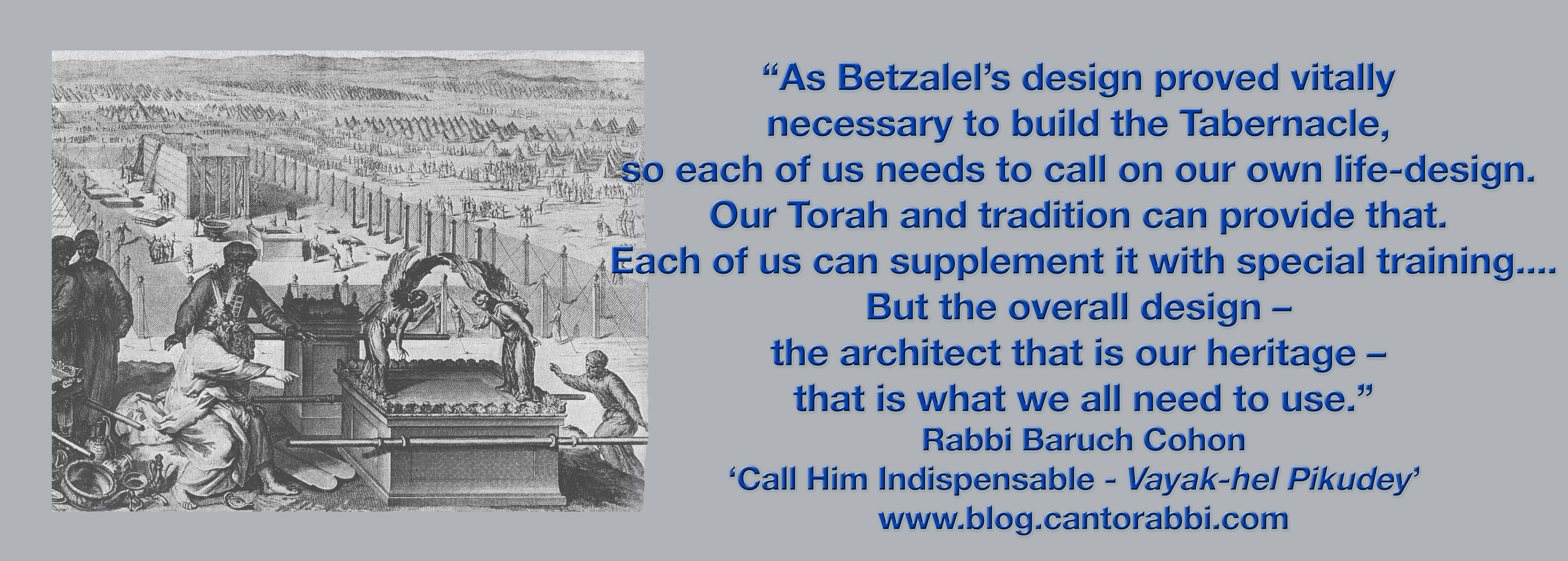
As Betzalel’s design proved vitally necessary to build the Tabernacle, so each of us needs to call on our own life-design. Our Torah and tradition can provide that. Each of us can supplement it with special training – classes, parental example, personal experience. But the overall design – the architect that is our heritage – that is what we all need to use.

Like Betzalel, call it indispensable.

Posted in Jewish Blogs | Tagged , , , , , , , , , , , , , , , , , , , , , , , | Comments Off on CALL HIM INDISPENSABLE – “Vayak-hel Pikudey” – Ex. 35-40 – by Rabbi Baruch Cohon

BREAKING THE TABLETS – Kee tisa, Ex. 30:11-34:35, by Rabbi Baruch Cohon

BREAKING THE TABLETS – Kee tisa, Ex. 30:11-34:35, by Rabbi Baruch Cohon

This week we will encounter some of the Torah’s more challenging passages. Our reading opens with a unique process of registering for the draft – as each man age 20 or over hands in a half shekel, which is then counted, thus technically avoiding counting human beings.

Then come commandments about building the Tabernacle, and stressing the importance of Sabbath observance even though it interrupts work on this sacred project.

Next, Moses ascends the mountain to receive the Tablets of the Law, engraved by the Divine process which makes them legible from both sides – a miracle in itself, as witness letters like the final mem where the engraving is closed on all sides, yet the middle did not fall out! Heavy as those stone tablets must have been, Moses was able to carry them both.

Weary of waiting forty days for their leader to return, the people now pressure Aaron to make the Golden Calf. This first religious rebellion by the Israelites precipitates some violent results. Moses and Joshua are on their way down the mountain to bring the Tablets back to camp, when they see their people dancing around an idol – that aigel hazahav, the Golden Calf. Shocked and scandalized, Moses reacts by breaking the tablets.

Breaking the tablets??? After spending 40 days on the mountain top communicating directly with G-d? Moses, what are you doing? Aren’t those dancing Israelites the ones you did all this for? Don’t they obviously need the tablets to bring them to the true faith?

This surprising action called for explanation, and the Midrash provides it. Moses did not break the tablets on purpose, we are told. In fact he was able to carry them only because the Heavenly inscriptions supported them. In effect, the commandments were carrying the tablets. They floated. Moses only provided the direction. When faced with the sight of Israel’s idolatry, the letters flew off! Moses could no longer hold the huge rocks, which fell down the mountain and broke.

How many leaders face shocks that threaten them as the Golden Calf threatened Moses? From ancient times until today, an impatient public will dump long-term goals to grab some cheap pleasure. And we need not analyze Aaron’s role here; apparently his agonized brother credited him with merely buying time. Underlying the whole story we find a general failure of faith. Just a few weeks ago we were reading about the supernatural experience of an entire national group receiving its Divine message of identity at Mount Sinai. And here they are, ready to abandon that identity, to forget that message, to give up the destiny that Moses represents, to eat and drink and dance around a four-legged idol. In fact, they are celebrating their own rejection of their leader’s message.

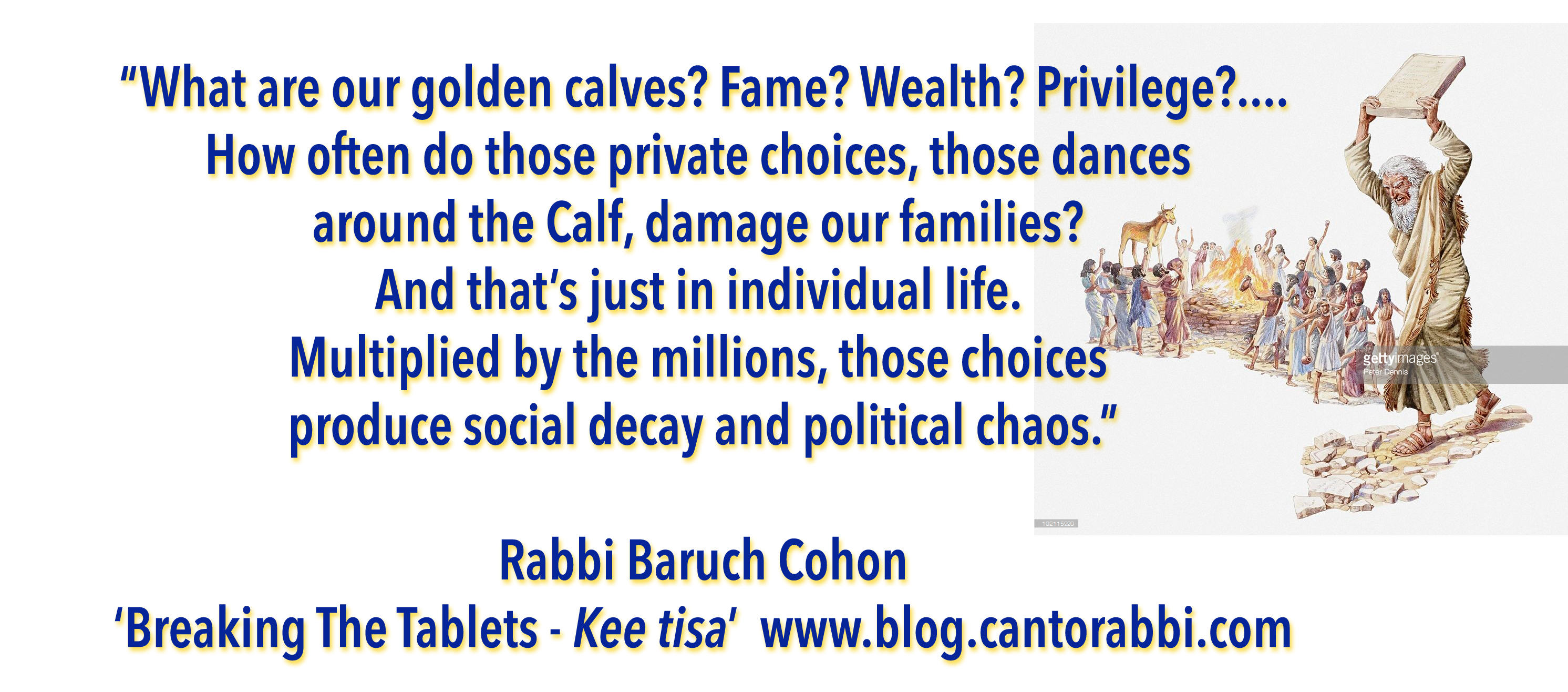
What are our golden calves? Fame? Wealth? Privilege? Facing the choice between loyalty and live-it-up, how often do we go the wrong way? How often do those private choices, those dances around the Calf, damage our families? And that’s just in individual life. Multiplied by the millions, those choices produce social decay and political chaos.

Take one current example. Peace is a great goal, but it takes two serious opponents to make peace. Serious, and honest. When one side truly offers peace, and the other side responds with lies, international committees dance around the golden calf to celebrate a false treaty, and disaster can result.

This week and every week, the Golden Calf is there. If we aim for a bright future, let’s ignore that idol.

Posted in Jewish Blogs | Tagged , , , , , , , , , , , , , , , , , , | Comments Off on BREAKING THE TABLETS – Kee tisa, Ex. 30:11-34:35, by Rabbi Baruch Cohon

AMALEK and KHAMENEI – a pre-Purim Blog by Rabbi Baruch Cohon

AMALEK and KHAMENEI – a pre-Purim Blog by Rabbi Baruch Cohon

Before we take that first Purim drink, let’s read the Torah. What passage do we read on the Sabbath before Purim? Zakhor – “Remember what Amalek did to you!” Indeed this Sabbath is called Shabat Zakhor – the Sabbath of memory. And just one day later, on Purim morning we will read Vayavo Amalek – the story of the battle our ancestors fought in the desert on the way out of Egypt, a battle against a hateful and cowardly enemy tribe called Amalek. Time and again they attacked from the rear, killing the stragglers, the weakest of the trekking Israelites. Finally at a place called Rephidim they got punished. Of course they did not quit harassing Israel. After our ancestors settled in the Land and Saul became king, there was more warfare with Amalek.

So what does all this have to do with Purim? The battles with Amalek predated the Purim story by a few centuries. But the connection is there. Haman, the Purim villain, is identified in the Book of Esther as the son of Hamdassa the Agagite. Agag was the king of Amalek, the defeated chieftain whom the prophet Samuel kills in the special Haftorah for Shabat Zakhor. So the rabbis logically taught that Haman was descended from Amalek.

Indeed he was. Likewise Amalek’s spiritual descendants. Titus, Torquemada, Chmelnitzky, Hitler, Arafat – to name just a few. Destroying Israel was Amalek’s goal, a goal not limited to one locality or one kind of weapon. Haman brought it to Persia. And built a 75-foot gallows to hang Mordechai.

Now Amalek returns to Persia. His current descendants don’t use gallows – or crucifixes or gas chambers or UN committees. They plan to use atom bombs.

Esther’s Megillah tells the story of Haman’s threat and Esther’s courage as she champions the Jews before an unpredictable head of state. Could she help her people now? Recently Bibi Netanyahu met with the new president of the United States, and it was a much friendlier meeting than he had in Washington for many years. And our current ambassador to the United Nations expressed a strongly pro-Israel policy that we certainly haven’t heard lately. Could Nikki Haley be a new Queen Esther?

Check the Megillah. Even after condemning Haman to die on the gallows he built, Ahasuerus refuses to cancel his edict setting a date for mass murder of Jews. What he does, however, is arm the Jews and give them a chance to defend themselves. This they do with great success, once again defeating Amalek. Essentially, isn’t that what Bibi seeks?

Once again, Amalek returns. And once again our people is in serious danger. But we will survive. No enemy can finally prevail. We believe in miracles. And we celebrate those miracles. As the Talmud teaches, “When the month of Adar enters, we increase joy!” Purim coming on the 14th of Adar, that gives us 2 weeks to get in the spirit! In fact, the same Talmud tractate, Megillah, tells us to drink enough shnaps on Purim till we can’t tell the difference between Arur Haman – “cursed is Haman” – and Baruch Mordechai – “blessed is Mordechai.” And the Hebrew words for not knowing [the difference] became the name of Israel’s festive annual Purim parade, Ad-d’lo-yada.

We might well observe that in the Purim story itself Mordechai assures Esther that if she fails to convince the king to defeat Haman, “release and rescue will arise for the Jews from another place, and you and your father’s house will be wiped out.” Whether Mordechai was drinking or not, he knew the difference.

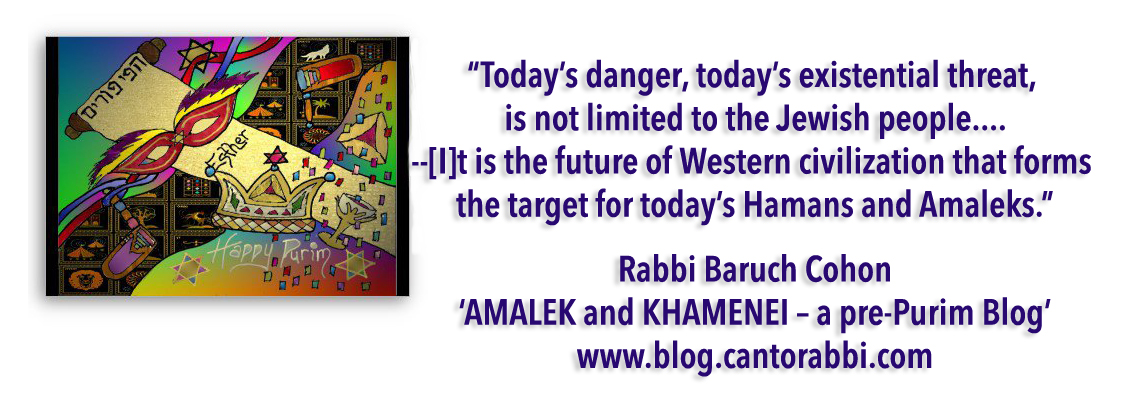
Today’s danger, today’s existential threat, is not limited to the Jewish people. Telephone calls and emails to Jewish Community Centers in the U.S. notwithstanding; individual attacks on kippah-wearing Paris Jews notwithstanding; demonstrations and lectures spewing Jew-hatred on college campuses notwithstanding – it is the future of Western civilization that forms the target for today’s Hamans and Amaleks. Let’s face facts. Khamenei and/or ISIS will attack both Israel and America if given a chance. Trial attacks already took place. And “release and rescue” can arise from the very places that once held our mortal enemies – places like the Church, and Russia, and America First. Thank G-d we have some friends now.

More than ever, we should celebrate this Purim. Drown out Haman’s name with those groggers. And make sure you only drown out Haman – certainly not Mordechai. Nor Esther. Nor even Ahasuerus. How can we time those groggers right? Gotta know the difference. I hope we do.

So drown your worries with another L’hayyim – could be non-alcoholic if you prefer! And let our comedic Purim performances show Amalek that nobody can destroy our sense of humor. That is definitely a Purim miracle.

As the old song goes, Haynt is Purim, brider, es is a yomtov grois! Today is Purim, brothers, a great big holiday! Enjoy it.

Posted in Jewish Blogs | Tagged , , , , , , , , , , , , , , , , , , , , , , , , | Comments Off on AMALEK and KHAMENEI – a pre-Purim Blog by Rabbi Baruch Cohon