MIRIAM STARTED IT – B’haalot’kha – Num. 12—by Rabbi Baruch Cohon


MIRIAM STARTED IT – B’haalot’kha – Num. 12—by Rabbi Baruch Cohon

First it was Miriam, then Aaron who spoke against their brother Moses, as the Torah tells us, “because of the Cushite wife he took.” And so opens a singular story of family friction, dismal punishment and recovery.

The word “Cushite” challenges the commentators. “Cush” is the Hebrew name of Ethiopia. Was this a new wife? A new black wife? Was Miriam racially prejudiced? No, says Ibn Ezra. In all his 120 years Moses only took one wife, namely Zipporah, daughter of Jethro the priest of Midian. And Ethiopia is many miles from Midian. The Midianites are not Africans. But they are tent-dwellers in a hot country, and ”have no whiteness at all” but are tanned very dark. So what does Cushite mean? Both Rashi and the Midrash insist that Cushite refers to Zipporah’s beauty. One proof cited is from gimatria – which does not mean Geometry, you know, it means Numerology. Every Hebrew letter is also a number, and the sum total of the letter-numbers in cusheet = 736, identical to the sum total of the letters in the words y’fat mareh – “beautiful appearance.”

Another proof states that everyone acknowledged Zipporah’s beauty just as they acknowledge that an Ethiopian is black. It was obvious. Not only did she have good looks; she also behaved beautifully. So what is Miriam’s beef?

Rashi says Miriam objected, not to Moses’ marrying Zipporah but to his sending her away. Just a few sentences earlier we read about two men named Eldad and Meydad “prophesying in the camp.” When this report came out, Miriam was with her sister-in-law, and heard Zipporah say: “Alas for the wives of these men. If they are moved to prophecy, they will separate from their wives the way my husband separated from me.”

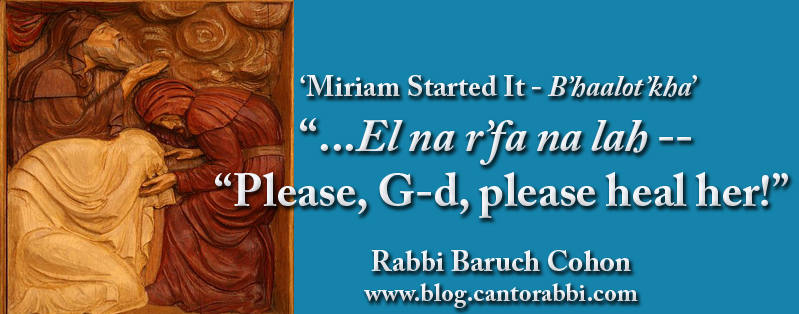
Judging from this insight, Moses and his marriage experienced the familiar pattern of a man’s calling, his work, damaging or even destroying his family life. And Miriam’s action qualifies her as an ancient feminist. Indeed we have no record of Miriam herself ever marrying or raising a family. Among righteous women in the Torah, she is unique. Her devotion to her birth-family is total. She guards the basket where her baby brother floats in the Nile. She convinces the Egyptian princess to let her take him to a Hebrew wetnurse – their mother. Later she is described as a prophetess at the Red Sea, leading the women in sacred song and dance. In her merit a well is said to accompany the Israelites on their desert trek. And now, when Miriam badmouths her brother Moses, she is struck with leprosy! A leper in Hebrew is m’tzora – which the rabbis parse as an abbreviation for motzi shem ra – “bringing out a bad name”, in other words slander. In Miriam’s case the punishment is physical and requires her to stay outside the camp for a week. It is brother Aaron who appeals to the leader Moses, who in his deep humility offers the most compact prayer – just five short words – for her recovery: El na r’fa na lah — “Please, G-d, please heal her!” And in respect for Miriam, the camp does not move until she is healed and returns.

No wonder that the strength and talent and devotion that characterized Miriam made hers a favorite name that Jews give their daughters all through history. She’s not one of our matriarchs. But she is a rare and valuable human being. Even when she is critical of her brother Moses, all Israel can consider ourselves blessed to have Miriam with us.
Posted in Jewish Blogs | Tagged , , , , , , , , , , , , , , , , , , , | Comments Off on MIRIAM STARTED IT – B’haalot’kha – Num. 12—by Rabbi Baruch Cohon

BLESSINGS AND MUSIC – Naso – Num.4:21–7 – by Rabbi Baruch Cohon

BLESSINGS AND MUSIC – Naso – Num.4:21–7 – by Rabbi Baruch Cohon

Of all the topics discussed in this week’s reading, one that comes near the end is easily the most familiar, and perhaps most important for our generation. It is identified as the Priestly Benediction, pronounced by Aaron’s sons in the ancient Temple, and by their descendants in traditional synagogues ever since. In many liberal congregations, the rabbi replaces the cohanim for the blessing.

It consists of 3 brief Hebrew sentences. The first one, just 3 words long, vouchsafes physical safety. “May G-d bless you and guard you.” The second one, in 5 words, asks for spiritual awareness: “May G-d’s presence shine on you and be favorable.” And the third one’s 7 words promise peace: “May G-d’s presence enter your life and bring you peace.” That wonderful line asks for much more than the absence of armed conflict. It is addressed to each individual. It asks for peace of mind, and peace of spirit.

The Priestly Benediction, whether pronounced by descendants of Aaron or by clergymen, calls for an accepting answer from those being blessed. And in synagogue practice it also includes music.

Rockdale Avenue Temple in Cincinnati was a model of Classical Reform as I remember it in the ‘30’s. Among the minimal uses of Hebrew in its festival services came the Priestly Benediction, recited by the rabbi in stentorian tones (remember this was before the days of most microphones.) After he said the first line, we heard the four church singers in the choir loft in perfect harmony: “The Lord bless thee and keep thee.” Each line got a corresponding answer. Three lines. Three angelic-sounding musical responses delivered in a classical major cadence. A spell was cast.

At the other pole of observance, at the Chabad synagogue where, along with other cohanim, I took part in the blessing this Shavuot morning, the prayer leader gave us a melody to introduce each word, excepting only the Divine Name. Two trademark Chabad melodies alternate, and the cohanim all have to know what phrases to repeat. At the end of each line, some 150 voices chant “Amen” – in some 150 keys—with spirit. When we conclude the blessing, congregants shake our hands to show their appreciation.

Between these two poles we find musical expressions ranging from medium to minimal to missing. Many synagogues have the cohanim sing a melody just before the last word of each line. Others have the cohanim do a plain repetition of the cantor’s chant on each word, and the congregation responds with the words Ken y’hee ratzon – “May it be G-d’s will.” All traditional synagogues, and any liberal ones who follow the custom, have the cohanim repeat each word that the cantor chants, symbolizing the idea that they are not the source of the blessing. They are the conduit. Musically, physically and conceptually, we ask Divine blessing on each other. And by our positive answer we express the confidence that we will succeed.

The process of cohanim blessing the congregation is called dukhenen. Experience it, next High Holidays and Succoth, whether you are a cohen and can relay the blessing or a congregant who can receive it. And join in singing the response. Hear the music. Feel the echo.

Posted in Jewish Blogs | Tagged , , , , , , , , , , , , , , , | Comments Off on BLESSINGS AND MUSIC – Naso – Num.4:21–7 – by Rabbi Baruch Cohon

RISE AND RECEIVE – Shavuot 1st day– by Rabbi Baruch Cohon

RISE AND RECEIVE – Shavuot 1st day– by Rabbi Baruch Cohon

Of all our annual holidays, this week’s festival of Shavuot is by far the one most often ignored. No family gatherings like the Passover Seder, no L’chaim parties like Purim, no gift exchanges like Hanukkah, no solemn fasting like Yom Kippur. Why celebrate it at all? Just because the Torah says so?

For all who question tradition, a legitimate answer is called for. Yes, the Torah says so, in fact equating Shavuot with Passover and Succot as one of the 3 annual pilgrim festivals, timed to the agricultural seasons, that brought our ancestors regularly to the Temple in Jerusalem. But another historical event, even stronger, identifies Shavuot as supremely important. That event pre-dates the Temple, even pre-dates entering the Promised Land. It is the Revelation at Mount Sinai.

There we were, a couple million of us, ex-slaves, seven weeks out of Egypt, camped at the foot of a medium size mountain. The man who led us across the Red Sea climbed that mountain, while we waited below. Three days we waited, and we prepared. We washed our clothes. We deprived ourselves of marital relations. We even stayed outside the boundary of the mountain itself, as Moses warned us to be careful not to touch that mountain. For this event, it would be sanctified to G-d. On the third day we heard thunder, we saw lightning, smoke and fire from the top of the mountain – and the mighty blast of a great shofar.

And then on the fourth day, Moses and Aaron climbed the mountain alone. In great awe, the rest of us stayed below. And we heard a voice – a super human voice that no nation ever heard before. Or since that day. We heard the Ten Commandments, spoken aloud, directly from their Divine Source. That fourth day at Mount Sinai is the day on our calendar as the First Day of Shavuot.

Only this once does our Torah describe such an event. It even tells us that the people were afraid of the Voice of G-d, so they asked Moses to go into the sacred smoke and bring them the Covenant, lest they succumb to the danger of direct Divine contact. Commentators vary in their descriptions of the event. Some insist that the entire nation heard all the Ten Statements – aseret ha-dibrot. Others maintain that Moses relayed them from #3 on. Either way, the People of Israel stood at attention and accepted their responsibility. Today, in synagogues throughout the world, once again Jews stand and listen to the Big Ten – frequently called Commandments, but literally the Ten Statements – rather an introduction to our duties as responsible human beings.

What does that responsibility include? Remember, Rabbinic tradition expands that responsibility to include all the Mitzvos – 613 total. That total number underwent changes in history, such as the necessary elimination of all the sacrificial duties after the Temple was destroyed. But the principles enunciated at Sinai remain.

This Shavuot, and next Shavuot, and every day, can we live by our famous Big Ten? If we do, we’ll be in good company, both among our fellow Jews and among people whose ancestors never stood at Sinai. How does that work?

Very simply. Those first two Statements – the ones they all heard directly, even according to all the commentators – establish Divine Authority, and rule out idolatry. The other 8 give us basic definitions of right and wrong. Contrary to the prejudices of whoever agitates to remove them from our public buildings, these Statements do not discuss religious ceremonies at all. What do they say?

Never swear falsely. “Taking the name of G-d in vain” means just that. Whether or not you place your hand on a Bible when you take an oath, that oath should be honest.

Take a day of rest once a week – for yourself and for those who depend on you.

Honor your parents. Hopefully they will deserve your respect and honor. Give them the benefit of the doubt anyway.

Do not commit murder. Remember always: lo tirtzakh does Not mean “thou shalt not kill.” Bitter as it may be, the truth is that killing is not always wrong. Witness self-defense, legal execution, and war.

Do not commit adultery. Worth considering in these days of destruction of the family.

Do not steal. Any questions there?

Do not bear false witness. Sometimes it’s called “framing” someone. Dishonesty in every form is wrong.

Do not covet. We cannot help admiring what our neighbor may have but admiring stops short of plotting how to take it away from him.

This Shavuot and every Shavuot, let’s stand to hear these principles repeated, and let’s accept them in our lives. Like our ancestors at Sinai. we should rise, and receive the Torah, as symbolized by the Ten Statements. It sets principles for all humanity. It is our Jewish Constitution.

Posted in Jewish Blogs | Tagged , , , , , , , , , , , , , | Comments Off on RISE AND RECEIVE – Shavuot 1st day– by Rabbi Baruch Cohon

LEADERS THEN AND NOW – Bamidbar – Numbers 1:1-4:20, by Rabbi Baruch Cohon

LEADERS THEN AND NOW – Bamidbar – Numbers 1:1-4:20, by Rabbi Baruch Cohon

Along with the details of the military census, the duties of the tribe of Levi, and the protective coverings for transporting the Tabernacle and its furnishings, this week’s Torah reading gives us the layout of the Israelite camp in the desert. Facing decades in that harsh location, we begin this phase of our history with the Sedrah – and the entire book – named for it: Bamidbar, “In the desert.”

This is where those refugee slaves became a nation. This is where their chiefs had to become leaders. Not an easy process.

One significant part of that process is reflected in the layout of the camp. Central in every camp was placed the Tabernacle. Members of the tribe of Levi – not counted in the military census – maintained the portable sanctuary, so they had to pitch their tents closest to it on all four sides. One Levitic family is assigned to each side. Merari on the north, Kehos on the south, Gershon on the west, and on the east the families of Moses and Aaron – adjoining the Tabernacle’s entrance. We note the importance of the eastward direction. Keydma mizrakha — “forward, eastward” – says the Torah. Both for Aaron and his sons as kohanim and for his brother Moses as head of state, this location positions them to lead, whether to break camp and move on, or to find a stopping place however temporary.

Another camping assignment illustrates military and political leadership then and later. Of the 12 tribes, 3 are assigned to camp side by side, on each side of the Tabernacle, just outside of the Levitic camps. Each tribe counts its military members, and those numbers are mentioned here. On the north we have the tribes of Dan, Asher and Naftali. Their total number of fighting men: 157,600. On the south are Reuven, Shimon and Gad, with a total of 151,450. On the west are Ephraim, Menashe and Benjamin, whose total is 108,100. And on the east, parallel to the Tabernacle entrance, the tribes of Judah, Issachar and Zebulon, with a total of 186,400 soldiers. Of course these totals add up to 603,550, the number of fighting men Moses already recorded twice – once when they left Egypt, and the second time at the beginning of this Sedrah.

As an interesting sidelight on these numbers, we might notice that the largest number of potential soldiers is camped on the east – prepared to support the national and religious leadership of the people as they head the march through the desert.

Of the tribes assigned to each side, the Torah does not specify what order they should camp in. Commentators differ about that. The Lubavitcher Rebbe, for example, assigns the central positions to Asher on the north, Shimon south, Menashe west and Issachar east, while the Hertz Commentary assigns them to Dan, Reuven, Ephraim and Judah. Very likely, Rabbi Hertz had historical reasons for selecting Judah’s descendants to occupy the position closest to the Tabernacle entrance, as a reward for the past leadership that Judah himself showed, and the fact that Israel’s kings – the House of David — would some day emerge from Judah’s tribe.

Considered today, we have to realize that our Tabernacle is still portable. All of us, from whatever family or tribe, can be grateful for the devoted ancestors that moved our people and our heritage forward. Their route covered much more of the planet than the desert of Moses’ time. For many modern Israelites it led to the same destination.

For the rest of us, let us pursue our trek into the Jewish future with the same determination that Moses and his tribal leaders had.

Posted in Jewish Blogs | Tagged , , , , , , , , , , , , , , , , , , , , , , , , , , , , | Comments Off on LEADERS THEN AND NOW – Bamidbar – Numbers 1:1-4:20, by Rabbi Baruch Cohon

DESTINY OR DEBATE – Behar/Behukosai – Lev. 25-27– by Rabbi Baruch Cohon

DESTINY OR DEBATE – Behar/Behukosai – Lev. 25-27– by Rabbi Baruch Cohon

As we conclude the Book of Leviticus this week with a double reading covering its last three chapters, we might well consider this a particularly appropriate year to read this text. This spring, we will acknowledge the 50th anniversary of the Six Day War. That memorable Israeli victory reunited Jerusalem and reconquered historic territory. What happened since then effectively ruined much of that accomplishment. And this week’s Torah readings explain modern history rather dramatically.

The first of these readings is called Behar – “On the mountain” – referring of course to Mount Sinai where our ancestors accepted the Divine commandments that became our Constitution. As you know, the entire Sinai peninsula was captured in 1967, and later given back to Egypt. But the commandments still belong to us. Included in those commandments are rules for tending and preserving the land the Israelites were heading for. Also principles for how to treat each other. We will read about the sabbatical year, when farms should be left unplowed to rest the earth. And we will also read about responsibility to help “your brother who is waxen poor.” If you lend him money, take no interest. Help him live. Whether he is a native Jew, or a convert, or as Ibn Ezra includes a resident alien – don’t let him starve. And we notice that the Torah directs this rule to the individual, not the state. This is not a “stimulus package.” It is an Israelite’s duty to save a neighbor. We are one people.

The second reading, Behukosai – “In My statutes” – details the results to be expected from following Torah principles. And from violating them. Make those principles our guide, we will read, and we can relish the joys of peace and prosperity. We will even read about further victories, that if we must go to war “five of you will chase a hundred enemies, and a hundred of you will chase a thousand. Your enemies will fall before you.” Speaking in G-d’s name, the Torah predicts: “I will walk among you, and you will be my people.”

But then we will also read about the reverse effects. Forget about our mutual concern, despise the Mitzvos, exploit the land and each other? Then “I will let your cities be ruined, and your holy places destroyed…” This full list of curses, called the tokhakha, goes on and on – and is a mere preview of the list in Deuteronomy. Both lists hardly anticipate our history.

Considered from the vantage point of the last half century, we can draw a distinct parallel.

The Six Day War brought a miracle to Israel and to World Jewry. We thought that the miracle was military victory. What it really was, was the spirit of national unity that made victory possible. Secular kibbutzniks and religious yeshiva students joined forces to defeat their smug enemies. But they all served under assorted leadership. During the battle for Jerusalem, General Motta Gur radioed headquarters with a historic 3-word message: Har ha-ba-yit b’ya-deynu – “The Temple Mount is in our hands!” And a single soldier climbed the Dome of the Rock and attached an Israeli flag, signaling Jewish return to the holy hilltop after 19 centuries. But no less a hero than Moshe Dayan ordered it taken down. By the following week, national unity began to dissolve.

Over the succeeding decades, we see appeasement groups within our communities both in Israel and worldwide, Jewish pressure on the left. And we see opposing efforts on the right, supporting Israeli power. Neither national unity nor Torah principles can prevail. From the Middle East to the committees of the UN, enemies threaten the Jewish future. Do we have something to learn? Definitely.

This week’s double reading completes this year’s review of Leviticus – the book of priestly statutes. Next comes the Book of Numbers, in Hebrew called Bamidbor – “In the desert.” In many ways, that’s where we are. We need to find our way out of this religious and historic desert where we find ourselves. This week’s double Sedrah offers us one strong guide: Help our fellow Jews, remembering that we are one people.

Group of People Waving the Flag of Israel

Posted in Jewish Blogs | Tagged , , , , , , , , , , , , , , , , , , , | Comments Off on DESTINY OR DEBATE – Behar/Behukosai – Lev. 25-27– by Rabbi Baruch Cohon