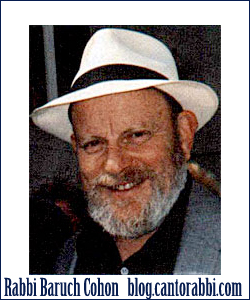
A FEW PURIM THOUGHTS by Rabbi Baruch Cohon

      Of all the holidays of the Jewish year, Purim stands out as the most light-hearted, high-spirited, almost frivolous of celebrations.  Wear funny costumes with crazy hats.  Have a party.  Yes, it’s a mitzvah to hear the Megillah – the Book of Esther – read in the synagogue, but when you hear the name of the villain Haman you twirl those noisemakers to drown it out.  Above all, have a drink.

          That’s right, have a drink.  And not just a formal l’hyyim.  The Talmud even recommends that a man should imbibe on Purim until he cannot distinguish between the words “bless Mordecai” and “curse Haman!”   The Hebrew for not distinguishing is ad d’lo yada – literally “until he does not know” – and that became the name of the annual Israeli Purim parade. 

Like other such times of letting it all hang out, that experience can backfire.  Of course, every Hebrew letter has a numerical value.  Alef = 1, bet=2, gimel=3… yod=10…kuf=100, etc.  Add up the value of the letters that spell out “bless Mordecai – baruch Mordechai,” then the value of the letters in “curse Haman – arur Haman” and you will come up with two identical totals:  502.  That’s right, the number for a drunk driving violation!

So much for drinking on Purim.  Have that party at home!

On another track, Purim celebrates a miracle, the one time when a threatened destruction of Jewry did not happen.  One time when the Jews were alerted to defend themselves, and they succeeded.  All because one young Jewish woman named Esther risked her life to plead the cause of her people to an unpredictable potentate.  As the Megillah tells us, Mordecai urges her to take the chance, because as he says “Don’t think you will escape this danger in the king’s house.  If you keep silent at a time like this, relief and rescue can come to the Jews from somewhere else, but you and your family will perish, and who knows if just for such a time you arrived at royalty!”  Esther bites her lip and decides to face the king, but she charges Mordecai: “Go and gather all the Jews in Shushan, and fast for me and pray for me for three days.  I and my maids will fast too.  Then I will go to the king, and if I perish, I perish.”  So Mordecai went and carried out what Esther asked him to do.

Want to know what the real miracle of Purim was?  That was it.  She said gather all the Jews. And he was able to do it.  She didn’t say gather all the Orthodox Jews.  Nor all the Reform Jews.  She didn’t say gather all the Litvaks.  Or the Galitzianer.  She didn’t say gather all the B’nai B’rith members.  Or the Ladies of Hadassah.  She said gather all the Jews.  And he did. 

Now that’s a miracle worth celebrating any time.  Happy Purim!
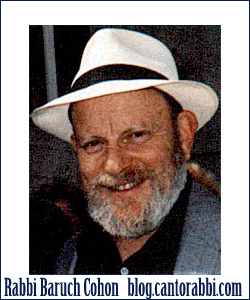
 cohon_baruch153.jpg

Posted in Baruch Cohon, Book of Esther, Esther, Jewish, Jewish Blogs, Jewish Festivals, Jewish Traditions, Megillah, Mitzvah, Mordecai, Purim, Rabbi | 1 Comment

A MITZVAH TO REMEMBER Shabat Zakhor by Rabbi Baruch Cohon

       On the Sabbath before Purim we read Deuteronomy chapter 25:17-19, which commands:“Zakhor —Remember what Amalek did to you when you came out of Egypt, attacking you from the rear and killing the stragglers.  He did not fear G-d.” 

          This is one of six events the Torah cautions us to remember.  They are: 1-Leaving Egyptian slavery, 2-Sabbath every week, 3-Receiving the Torah at Sinai, 4-Angering G-d in the desert, 5-Miriam’s punishment, and 6-Amalek’s cowardly attack. 

          In our time, we could add two more: 7-Losing 6 million in the Holocaust and 8-Returning to the land of Israel.

          Sometimes remembering means Yes, let’s do it again – like Shabat.  Other times it means Never Again.  Torah teaches us to know the difference.

          But there is something special about the commandment to remember Amalek’s attack.  The text continues: “When G-d will relieve you of your enemies and establish you in your land, you must blot out the memory of Amalek from under heaven; do not forget.”  This reads like a commandment to total destruction, never carried out.  In fact, later Biblical history recounts how the prophet Samuel faces Agag, the captured king of Amalek, and runs him through with a spear.  Still, Amalek’s memory is not “blotted out.”  Paradoxically, this reading reminds us not to forget the memory that we failed to destroy.

          Of course it previews Purim, because Haman, the villain of the Purim story who plotted to massacre the entire Jewish people in one day, was descended from Amalek.  The Book of Esther identifies Haman as a member of Agag’s tribe.  By extension, so were other menacing figures in Jewish history, like Nebuchadnezer, Antiochus, Titus, Torquemada, Chmelnitzky, Hitler, Arafat, and Ahmedinejad.  If not physically then spiritually they are Amalek’s heirs.  Amalek and its threat lives on.

          We might well wonder, does an extreme threat validate extreme violence?  If so, did the ancient Israelites perhaps make their mistake by trying to win the “hearts and minds” of Amalek?

cohon_baruch152.jpg

Posted in Amalek, Amalek's attack, Baruch Cohon, Book of Deuteronomy, Egypt, Israel, Jewish, Jewish Blogs, Jewish Festivals, Jewish Law, Jewish Traditions, Judaism, Mitzvah, Purim, Rabbi, Shabat Zakhor, Torah, Torah commandment, Torah Study | Comments Off on A MITZVAH TO REMEMBER Shabat Zakhor by Rabbi Baruch Cohon

RINGS ON THE ARK by Rabbi Baruch Cohon

RINGS ON THE ARK – Parsha T’rumah

          Chapters 25-27 of Exodus provide a description of the first Jewish sanctuary in complete detail.  All it lacks is a blueprint, and succeeding generations of construction-minded scholars have supplied that.  Some modern editions of the Torah actually include pictorial depictions of the Ark, the altars, the showbread table, the curtains – all the elements that made up the ancient Israelites’ religious center, the place where they offered prayers and sacrifices.  Here is where the gold they borrowed in Egypt got put to use, as the wooden structures were decorated in the precious metal. Another use for the metal, however, was more practical.   On each of the four corners of the Ark, and each of the four corners of each altar, they had to mount heavy gold rings.

          Why did they need rings on the Holy Ark?  To carry it.  Long wooden poles went through each pair of rings, and men from the Tribe of Levi put their shoulders under those poles and transported the sacred structures as the people journeyed through the desert.  Primitive transportation, to be sure.  For all those 40 years, from the Red Sea by a tortured route to the east bank of the River Jordan, these people had no wheels.  Egypt had wheels.  Moab had camels.  But Israel walked.  Israel needed those rings on the Ark.

          So Judaism started out as a portable religion.  Only in Solomon’s Temple were there no rings on the ark.  That would be a permanent House of G-d.  And so it was for generations.  Until disaster came.  Enemies attacked and destroyed it.  Twice.  The first time, brave and dedicated leaders were able to go back and rebuild it.  But the second time, no way of rebuilding.  What would happen to Judaism?  Where would a defeated nation find rings to carry the Ark of the Covenant?         

Then came a dedicated teacher and visionary named Yohanan ben Zakkai.   During the Roman siege of Jerusalem, when no Jews were permitted to leave the city except to bury the dead, the Talmud recounts that he lay down in a coffin and had his students carry him out.  Reaching the Roman camp, Yohanan proceeded to stand up out of the coffin and tell the officer “Take me to your leader.”  That leader was a general named Vespasian, whom Yohanan greeted as Emperor.  Vespasian corrected him, but Yohanan predicted that he would become emperor, as indeed he did.  Whether Vespasian believed him or was just flattered, he asked Yohanan: “What do you want?  You risked your life to come to me.  What are you seeking?”  Then Yohanan asked for the right to take his students to a town called Yavneh and teach them there.  Vespasian agreed.  The school they started was called Kerem b’Yavneh – the vineyard in Yavneh – because the students lined up like the rows of vines in a vineyard.  There they kept Torah alive. 

When Rosh Hashanah came, they hesitated to blow the Shofar.  A new problem, since in their memory the shofar was never blown outside of the Temple in Jerusalem.  But here it was, the morning of Rosh Hashanah, which is defined in the Torah as Yom t’ruah – the day of sounding the horn.  They had to discuss the law on this topic.  Yohanan told them: “Sound the Shofar.  We will discuss it later.”  Once it was sounded, they realized that discussion was unnecessary.  The Shofar call in Yavneh replaced the rings on the Ark. 

Again, Judaism was portable.  It remained portable, journeying to every continent on the globe. It remains portable now, whether moving from any city’s downtown to uptown, or returning to Jerusalem.  And I daresay it will remain portable even if alien shrines get removed from the Temple Mount and a new Sanctuary is built there.  B’chol ha-aretz k’vodo – “Throughout Earth is G-d’s glory.”

cohon_baruch151.jpg

Posted in Ark, Baruch Cohon, Exodus, Israel, Jewish, Jewish Blogs, Jewish Traditions, Judaism, Kerem b'Yavneh, Parsha T'rumah, Rosh Hashanah, Talmud, Torah, Torah Study, Yohanan ben Zakkai | Comments Off on RINGS ON THE ARK by Rabbi Baruch Cohon

GETTING DOWN TO CASES – Mishpatim by Rabbi Baruch Cohon

GETTING DOWN TO CASES – Mishpatim – Ex.21-24

          Last week the Torah gave us principles of conduct.  General rights and wrongs.  Now we get into some specifics.  We know murder is wrong, but what actually constitutes murder?  And what penalty should a human court impose?  Questions like these get answered this week, some in remarkable ways.

          These chapters detail laws about theft, seduction, injury, loans, idolatry, festivals, witchcraft, how to treat servants and when to rest the land.  Since last week’s blog explored the subject of murder, let’s see how the Torah defines and punishes it. 

           In the days of the Torah revenge killing was acceptable.  Like the Hatfields and McCoys of old Kentucky, the closest relative of a victim had the recognized right, even the duty, to kill the man who killed his brother.  On the other hand, if that killing was not deliberate, the killer would have a place to take refuge.  Elsewhere in the Torah we will read about cities of refuge where the avenging relative would not be allowed to enter.  Interestingly, the practice of refuge for the inadvertent killer survived long after Torah times, and in unexpected places. 

On our first visit to Hawaii we were taken on a sightseeing boat to a cave which was not accessible by land.  There a diorama in the wall told how this cave was used.  One who killed someone inadvertently could go there and remain safe until the death of the Big Kahuna.  Exactly the same as the Cities of Refuge that Moses set up in ancient Israel.  Even the word Kahuna meaning priest has a parallel sound to the Hebrew Kohen.  A rabbi friend in Honolulu explained to me that when the Polynesians sailed across many miles of ocean to settle Hawaii they needed expert navigators, and at that time the best navigators in Asia were Jews.  So apparently Hawaii got some Torah along with its pioneer population.  A researcher at the University of Hawaii found a large number of Hawaiian words that have parallel meaning and sound to their Hebrew equivalents. Shaloha!

  Now back to Exodus.

The ultimate refuge for a desperate fugitive was the holy altar.  Even that, however, is not available to a real murderer.  Here we learn that “if a man deliberately comes after his neighbor to kill him with guile” by deceit or by ambush, and then runs to the temple to save himself from justice, “from My altar you must take him to die.”

Among the most impressive of these many laws is the charge to judges:  “Do not take a bribe, for a bribe will blind the clearest of eyes and subvert the words of the righteous.”  Judges are further warned neither to oppress a poor litigant who is at their mercy nor to favor the poor (out of a sense of pity even though he is guilty).  In a time and place known for corruption, the Torah denounces corruption.  Rich in lessons for today, these chapters seem to anticipate democracy as we read: “Do not follow a majority to go astray.”  Sometimes majorities can be wrong too.

          Ideals are great.  But they are merely slogans unless we can put them to work in our lives.  That requires getting down to cases.

cohon_baruch15.jpg

Posted in Exodus, Israel, Jewish Blogs, Jewish Law, Jewish Traditions, Kahuna, kohen, Mishpatim, Shaloha, Ten Commandments, Torah, Torah Study | Comments Off on GETTING DOWN TO CASES – Mishpatim by Rabbi Baruch Cohon

BY-LAWS NEEDED – Parsha Yitro by Rabbi Baruch Cohon

Parsha Yitro (Ex.18-20)          

Last week’s Torah narrative saw the Hebrew slaves freed from Egypt.  Losing no time, this week we read of their arrival at Mount Sinai to receive the Torah.   Leaving Egypt made them free. But not till they arrived at Sinai did they become a nation.

          What made this motley crowd a nation?  The Torah.  It has been called the Jewish equivalent of a Constitution.  Just as the U.S. Consitution proclaims a nation and includes the Bill of Rights, so the Torah validates a nation and includes the Ten Commandments – which can well be described as a Bill of Rights and Wrongs.  In fact, these ten – “ten statements, aseret ha-dibrot” as they are called in Hebrew – are what Moses first attempts to bring down the mountain to the people.  The simple directness of the Big Ten constitutes their importance.  Of course we all know how Moses was carrying the tablets of the Law, and partway down the mountain he saw his people dancing around a golden calf – breaking the very law he was carrying.   In shock he broke the tablets.   That just underscores their value as a guide to life. 

          This Bill of Rights and Wrongs, these ten principles of conduct, inspired great scholars and humble people ever since Moses.  Whether you learned them from your first teacher or Cecil deMille, from your clergyman or your mother, these are words to remember.    Above the Holy Ark in the synagogue or on the wall of the courthouse, these are words to remember.

1-What is right?   Acknowledge the One G-d who inspired you to be free. 

2-What is wrong?  Splitting your allegiance, trusting in idols – whether humans or wealth or prestige or “whatever I can get away with.”                    

3-What is wrong?  Perjury, swearing to a lie.  Punishment will follow.       

4-What is right?  Remember the Sabbath.  As the Creator rested after 6 epochal days, so we the creatures can take a day off once a week.  We need to.                                                                          

5-What is right?  Honor your parents.  Maybe they are not perfect.  They are human.  But they brought you into the world and rate your respect.   

6-10-What is wrong?  Murder.   Adultery.  Stealing.  False testimony to frame a fellow human. And coveting, greed that leads to so many other violations.

          Simple statements, yes.  But we cannot leave them at that, can we? 

Suppose One G-d is beyond your imagination, and you find it too difficult to believe in an eternal invisible power.  What inspires you?                

Suppose you see other people getting away with crooked or violent actions and prospering.  Why should you stick to the straight and narrow?                   

Suppose you can gain some advantage by telling a “little white lie?”

Suppose your boss tells you either to work on the Sabbath or look for a new job?                                                                                                                 

Suppose your father is in jail and your mother ran off with a stranger.   Do they still deserve your honor?                                                             

Suppose, like the character in the old film “The Road Back,” you are charged with murder and your first reaction is: “Sure I killed him.  In the war I killed lots of men.”                                                                                    

Suppose your mate sues for divorce on the basis of infidelity.  Can’t someone love more than one bed partner?                                                     

Suppose you just happen to slide that extra candy bar in your pocket and walk out of the store?                                                                          

Suppose you have the knowledge to save an accused rival from a questionable charge, but you hold back your testimony because “the guy deserves it anyway?”                                                                                 

And finally, is it really right that such a villain should have all that gold and I have none?

These questions demand answers in every generation.  So we have by-laws, commentaries to explain and challenge and investigate the truth and legitimacy of even such a basic document as the Ten Commandments.

        Arguably the clearest of such insights concerns the 6th commandment: Do not murder.  We note that it does not say “thou shalt not kill.”  That is an incorrect translation.  The Hebrew is Lo tirtzakh,not Lo taharog.  Killing can be done in more than one context.  The one that is prohibited here is specifically murder.  Not self-defense.  Not warfare.   Not capital punishment.  Human authorities have to try an accused murderer, and a conviction must be based on admissible evidence.  In the days of the Torah, that evidence required two eye-witnesses.   One was not enough. 

          Notably also, the Torah does not offer special rewards for killing an enemy.   No 70 virgins in the hereafter.  No statues honoring the general or the terrorist who destroyed the most “heathen.”      

          Let me invite you to participate in these By-laws.  Pick a commandment and comment on it. I’ll look for your thoughts.


cohon_baruch156.jpg

Posted in Baruch Cohon, Exodus, Jewish, Jewish Blogs, Jewish Law, Jewish Traditions, Moses, Mount Sinai, Torah, Torah Study | 1 Comment