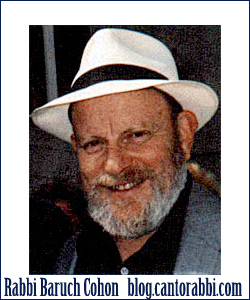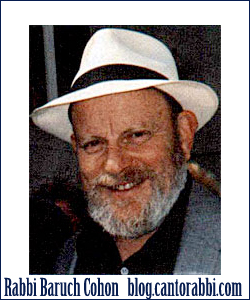
LOYALTY OR ELSE by Rabbi Baruch Cohon

          This week we will read a section called R’ey – “See” – in the Book of Deuteronomy chapters 11-16, comprising the second of Moses’ farewell speeches.  He starts by telling his people: “See, I place before you today a blessing and a curse.  The blessing if you follow G-d’s commandments that I give you, and the curse if you do not follow them but leave the path that I charged you to take.”

          Among those commandments we find some warnings that we might call extreme.  For example, how to treat a false prophet.  How to react to a member of your own family who leaves the faith and invites you to come along.  What to do about an entire city that decides to practice idolatry.  In all such cases, the penalty is death.

          Hardly sounds like a religion of love and justice, does it?  It even reminds us of some current reports about fatal fatwas pronounced against prominent ex-Muslims.  And who knows how many humble victims of similar fatwas we don’t hear about. 

Torah commentators deal carefully with these commands to violence, as when Moses says “Your hand shall be first against him (the apostate) and finally the hand of all the people.”  Rashi and others insist that the violator first had to stand trial, and only if found guilty would he be killed.  Rabbi J. Hertz (former Chief Rabbi of England) points out that “Jewish history does not record a single instance of punishment for religious seduction by a false prophet or a member of one’s family.”  Regarding a disloyal city, the Torah text itself warns the people who destroy that city to take no spoils.  This is not to be a venture for profit.  This is not the Inquisition which confiscated the property of its victims.  And the Tosefta states: “The destruction of a whole community because of idolatry never occurred nor will it ever occur.  The sole purpose of the warning is that it should be studied and one might receive a reward for such study.”  

Study, indeed.  If we studied our heritage more and understood it better, we might find ourselves more loyal to its message, and have fewer false prophets, fewer intimate seducers, and fewer rebel communities. 

          Perhaps we need to ask who are the real sufferers in cases of disloyalty to the faith and desertion from the community?   Over and again we hear that while we lost 6 million in the Holocaust, we lost at least that many since then, to assimilation and conversion.  Leaving figures aside, we can see a decline in Jewish commitment and a weakening of Jewish education, particularly in the non-Orthodox population.  Seeing the advances in genetic science, we might predict a time when only your DNA will prove whether you have any connection to the Jewish people.  Maybe the “idolaters” – or secularists or apostates or intermarrieds – among us are the real sufferers.  And they don’t even know what they are missing – all the wonderful color and flavor of Jewish life.  

          They deprived themselves of the “blessing…if you follow the mitzvos that I command you today.” 

          No, no one will judge them and kill them.  In fact, many people stand ready to welcome them back.  As the prophet Isaiah sang in this week’s Haftorah: “All your children shall be taught of the L-rd, and great shall be the peace of your children.” 

cohon_baruch12.jpg

Posted in A Blessing and a Curse, Baruch Cohon, Book of Deuteronomy, Cantor, Israel, Jewish, Jewish Blogs, Jewish Traditions, Judaism, Loyalty, Moses, Rabbi, Torah, Torah Study | Comments Off on LOYALTY OR ELSE by Rabbi Baruch Cohon

THE SABBATH OF EYKEV by Rabbi Baruch Cohon

If my readers will put up with a personal Torah message, this week’s reading in Deuteronomy chapters 7 through 11– called Eykev — has a special meaning for me.

Every year certain dates bring special memories. Yortzite – or Yarzeit or יארצייט or however you want to spell it – the anniversary of death of a next of kin, is a hallowed observance for many of us. We light the memorial candle. We find a synagogue and say Kaddish, if we can. And we spend a few minutes with echoes and mental pictures or faded photographs of Mom or Dad or some other close relative who once shared our life.

Approaching still another such date, I revisit some of the conditions that make it significant, that make it mine.

Jewish tradition considers it a special mark of value to die on the Sabbath. Folklore tells us that a tzadik – someone who is righteous – meets our Maker on the holiest day of the week. Both of my parents died on Saturday. That doesn’t mean I have an opportunity to honor them any more than if they died on some other day. But conceptually it tells me that I’m not the only one who honors them. Tradition also identifies parents in the memorial prayer as  avi mori —   אבי מורי  or imi moratiאמי מורתי – my father, or mother, my teacher. And indeed they were my first and best teachers.

Dates are also worth considering. My father’s yortzite is 18 days into the Hebrew month of Av, also called Menahem Av – literally “consoling the Father.”

That is the date on which I am writing.  Actually my father died on Shabat Eykev, which that year occurred on the 18th.

I like to think of this date as chai av – chai, the Hebrew word for Life, חי with the numerical value of 18, and אב – av which means Father. Thus, chai av translates “father lives.” But that’s not how I first thought of it.

The month of Av is the saddest month of the Jewish year, the month when we commemorate the destruction of both the First and Second Temple and the 1492 Expulsion from Spain, as well as other calamities, all on the same day, tish’a b’av – the ninth of Av.

Nine plus nine = 18, my father’s yortzite. His death at just 71 hit me as a double tragedy, tish’a+tish’a. Only as the years passed and I found ways to honor his memory did I begin to feel the day as  chai av – father lives.

Reading over this week’s Torah portion today, I come to the point where Moses tells about receiving the second set of holy Tablets – the Ten Commandments – having broken the first set when he saw his people worshipping a golden calf.  Here he also mentions the death of his brother Aaron, the High Priest, and the fact that Aaron’s son Elazar took his place.  Commentaries note that Aaron died long after the second tablets were received, but his death is mentioned here to show that his death grieved G-d just as much as the smashing of the first set of tablets.  One Hasidic commentary, in a work called Divrey David – “David’s words” – points out an additional significance.  The second set of tablets was not identical to the first.  The first set was G-d’s creation exclusively – hewn and inscribed by the Divine hand and given to Moses.  The second set was Moses’ work, although Divinely directed.  Correspondingly, Elazar was not identical to his father.  He functioned as High Priest to the best of his ability, but he would never be what Aaron was to his people.

Certainly this happens many times.  Children do not equal the example their parents set.  Not always, but frequently.

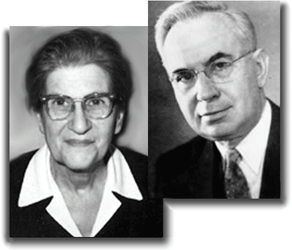
My father of blessed memory was a scholar and dedicated rabbi, who ministered, wrote books on Judaism, and taught a couple of generations of American rabbis.  I give thanks that we were able to create a foundation in memory of him and my mother, the Rabbi Samuel S. and A. Irma Cohon Memorial Foundation, which gives a substantial annual award for outstanding service to Klal Yisrael, the total Jewish People, as detailed on the website www.cohonaward.com  

But I know I could never fill his place.

 On Shabat Eykev and throughout the year, his memory is a blessing.


My Parents Rabbi Samuel S & A Irma Cohon

irma-sam.gif                        cohon_baruch1.jpg     

Posted in Aaron, Baruch Cohon, Book of Deuteronomy, Cohon, Cohon Award, Eykev, Jewish, Jewish Blogs, Jewish Traditions, Kaddish, Legacy, Moses, Parents, Rabbi, Teachers, Torah, Torah Study, Yarzeit | Comments Off on THE SABBATH OF EYKEV by Rabbi Baruch Cohon

WHAT MY TEACHER SAID by Rabbi Baruch Cohon

          A young boy comes home from Hebrew School, and his father asks him what he learned today.

          “Today we learned how the Jews left Egypt,” says the son.

          “Really.  Tell me about it,” the father says, settling back in his chair.

          “Well, they were running out of Egypt and they got to the Red Sea, and the Egyptian army was chasing them and they didn’t know what to do.  So they yelled to Moses.  And Moses called out the Navy and they put pontoons in the water, and the people started to cross on the pontoons.  But the Egyptians had their own pontoons and they were still chasing them.  So Moses called out the Air Corps and they bombed the Egyptians…”

          Daddy sits up straight.  “What?  Is that what your teacher said?”

          “Well…no.  But if I told you what he said, you’d never believe me.”

OK, you heard it before.  But this week as we start rereading the Book of Deuteronomy, we need to remember what the teacher says.  Teachers take a good deal of punishment these days for student failures.  Maybe they could do better.  Maybe we all could.  But the Book of Deuteronomy reminds us that teachers have great importance in our lives.  Nowhere in this fifth book of the Torah do we read a direct quote from G-d.  Those messages appear many times in the preceding four books, but not here.  Here Moses is spending his last days on earth reviewing the lessons of those previous books.  And our sages emphatically insisted that this book, which they called Mishneh Torah – the repetition of Torah — is no less sacred and no less important than the other four.   Our first and greatest leader, whom we traditionally call Moshe Rabbeynu – Moses our Teacher – is adding his personal input to the history his people lived and the laws they received.

          In fact, when we memorialize our parents who are no longer with us, we traditionally use the terms avi mori or immi morati – my father or mother my teacher.           

          Moses’ farewell speeches bring up some of the most basic and most  stirring thoughts and principles in the entire Torah. 

          Best known of these, of course, is Judaism’s one-line creed: Shma Yisroel – Hear, O Israel, the L-rd is our G-d, the L-rd is One.  Just as there is only one G-d, one Creator and motivator for every individual whether great or insignificant by human standards, so every individual has the same right to equal justice.  In the very first chapter of Deuteronomy, Moses reminds us not to show favoritism in judgment.  “Do not respect persons in judgment.”  Listen to the little guy just as closely as to the big shot.  This principle of uncorrupted justice led the sages of the Talmud to declare that “every judge who renders righteous judgment, Scripture considers him a partner of the Holy One in the work of Creation.”

          Fairness in dealing with our fellow human beings is not limited to the court of law.  We have a responsibility to treat people properly whether they owe us money or we owe them, whether they are our relatives or strangers, whether we share the same national or ethnic background or not, and presumably whether they are native citizens or illegal immigrants.  Surely we want to help our own people and we should.  But we have to guard against cheating others.  “One rule for the native-born and for the stranger among you.”  That’s what the Book of Deuteronomy commands.

          That’s what my teacher said.

cohon_baruch15.jpg

Posted in Baruch Cohon, Book of Deuteronomy, Jewish, Jewish Blogs, Moses, Shma Yisroel, Talmud, Teachers, Torah, Torah Study | Comments Off on WHAT MY TEACHER SAID by Rabbi Baruch Cohon

FIGHTERS AND BUILDERS, in Israel and Hawaii by Rabbi Baruch Cohon

The last chapters of the Book of Numbers accent words and conditions that echo significantly in modern times.  Still camped on the east side of the Jordan River, Moses and his associates, Elazar the High Priest (Aaron’s son and successor since Aaron’s death) and Joshua who will later succeed Moses, receive instructions as to how to conquer and divide the Land of Israel among the tribes and their families. 

          First comes the fighting force.  Each man over the age of 20 is drafted.  He then becomes a Halutz, here translated “armed.”  Some 25 centuries later that word got revived into modern Hebrew, as the Jews returned to the Land.  Now a halutz is translated “pioneer.”  Indeed the pioneering effort included some armed conflict.   That conflict recurs all too often even though the pioneering days are mostly past.  But in Numbers, all the tribes are required to supply fighters, halutzim — all the tribes, whether they will settle west of the Jordan or, like Reuben and Gad and half the tribe of Menasseh, will make their homes where they found good pastureland on the east bank.

          Settling and maintaining the Land of Israel thus becomes the responsibility of all Jews including those who live in the Diaspora.  Like the tribesmen of Reuben and Gad, we are again called on to send young builders – and some old money – to help in this effort.

          These chapters also lay out the boundaries of the Land of Israel.  Some of the places named don’t tell us much, since place names changed many times since Biblical days, but others are quite clear.   For example, Lake Kinneret also known as the Sea of Galilee on the northern border, and the Jordan River and the Salt Sea (or Dead Sea) on the east.  (No West Bank fictions here.)  And of course the Mediterranean on the west.     

          Of particular interest are the Cities of Refuge that the Torah mandates even before the land is conquered.  If a killing takes place that is not premeditated murder, the killer can take refuge in one of these cities and remain safe from the revenge of the victim’s family.  Six of these cities must be established, three on each side of the Jordan.  The accidental killer must remain in the city until the death of the current High Priest.  He is not to leave this self-imposed detention.  If he does, the “blood redeemer” (generally the victim’s next of kin) can legally kill him.  But also, the Torah explicitly defines who is eligible to use the City of Refuge, and gives examples of the types of accidental injury that qualify.  It also details examples of deliberate violence that does not qualify.  Justice must be done.  Punish the guilty and protect the innocent.  Check Chapter 35.

          A fascinating parallel to this passage appears in, of all places, Hawaii.   We once visited a national park in an isolated cave, accessible only by water, where I saw a diorama – a sand image on the cave wall – explaining the historical function of that cave and others like it.  It was a refuge for the accidental killer, and he could remain there safely until the death of the Big Kahuna – Hawaiian for High Priest!  Even the word “kahuna” is related to the Hebrew “cohen.”  Astonished at the parallel, I consulted a friend who was at that time the only rabbi in Hawaii, and learned that the early Polynesian settlers of those islands arrived there in open boats over some 1,000 miles of ocean.  To make such a voyage they needed navigators.   At that time, the best navigators in the world were Jewish sailors.  When they arrived in the beautiful new islands of Hawaii, they stayed.  So did the navigators.  In fact, the Hawaiian language now includes words that have similar sound and identical meaning to those words in Hebrew.  Kahuna is one.  Another is the word for gift: makana in Hawaiian, matana in Hebrew.

          It all goes back to the Book of Numbers! 

cohon_baruch14.jpg


Posted in Baruch Cohon, Book of Numbers, cohen, Hawaii, Israel, Jewish, Jewish Blogs, Kahuna, makana, matana, Torah, Torah Study | Comments Off on FIGHTERS AND BUILDERS, in Israel and Hawaii by Rabbi Baruch Cohon

HEIRS, HEIRESSES AND ERRORS by Rabbi Baruch Cohon

          This week we will read in the 27th chapter of Numbers the plea of five women.  It seems that a man named Zelophehad – the name sounds better and easier in Hebrew, Tzlof-khod (two syllables, not four) – had a family of daughters: Mahlah, Noa, Khaglah, Milcah and Tirtzah.  No sons.  He died. The Israelite nation was camped east of the Jordan, and all the Hebrews were looking forward to the land they would soon conquer and possess.  Who would take over Tzlofkhod’s property?  Who could inherit it?

          His daughters appealed to Moses.  Inheritance customarily passed to a son.  If there was more than one son, the oldest got a double portion.  Daughters were expected to get married and live on their husbands’ property.  Before marriage they could live in their brothers’ home.  No brothers – no home.  And here were five young girls, not yet married, who might become homeless beggars.  They had good reason to appeal.

          Now we might ask why do they state their case at this time?   Nobody had any land yet.  The Land of Israel was on the other side of the Jordan.  A dangerous crossing and many battles still stood between them and any land settlement.  One reason for their timing might be that they were from the tribe of Menashe.  Later, in chapter 32, we will read that half of that tribe joined with the tribes of Reuben and Gad to get permission to send their soldiers to fight for the land with the other tribes, and then themselves to settle on the East Bank.  If Tzlofkhod belonged to that half of Menashe, his family property was already to be assigned. 

          In any case, the Five Daughters raise the issue of inheritance and Moses gets a ruling.  Once the land is divided, each property is to stay in the family that receives it.  Under Divine direction, Moses sets out the order of inheritance: Sons first.  If no sons, daughters.  If no daughters, the owner’s father.  Without him, brothers of the owner.  Lacking those, next in line are brothers of the owner’s father, and then the closest living relative.  So here we have a law more than 3,000 years old that gives property rights to women.  Limited, to be sure, but firm.                              

          One more requirement characterizes this law: the property must remain in the tribe.  While the Five Daughters take possession of their father’s inheritance, they are under orders to marry men of Menashe.  Even within the Jewish people and the Jewish state, each tribe had an assigned territory and assigned boundaries which had to remain fixed.  Individual families and their individual plots of land were part of that territory.   Logically, if one of our five ladies chose to marry a man from Judah or Issachar, she would have to give up her share of the property and move to her husband’s home.

          In a tribal society, intermarriages generally resulted from war, and frequently involved slavery and brutality.  When inheritance was involved, unfair results inevitably followed.  So the laws of inheritance were quite strict.  Of course several important Biblical narratives concern exceptions to those laws.  Tzlofkhod’s daughters were not the first to challenge them.  The Patriarchs themselves made exceptions.  Abraham chose Isaac as his heir, not the older son Ishmael.  Jacob bought the birthright from his senior twin Esau, and then deprived his own firstborn Reuben of the primogeniture rights as punishment for bedding his father’s concubine.   And the widow of an intermarriage named Ruth entered Judaism and its people wholeheartedly, to become the ancestor of King David.  But with all the exceptions, the inheritance – both physical and spiritual – stayed home.  

          What we bequeath to our sons and daughters can be real estate, or trust funds, or heirlooms – or just love and memories.  Let’s educate them to keep it within the borders of our great heritage.

 cohon_baruch13.jpg

Posted in Baruch Cohon, Book of Numbers, Five Daughters, Jewish, Jewish Blogs, Jewish Law, Jewish Traditions, Moses, Rabbi, Torah, Torah Study | Comments Off on HEIRS, HEIRESSES AND ERRORS by Rabbi Baruch Cohon