WRITE THIS SONG – by Rabbi Baruch Cohon

          Chapters 31 and 32 of Deuteronomy offer some great messages.  Moses, at age 120, and his intended successor Joshua are told to “write this song and place it in the mouths of the people.”  They get this order in chapter 31, when Moses finishes one of his farewell speeches to the people, and charges Joshua to be strong and courageous in leading them.  Up to this point, no one is singing.  So what song should Moses write?

          The commentators differ in their explanations.  Ibn Ezra takes this commandment as referring to the entire Torah, which each Jew should write a copy of once in his life, or engage a scribe to write it.  This interpretation gives us the tradition of carrying out this mitzvah to honor a special event in our family or community.

Nachmanides, the Ramban, identifies the song as Haazinu which is the text of the next chapter, and contains some of our most classic lyrics.  Opening with exaltation:

Listen, you heavens, and I will speak,

and let the earth hear the words of my mouth.

My doctrine will drop as the rain,

My speech will distill as the dew …

For I will proclaim the name of the Lord;

Ascribe greatness to our G-d.

The Rock, His way is perfect, for all His ways are justice.

A G-d of faithfulness … just and right is He.

The poem goes on to detail how the people Israel received Divine love and care.  Then how they made mistakes:

  Jeshurun got fat and kicked … and he forsook G-d who made him,

     And contemned the Rock of his salvation.

As if using past experience to predict his people’s future, Moses soon launches into the lines that are arguably the most accurate forecast of what goes on today:

          They angered Me with a non-god, provoking Me with their vanities;

And I will anger them with a non-nation, provoking them with a vile people.

Think about it.  When a majority of world Jewry rejects religion, when groups of Jews in Israel and elsewhere sample cults from Zen to Scientology, and when they view any observant Jews as extremists, should we be surprised that a “non-nation” can threaten Israel’s existence?  As has been amply proven, there never was a nation of Palestine, and those who now call themselves “Palestinians” are the same Arabs who live in Jordan and surrounding countries. Yet they harass Israel while a hostile world looks on.

If Israel and world Jewry “returned to G-d,” would that situation change?  We don’t know.   But here is what the song of Moses says:

If only they were wise, they would understand this,

they would discern their latter end…. 

For the Lord will judge His people, and have compassion for His servants…. 

Sing aloud, you nations, about His people, for He will avenge their blood, 

and render vengeance to His enemies, 

and He will make expiation for the land of His people.
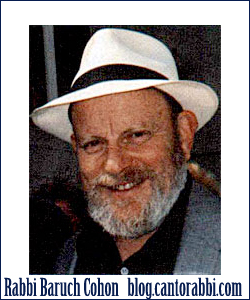
 

cohon_baruch12.jpg


Posted in Baruch Cohon, Book of Deuteronomy, Cantor, Israel, Jewish Blogs, Jewish Traditions, Joshua, Legacy, Mitzvah, Moses, Return to G-d, Song, Torah, Torah Study | 1 Comment

HIDDEN AND REVEALED by Rabbi Baruch Cohon

“Things that are hidden belong to the Lord our G-d, but what are revealed belong to us and our children forever, to carry out all the words of this Torah.”  Deut. 29:28

          Moses spoke these words to the people of Israel in the third of his farewell addresses to them on the east bank of the Jordan River.  Rashi, our greatest commentator, interprets them as referring to how we hold people responsible for what they do.  He pictures the Israelites arguing with Moses, protesting: “what can we do?  You punish all of us because of one person’s violation. Isn’t it true that no one knows the hidden thoughts of his friend?” Moses would answer: “I do not punish you for hidden violations, because they belong to G-d.  But open iniquities belong to us and our children, and it is we who must remove evil from our midst.  If we do not do justice to the individual violator, the whole nation will be punished.”  Indeed, Jewish law always took a particularly serious view of public violations because they could involve other people besides the violator.  Here, Rashi quotes the Talmud in tractate Sanhedrin, commenting on ten little dots that appear in the Torah scroll above the ten letters of the words lanu ul’vaneynu – “to us and our children”.  Those dots are understood to signify that even for public violations the people were not punished until they crossed the Jordan, accepted the oath, and thus became responsible for each other: areyvim zeh la-zeh. That mutual responsibility guides us throughout our history.  In Moses’ message, that responsibility should lead us to carry out the words of this Torah.

           A 19th-century commentator named Benjamin Szold uses the cantillations to suggest a different translation.  The word haniglot – “the revealed” – is chanted to a particular melody not connected to the following words.  So Szold reads the sentence this way: “The hidden things belong to G-d, and the revealed things also.  For us and our children is the task of carrying out the words of this Torah forever.”  Maybe it is not our duty to punish a public violator, but right living is our duty. 

          Either way, we are eternally connected to our fellow Jews – areyvim zeh la-zeh.  Mutual responsibility and mutual concern.  What happens to a secular Jew in Russia or a primitive Jew in Ethiopia, to a traveler in Bulgaria or a settler in Judea or a Hasid in Brooklyn, happens to you and happens to me.  What we don’t know about them, we leave to G-d.  What we know, and what we share with all of them, belongs to us and our children, Lanu ul’vaneynu ad olam– to carry out our Torah forever. 

cohon_baruch11.jpg

Posted in Baruch Cohon, Book of Deuteronomy, Israel, Jewish, Jewish Blogs, Jewish Law, Jewish Traditions, Moses, Rabbi, Talmud, Torah, Torah Study | 1 Comment

WHAT TOOLS DO WE USE? By Rabbi Baruch Cohon

Parsha Ki Tavo

          One of the definite duties Moses gives his people, to be done when they finally will cross the Jordan and enter the Promised Land, is to build an altar.  This altar must be built of stone, and sacrifices will be offered on it.  Moses details how it should be built.  He does not say what tools to use in the construction, but he specifies what not to use.  “You shall build an altar to the Lord your G-d, an altar of stones; do not raise iron on them.” (Deut. 27:5)  Use unhewn stones, called sh’leymot – “complete” – not touched by a violent axe.  The Talmud explains that the altar promotes peace between Israel and G-d, and the word for peace is shalom from the same root as sh’leymot, so the unhewn stone symbolizes that peace.  But iron is what weapons of violence are made of.   Don’t mix them.

          Contrasted with some other leaders’ methods to achieve salvation, like Mohammed’s “sword of the prophet” or Torquemada’s “auto-da-fe”, this caution by Moses is remarkable.  Carried through the generations and translated into principles, we see it reflected in religious relations.  Judaism never practiced forcible conversion.  No stories of “convert or die.”  In fact, for most of Jewish history, no missionary activity at all.  From time to time, we hear suggestions that maybe we should actively seek new Jews, but we don’t.  Many seekers come to adopt Judaism and they are welcome, but there is no campaign to attract them and certainly no pressure on them to change their faith. Those who become Jewish do so voluntarily and only voluntarily. 

No axe on our altar.

cohon_baruch1.jpg

Posted in Baruch Cohon, Book of Deuteronomy, Israel, Jewish, Jewish Blogs, Jewish Traditions, Judaism, Moses, Parsha Ki Tavo, Rabbi, sh'leymot, Talmud, Torah, Torah Study | 1 Comment

GOING TO WAR by Rabbi Baruch Cohon

Two sections in the Book of Deuteronomy begin with the words  – “When you go out to war.” 

The first section, Chapter 20, details rules to be followed in warfare.  Judaism never said that all was fair in love and war.  Far from it.  Just as Jewish tradition sets out rules and principles for interaction between the sexes, it sets very strict standards for how to conduct military operations.  Those standards start with a special role for the cohen, the priest attached to the army unit.  Much more than a chaplain, he is known in the Talmud as mashuakh milkhama – “anointed for battle.”  And he is the one who urges the troops to courage, to have confidence that G-d is on their side.  At his instruction the officers call out all those who qualify for deferments: one who built a house and did not yet move in, one who  planted a vineyard and did not use its fruit, one who betrothed a woman and did not  yet marry her.  And one more: one who is “fearful and faint-hearted,” lest he infect his comrades with his fear.  Some interpret this as referring to one who is afraid of the sins he might commit in warfare.  Read “conscientious objector?” 

Then we read about how to treat an enemy city.   Offer terms for peace first.  If they accept, take them all prisoner and put them to work.  If they refuse, attack!  Destroy the male population and take the women and children along with the livestock.  More about this later.

Even trees rate special treatment.  At a time when trees around an enemy city were routinely used for battering rams, the Torah requires that the army look at the tree first.  Is it a fruit tree?  Leave it alone.  Do not raise an axe against it, “for is the tree of the field a man that it should join you in a siege?”  Only if it is not a fruit tree may it be used in battle.

The second Kee teytzey section starts at Chapter 21 verse 10, and opens this week’s Torah reading.  Unlike the first section, it is not about military rules at all.  It concerns women’s rights.  Those rights apply in a unique way to a female prisoner of war.  “If you see among the captives a beautiful woman, and you desire her,” says the Torah, “you can take her for a wife.”  Bearing in mind, of course, that polygamy was the custom, the Jewish soldier still had certain specifics to observe in this case: “Bring her home; she must shave her head and pare her nails, take off the clothes of her captivity, sit in your house and weep for her father and mother for a month.”  What a remarkable law. First you have to house her.  Then she has to make herself as unattractive as possible by losing that long hair and those beautiful clothes.  And you have to stay away from her for a month while she is in mourning.  “After that you may have intercourse with her and be her husband and she shall be your wife.”  Right.  Make her as unattractive as possible – bald, dressed plain, with tear-stained eyes – and then you can first take possession?  No wonder the Torah continues: “It shall be, if you do not want her, send her away wherever she will go.   You may not sell her as a slave, because you have humbled her.”  This was Jewish law 3,000 years ago.   Tell it to most armies today.

What is particularly interesting about both of these sections is the opening phrase: Kee teytzey lamilkhama – When you go out to war.  Not if, but when.  Note that the Torah does not say go to war, or don’t go to war.  It does not say all war is good or all war is evil.  War happens.  That, the Torah takes for granted.  What it teaches is standards of conduct that apply even in war.  In fact, Jewish law provides for three different kinds of warfare: #1 was Khova – the obligatory war, which happened only once, and was Joshua’s war to conquer the Land of Israel; #2 was Mitzva – defending Israel from attack, which included operations like reclaiming captured Israelites as well as peremptory strikes; and #3 was called R’shut – optional, as in the case of the wars of David and Solomon to expand Israel’s borders.  The rabbis of the Talmud insisted that the deferments mentioned in the Torah applied only in optional wars.  When the nation is threatened, universal service is required. 

Defining the need and purpose of warfare becomes more urgent as human beings reach higher on our scale of values.  Although our enemies try to take advantage of that reach, Torah standards can provide a clear avenue to wisdom on the subject.

 cohon_baruch16.jpg

Posted in Baruch Cohon, Book of Deuteronomy, cohen, Jewish, Jewish Blogs, Jewish Traditions, Kee teytzey lamilkhama, Rabbi, Talmud, Torah, Torah Study, war | Comments Off on GOING TO WAR by Rabbi Baruch Cohon

BLINDING THE WISE by Rabbi Baruch Cohon

Corruption is not new, we know that.  It’s at least as old as prostitution, and in some ways related.  Moses knew about corruption, in fact warned against it in this week’s Torah reading, in Deuteronomy chapter 16:  “Do not turn judgment aside.  Do not favor persons.  And do not take a bribe, because a bribe will blind the eyes of the wise and pervert the cause of those who are right.”  Blinding the wise, indeed.  Nothing hides the truth like self-interest.  Moses’ warning echoes today.

          No special treatment for corporations “too big to fail.”  No exceptions for Super Pacs.  In a civil case, the judge is warned not to favor the poor plaintiff over the rich defendant because the plaintiff needs a break.  Nor should he favor the rich litigant to avoid shaming a prominent citizen.  The very next words out of Moses’ mouth are famous:

          “Justice, justice shall you pursue.”

          Why repeat the word?  The commentator Bachya ben Asher amplifies:  “Justice, whether to your profit or loss, whether in word or in action, whether to Jew or non-Jew.”

          Bribery is not limited to money, either.  In a democracy, votes can also be used as bribes.  An official or a candidate can be pressured to change a key policy by the promise of a significant bloc of votes.  This year we see it clearly.  So maybe he really doesn’t believe in same-sex marriage, but if he comes out for it he can count on the support of Greenwich Village, West Hollywood and Haight-Ashbury.  Or maybe he truly believes in alternate energy, but if he plugs offshore oil drilling….   Etc., etc.

          Moses might not win an election today, but his plain straight words give us plenty to think about.

cohon_baruch13.jpg

Posted in Baruch Cohon, Book of Deuteronomy, Jewish Blogs, Moses, Torah, Torah Study | Comments Off on BLINDING THE WISE by Rabbi Baruch Cohon