ELEVEN DAYS, FORTY YEARS – D’varim – Deut. 1-3:22, by Rabbi Baruch Cohon

Screen Shot 2013-11-05 at 11.26.08 AM

ELEVEN DAYS, FORTY YEARS – D’varim – Deut. 1-3:22, by Rabbi Baruch Cohon

This week we start reading the Book of Deuteronomy, known in Hebrew as simply D’varim – words. “These are the words that Moses spoke to all Israel,” it begins, and then lists locations where the leader delivered his discourses. Three long lectures plus a farewell song. What does he do? Reviews their travels; Rebukes them for their misconduct; and Reminds them of the Law – the Torah – that they accepted from on High.

Opening with a geographical comment, our Sedrah notes that the distance from Mount Sinai (here called Horeb) via Mount Seir to Kadesh Barnea amounts to eleven days travel. Modern camel riders confirm that as accurate. Rashi’s commentary, however, calculates that during the Exodus the people made that trip in just three days. They spent a total of 39 days from the 20th of Iyyar when they left Horeb, to the 29th of Sivan when they sent out the spies from Kadesh Barnea; but they spent 30 of those days at Kivrot haTaavah eating meat, and 7 more days to heal Miriam from her contamination. So it was just the third day of actual travel that brought them to Kadesh Barnea. The reason for this speed, says Rashi, is that the Almighty wanted to bring them to the Promised Land as soon as possible.

So what took 40 years? That’s what Moses will tell us with the 3 R’s of his discourses – Review, Rebuke, Reminder.

Accompanying this beginning of Moses’ message we will read Isaiah’s vision – Khazon Y’shayahu — in our Haftorah. This, the last of three Haftorahs of Rebuke, immediately precedes the fast of Tisha B’Av which this year coincides with our Shabat so is postponed a day, to be observed on Saturday night and Sunday, in mourning for the Holy Temple which was destroyed on that day – twice, in fact – once by the Babylonians in 586 BCE and once by the Romans in 70 CE. Isaiah proclaims his vision in dramatic terms, comparing the rulers of his day to those of Sodom and Gemorrah, the evil cities destroyed in the Book of Genesis. The Hertz commentary describes Isaiah as “an implacable enemy of shallow ‘patriots’ and opportunist politicians.” And our tradition names this Sabbath after the opening word of this Haftorah: Shabat Khazon – “the Sabbath of Vision.” Isaiah’s vision picks up on Moses’ Review, Rebuke and Reminders. We need both.

In keeping with the mournful season, the bulk of this Haftorah is traditionally chanted in the melody of Lamentations – Eykha. But not the last line, where Isaiah declares: “Zion will be redeemed with justice, and those who return to her with righteousness.” We end with the positive, cheerful sound of the Shabat Haftorah, the melody many of us learned for our own Bar Mitzvah service. We have confidence in future opportunities, and with G-d’s help we will survive, just as Moses tells Joshua in our Sedrah: “Do not be afraid of [these enemies] because G-d is fighting for you.” Wars happen, and appeasement will not prevent them. One lesson from the Sabbath of Vision is Be Prepared. As individuals, as communities and hopefully as nations, let’s take it to heart.

No matter how dreadful the dangers we face, we have faith and we have weapons. What are they? Courage and confidence, yes. Plus justice and righteousness. An unbeatable combination.

On to victory. And then to peace. Ken y’hee ratzon.
ElevenDays Dvarim

Posted in Jewish Blogs | Tagged , , , , , , , , , , , , , , , , , , , | Comments Off on ELEVEN DAYS, FORTY YEARS – D’varim – Deut. 1-3:22, by Rabbi Baruch Cohon

CONTAMINATED VETERANS – Mattos, Num.30-32 – by Rabbi Baruch Cohon

Screen Shot 2013-11-05 at 11.26.08 AM

CONTAMINATED VETERANS – Mattos, Num.30-32 – by Rabbi Baruch Cohon

This week’s Sedrah tells us of various subjects, including responsibility for vows made by men and by women, a military draft and the brutal war against the Midianites, and finally the agreement for two and a half tribes to settle east of the Jordan. What we should not overlook is the specific command to the soldiers who conquered Midian.

Moses addresses the returning soldiers, after they divide the spoils and execute all prisoners of war who presumably took part in the religious seduction at Baal Peor, and Moses tells them: “All female children who never lay with a man, you may keep alive for yourselves. But you must stay outside the camp for 7 days. Whoever killed, or touched a dead body, purify yourselves for 7 days, and decontaminate all clothing, and anything made of leather, goat’s hair or wood.”

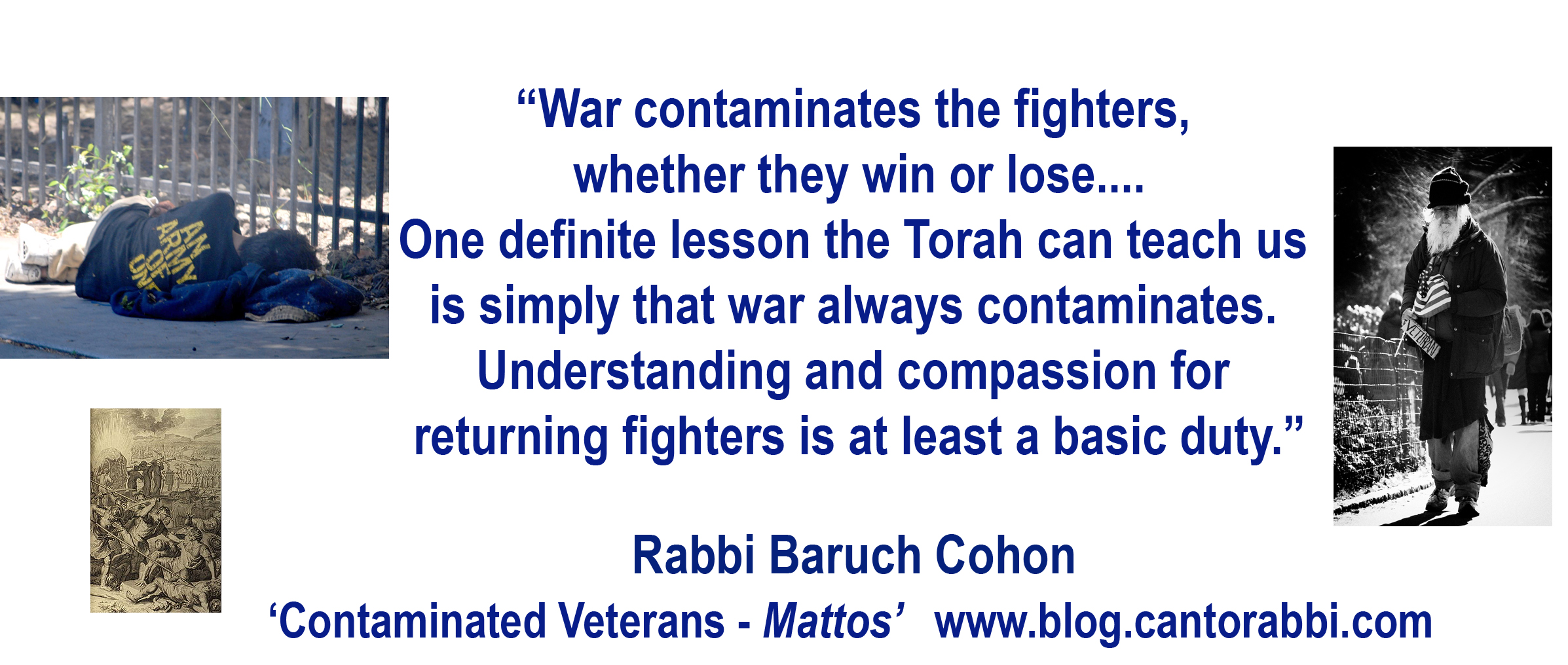
War contaminates the fighters, whether they win or lose. Back in Chapter 19, we learned about the 7-day quarantine for anyone touching a dead body. Here, as Rashi points out, quoting Rabbi Meir, contamination is not limited to touching. “Whoever killed or touched,” said Moses. The law includes killing with an arrow shot from a bow, because just as the weapon becomes contaminated, so does the shooter.

Does that contamination extend to killing with a gun, a torpedo – or a truck? Our soldiers, whether American or Israeli, do not get quarantined after every battle these days. But apparently, the soldiers who conquered Midian didn’t either. Only after the fighting was over. How does that apply to situations that go on for months? Clearly, it would be more than difficult to invoke Biblical law in modern warfare.

What does seem applicable, however, is the principle behind this law. Unlike some of our enemies, we do not celebrate mass murderers or promise them all those virgins in heaven. Fighting a war requires killing enemies. Life is a gift from G-d, even if that life threatens our own. When we are the killers, we are necessarily contaminated, whether physically or psychologically. That condition can show in post-traumatic afflictions, nervous disorders, and types of contamination that no 7-day treatment can cure. Violent conflicts produce human effects that challenge our best minds, and we still cannot come up with a way to prevent violence.

One definite lesson the Torah can teach us is simply that war always contaminates. Understanding and compassion for returning fighters is at least a basic duty. Until the human race can find a way to real peace, we can start by housing and healing those who fought. Those of us who can still remember our World War II service can testify that when we came home we were welcomed, honored, given a GI Bill and mustering out pay. It was a time of victory and pride – pride in our country and pride of our troops. Since then, every armed campaign became a political controversy. Results impact the volunteers who served. Today too many returning veterans are treated as if they truly have a contagious disease. To our shame, we pass them begging on streetcorners, or sleeping under bridges. By ignoring their plight, we contaminate ourselves.

Let’s take them off the street. Relieve their war-induced victimhood. They fought our battle. Yes, war contaminated them. Their contamination is our contamination!

Mattos Numbers30-32

Posted in Jewish Blogs | Tagged , , , , , , , , , , , , | Comments Off on CONTAMINATED VETERANS – Mattos, Num.30-32 – by Rabbi Baruch Cohon

LEADERS WANTED – Numbers 27 – Pinchas – by Rabbi Baruch Cohon

Screen Shot 2013-11-05 at 11.26.08 AM

LEADERS WANTED – Numbers 27 – Pinchas – by Rabbi Baruch Cohon

After taking a census of his people, Moses gets a look at the Promised Land, although only from Mount Abarim, one of the peaks of the mountain called Nebo. He hears the Divine warning that, since he will not enter the Land himself, he can expect to die as his brother Aaron died, in solitude on a mountain top. But while Aaron had his son Elazar with him to anoint as High Priest to succeed him, his brother Moses to transfer his clothes to his son, and both of them to bury him, we will see at the end of Deuteronomy that Moses will die in total solitude and G-d will bury him. Moses will have plenty to do from now till then. This “mountain view” is therefore nothing but a preview. And an opportunity to speak with G-d.

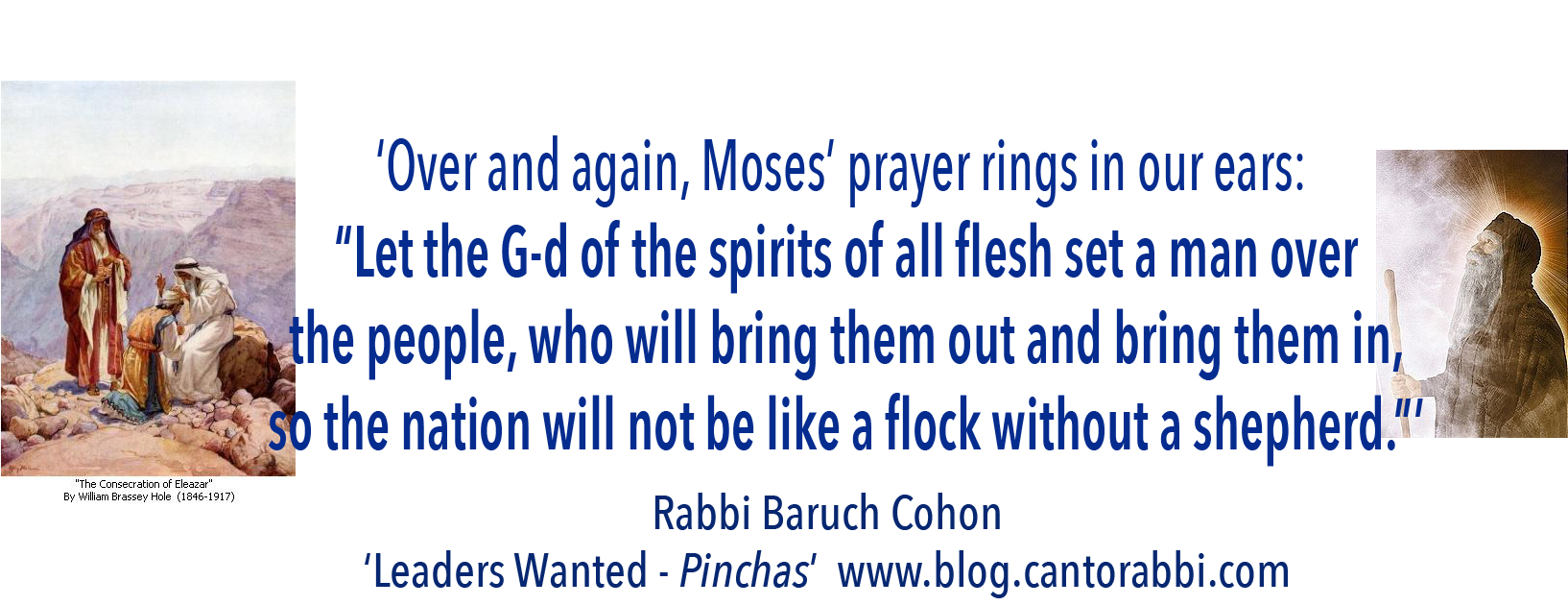
How does Moses use this opportunity? Does he beg the Almighty to reconsider, to let him lead his people across the Jordan? Does he pray for immortality? Maybe he would like to, but he knows better. He asks the Eternal One for a successor, a leader “who will go before the people to take them out and bring them in,” one who will galvanize them to win wars, and inspire them to build their future in peace. Like the American vice-president, this successor takes over only after the death of the current leader. After witnessing the process of choosing such a potential successor for both of this year’s candidates, we can relate to Moses’ prayer.

The answer Moses gets can teach us lasting principles about choosing leaders. He is told to take Joshua, his lieutenant who grew into maturity as Moses’ devoted helper, one of only two spies who brought back a positive report about the Land, who in his youth was described in the Torah as a “boy who did not move out of the Tent of Meeting.” “Take Joshua,” says G-d, ”a man who has spirit… Place some of your glory on him… Let him stand before Elazar the Priest to hear the word of G-d.” Then Joshua and the people will take action.

Elazar, son of Aaron, will supply the law, but he will not be the leader. By now, he and his brother Itamar learned from their father and from their uncle Moses what their role should be. High Priest is not head of state. Ayatollahs are notably missing from Jewish history. The notable exception is the family we recall every Hanukkah – the Maccabees. Matisyohu – Mattathias, the senior head of the Hasmonean clan, is identified in our prayers as kohen gadol – the High Priest. He and his soldier sons freed the people from the Syrian Greeks who tried to eradicate their faith and their culture. And then they set up a theocratic dynasty which became corrupt and earned the disapproval of the rabbis of the Talmud, who played down Hanukkah rather than glorify that dynasty.

Speaking of dynasties, of course, we note that Moses also had two sons. Why are they ignored?

Rashi and other commentators ask why this story immediately follows the case of the daughters of Zelophehad who had no brothers and therefore needed a special ruling in order to inherit their father’s property. The ruling they get specifies “if a man dies and has no sons.” The Klee Yokor commentary adds the condition that maybe he had sons who were not deserving to inherit, who lacked knowledge, wisdom and leadership qualities that their father did not give them. They should not inherit his position. As we read Moses’ career, we must admit that he did not raise his sons. He was facing continuous crises in leading the People of Israel.

Where were his sons? Certainly they were elsewhere during most of their father’s years of leadership. Neither Gershom nor Eliezer shows up in the Torah narrative much after their birth in the desert, well before the Exodus.

Clearly, selecting a leader is no easy job. Not even for Moses. As our history progressed, from tribal chiefs to judges to kings, it didn’t get easier. And when David had to deal with his various sons, bloodshed and revolt scarred the country until Solomon, the wise one, secured the throne.

Democracy complicates the process still further. Whether in Israel or the United States, in Germany or Russia, in Cuba or Egypt or any other country officially using the election process, brilliant and successful leaders are rare. Chosen successors might or might not extend their achievements. Too often momentous mistakes can produce inept or misguided leaders. Results for the people can be disastrous.

No inherited authority in the U.S., for sure. Even John Quincy and George W had to be elected independently. Our foreseeable heir to the White House will not be Ivanka Trump or Chelsea Clinton (Jewish connections notwithstanding). So good luck to Messrs. Kaine and Pence.

Over and again, Moses’ prayer rings in our ears: “Let the G-d of the spirits of all flesh set a man over the people, who will bring them out and bring them in, so the nation will not be like a flock without a shepherd.”

Pinchas

Posted in Jewish Blogs | Tagged , , , , , , , , , , , , , , , , , , , , | Comments Off on LEADERS WANTED – Numbers 27 – Pinchas – by Rabbi Baruch Cohon

BILAAM OR MICAH? – Balak – Num. 22:2—25:9, by Rabbi Baruch Cohon

Screen Shot 2013-11-05 at 11.26.08 AM

BILAAM OR MICAH? – Balak – Num. 22:2—25:9, by Rabbi Baruch Cohon

This week gives us a Sedrah and a Haftorah that are both full of marvelous, famous lines to quote. Our first prayer when we enter a synagogue is a line from this Sedrah: Mah tovu ohalekha Yaakov – “How fair are your tents, Jacob!” And later in this Shabos service we will hear the Haftorah, finishing with Micah’s message: Higid l’kha Adam mah tov – “He told you, oh man, what is good.” Great lines. Great quotes, echoing religious truth and inspiration.

We can also find a powerful political message in these readings. Here is Balak, king of Moab. He sees hundreds of thousands of aliens entering his country. He’s alarmed. There goes the neighborhood, right? These aliens will “lick up the land,” he says. They’ll take away jobs, housing, public facilities.

So what does he do? Build a wall? Threaten deportation? Not Balak. He sends for a sorcerer named Bilaam. “Come put a curse on them,” he says. “Keep them out of my schools, keep them out of my hospitals, keep them from learning my language.” And he sends a special delegation to the sorcerer with a definite message: This curse is worth money to the king.

Bilaam invites the delegates to spend the night while he consults with a Higher Authority, seeking a message from the Divine. That night in his dreams comes the Divine question: Mee ha-anashim ha-eyleh? “Who are these men?”

Come on, now. You mean HaShem doesn’t know who Bilaam’s visitors are? Of course He knows. So why is He asking? A great commentator, the Kli Yokor, points out that there are two ways of asking Who? One is for information; the other is an expression of scorn: Who ARE these guys? Who do they think they are? Who do you think they are? You think they’re princes, officers, statesmen? They’re PR men! Don’t go with them.

Of course, Bilaam is thinking with his pocket. If he shouldn’t go with this committee of PR men, then maybe a more important committee will be different – more clout, more cash. So he doesn’t go with Balak’s first group, but he does go with the next group. Higher rank. Higher offer.

The story continues with fascinating detail about Bilaam’s journey by donkey, his repeated forced stops along the way, his three projected curses which all turn into blessings, prompting Balak’s fury. And the reward Bilaam never collects. On this eventful trip, what ultimately stops Bilaam? His donkey. The world’s only talking donkey, right?

Wrong. In politics, as I’m sure you heard before, you can find plenty of talking jackasses. Bilaam’s donkey was not unique. Except…

Except that we are told in Pirkey Avot that this donkey’s power of speech was specially created at the time of the creation of the universe – on Shabos beyn hash’moshos – at twilight before that first Sabbath at the dawn of time – created then as one of the few exceptions that prove the rules of Creation, the rules of Nature. Specifically provided for this particular purpose. For this particular man – Bilaam.

How does he rate?

Granted, he had an evil streak – greed and cunning and a deep desire to destroy Israel. Granted, he found himself unable to utter the curse, but he managed to send women out of Midian to seduce the Israelite men into idolatry. Yet, despite his evil side, Bilaam was very lucky. He had a fabulous donkey who saved his life, not once but three times right here in this story. He himself could not see what the donkey saw – a mal’akh blocking his way.

What’s the mal’akh? An angel? Literally a messenger? He’s more than that. The mal’akh with the drawn sword is the consequence of Bilaam’s action.

It takes a lot of wisdom to see the consequences of what we plan to do. Bilaam couldn’t see those consequences, but the donkey could. The third time she sees the danger, the donkey squats down on the ground for safety, whereupon Bilaam blows his stack and beats his donkey with a stick. Only then does the donkey speak, saying, in effect: “You think I’m only a jackass, but I’m smarter than you are. Open your eyes and look what you may be getting us into!”

Isn’t that what any political leader, in fact any responsible human being needs to hear? Sometimes it takes the talking donkey in our midst to open our eyes. She never went to school, Bilaam’s donkey. She has no wealth, no power, no status. But she can see what Bilaam can’t see – because she is not blinded by the thought of Balak’s gold. Bilaam cannot see the results of his own curse.

You can discriminate against people. You can keep them down. You can exploit them. You can even praise them while you’re doing it. That’s what Bilaam did when he said Mah tovu, isn’t it? Praise the aliens for building nice tents. But his real objective was to get those tents for himself, or to destroy them. It would be like Khamenei praising the skyscrapers of Tel Aviv.

Sooner or later there’s an avenging messenger to deal with.

And here’s where the prophet Micah comes in, to tell us: Look ahead, and see the real purpose. What does HaShem require of us? Asot mishpat – DO justice, don’t just talk about it. Justice is even. Justice is fair. Don’t favor the rich; don’t favor the poor.

Secondly: Ahavat Khesed – love mercy. Know the difference between love and seduction. Bilaam wanted to be seduced by Balak’s PR men, and glorified with Balak’s gold. When that didn’t work, he stirred up some seduction himself, and spread disease among those alien Hebrews. Couldn’t beat them with a hex? We’ll beat them with sex. And pass it off as love.

So Micah comes to tell us: Ahavat Khesed – love mercy. More than passion is compassion.

Third: And always, whether you lead a nation, a city, a family, a local organization, or a chapter of a global movement – or just lead your own life – Hatzneya lekhet – walk with humility. Humility does not mean to be timid and always take the back seat. Humility means, be ready to listen – listen to the message of your heritage, and you have a great one…listen to the voice of your conscience…even be ready to listen to somebody you may think is only a talking donkey. Just be careful. Don’t confuse the talking donkey with the prophet.

Today, we need to listen to the Prophet Micah.

Ken y’hee ratzon.

BilaamOrMicah Balak

Posted in Jewish Blogs | Tagged , , , , , , , , , , , , , , | Comments Off on BILAAM OR MICAH? – Balak – Num. 22:2—25:9, by Rabbi Baruch Cohon

ALL ABOUT MIRIAM – Chukas, Numbers 20 – by Rabbi Baruch Cohon

Screen Shot 2013-11-05 at 11.26.08 AM

ALL ABOUT MIRIAM – Chukas, Numbers 20 – by Rabbi Baruch Cohon

At the beginning of Chapter 20 in the Book of Numbers we will read this week of the death of Miriam, sister of Moses and Aaron. Tersely the Torah says: “The people stayed at Kadesh. Miriam died there and was buried there.” Period.

At the end of the same chapter we will read of the death of Aaron, the High Priest. During his last day, he gets taken up the mountain by his brother Moses, along with his son Eleazar. There, at G-d’s command, Moses divests Aaron of the priestly clothes, the evidence of his position, and dresses Eleazar in those clothes as his successor. Then Aaron dies peacefully, and the entire camp mourns him, shedding tears for 30 days.

Tears? Now wait a minute. Wasn’t Miriam worth a few tears? She started her career by saving her baby brother Moses from Pharaoh’s genocidal edict, and providing the Egyptian princess with a Hebrew nursemaid for him – namely her mother. She continued her service by leading the women of Israel in song when they crossed the Red Sea on dry land. She is called n’viah — a prophetess – both there and in the later books of the Bible. All right, she badmouthed Moses’ wife. But so did Aaron. And Miriam took the punishment for that offense, spending a week in quarantine outside the camp. During that week the people stayed where they were; they would not move on without her. She was important to them.

Just how important Miriam was, we learn from the very next sentence after her burial. “There was no water for the people, and they protested to Moses and Aaron.” In this succession of events, the rabbis found a connection. Miriam was the connection. In her merit, a miraculous water well accompanied the people on their desert trek. When she died, no more water.

The Lubavitcher Rebbe notes the traditional principle Eyn ma-yim ella Torah – “Torah is the only water,” signifying that just as water is indispensable to physical life, so Torah is what we all need for our spiritual life. And he comments that just as Miriam’s lifelong interest was in helping children, so every mother, sister and teacher can give spiritual life to the growing generation. Certainly for most of us, our first taste of the water of Torah – from how to pronounce haMotzi to honoring our parents and telling the truth – the very concept of Mitzvah — came from a woman. Could be our mothers, grandmothers, older sisters – each one following Miriam’s example. So we all still drink from Miriam’s well.

Of course, something else is missing from the story of Miriam’s death. Who buried her? After all, she had next of kin. If Abraham could insist on buying the Cave of Machpelah to bury Sarah…if Isaac and Ishmael could overcome their conflict with each other and join in burying their father Abraham… if Jacob could build a special tomb for Rachel… did Miriam have to be buried by some impersonal burial society?

These questions bring up another, also quite interesting question. Besides her brothers, did Miriam have any family of her own? The Torah mentions none. No mate, no children. True, later commentators and Talmudic rabbis associate Miriam’s identity with several other women who are named in the Torah, including the wife of Caleb – Joshua’s fellow-spy and the only other one who brought a positive report about the Holy Land. They also posit that Miriam, by another name, had a son named Khur who once climbed the mountain with Moses. But none of these connections appear in the Torah text. And none of them figure in Miriam’s last rites. On the textual evidence, she died as she lived – by herself.

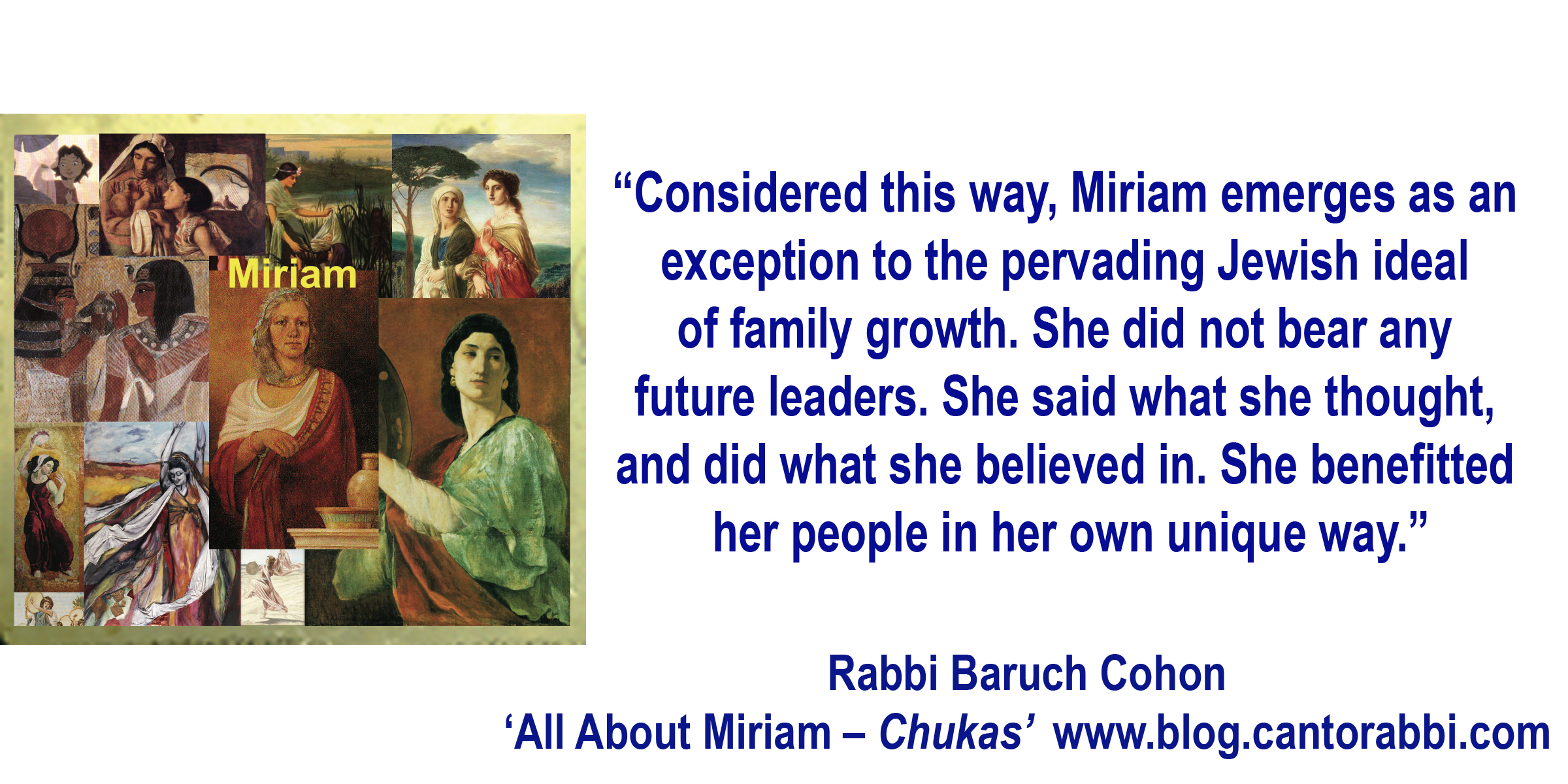
Considered this way, Miriam emerges as an exception to the pervading Jewish ideal of family growth. She did not bear any future leaders. She said what she thought, and did what she believed in. She benefitted her people in her own unique way. Among the great women of the Bible, she clearly stands alone.

No wonder hers is a favorite name for Jewish daughters, ever since her time.

MiriamChukas

Posted in Jewish Blogs | Tagged , , , , , , , , , , , , | Comments Off on ALL ABOUT MIRIAM – Chukas, Numbers 20 – by Rabbi Baruch Cohon