“KEE” IS THE KEY – Kee teitzei – Deut. 21:10-25:19, by Rabbi Baruch Cohon

Screen Shot 2013-11-05 at 11.26.08 AM

“KEE” IS THE KEY – Kee teitzei – Deut. 21:10-25:19, by Rabbi Baruch Cohon

Of all the laws stated in this week’s reading — from capital punishment for rape to compassionate treatment of farm animals, from the warning against making vows to the reminder of proper relations with neighboring tribes, with the periodic refrain “purge the evil from your midst” — perhaps the most significant lesson for our generation comes in the opening words of Kee teitzei. Like parallel passages in last week’s Sedrah, this sentence, Kee teitzei lamilkhama al oy’vekha, concerns conduct in warfare, and its translation raises a question.

One English version starts this way: “When you go out to war against your enemies…”

Another one says: “If you go out to war against your enemies…”

Then they both continue with a detailed message about how to treat a female captive.

The question raised concerns the translation of the word Kee. Does it mean when? Or if? “When” would accept the reality that wars happen, and there are rules – or there should be rules – governing the soldier’s conduct. On the other hand, “If” would indicate a choice. You go out to war only if you want to? Volunteers get sworn in; civilians are exempt?

On further examination, an ordinary Hebrew-English dictionary will offer several translations of the word Kee, including both “if” and “when.” Interestingly enough, the same dictionary will also translate Kee as “because.” And thereby we can learn something. Kee teitzei la-milkhama – you go to war because – because you have enemies and they attack you, because you have to fight them off before they destroy you, or maybe because you want to make peace and they won’t negotiate with you.

With one little word, our Sedrah illustrates a historical truth that gets ignored in our time: it takes two to make peace, but only one to make war. If you go out to war, and when you go out to war, it’s because you have no choice. Contemporary policies may imagine such a choice, but go find it. Cases in point: Gaza rockets, 9/11 attacks, Pearl Harbor.

Treatment of captive women as outlined in the Torah for victorious Israelite soldiers differed entirely, of course, from the treatment Israelite women could expect under the reverse conditions.

Several connected messages sharpen this point. Later in the Sedrah we will read: “Do not despise an Edomite; he is your brother.” And even this one: “Do not despise an Egyptian, because you were a stranger in his country.”

On the contrary, at the very end of the Sedrah we will read a section that will be repeated on Purim: “Destroy the memory of Amalek!” Not just the fighting forces of Amalek, but his evil plan. The very memory of Amalek must be destroyed. Significantly, next Purim we will again hear the interpretation: Haman mi-zera Amalek – Haman the Purim villain is descended from Amalek! Evidently Israel went to war against Amalek, but did not purge the evil. Besides Haman, the descendants of Amalek – whether physical or spiritual – include Torquemada, Khmelnitsky, Hitler, Arafat, Khamenei… and the list goes on, demanding our attention, calling for action. Not if, not when. Because. Because we must purge the evil.

In order to purge the evil, we must identify our enemies.

Kee teitzei

Posted in Jewish Blogs | Tagged , , , , , , , , , , , , , , | 1 Comment

JUSTICE, JUSTICE – Shoftim – Deut. 16:18 – 21:9 – by Rabbi Baruch Cohon

Screen Shot 2013-11-05 at 11.26.08 AM

JUSTICE, JUSTICE – Shoftim – Deut. 16:18 – 21:9 – by Rabbi Baruch Cohon

This week we will read about the community structure Moses outlines for his people to establish in the Promised Land. He starts with law courts and judges and magistrates, then proceeds to religious practice, to crime and punishment, to the monarchy, and to the laws of warfare. Throughout, he delivers the message that Israel is to be ruled by law, not by the whims of human officers. And he enunciates some great principles. Sample a few:

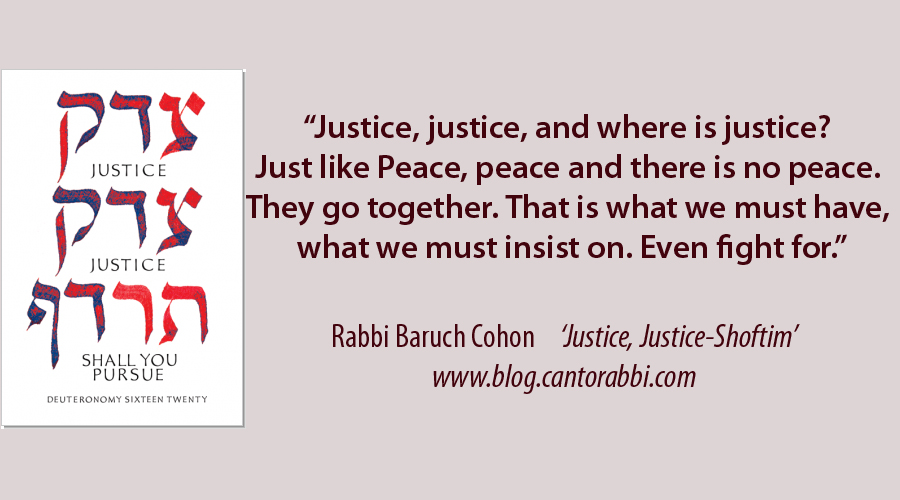
“Tzedek tzedek tirdof — Justice, justice shall you pursue.” The very third sentence of this section sets a standard.

Uviarta ha-ra mikirbekhaExcise the evil from your midst.” No. not exercise. Excise – get rid of it! This line gets repeated, as it applies to more than one situation.

Lo yumas al pee aid ekhad – The condemned shall not die on the testimony of one witness.” Any capital crime required two eye witnesses for a conviction. No circumstantial evidence allowed. Even the accused got the benefit of the doubt.

Kee ha-adam aitz hasadeh? – Is the tree in the field a man?” When besieging an enemy city, don’t cut down fruit trees to build scaffolds over the city’s walls. The tree is not your enemy.

And of course, the most famous one: “A-yin takhas a-yin – An eye for an eye.” Particularly applied to a false witness, Moses specifies: “As he plotted to have done to his brother, so shall you do to him.”

The first of these quotes is unquestionably the dominant one. “Justice, justice…” Significantly, our commentators question the repetition. Certainly repetition is a familiar feature of human speech. Speakers – including rabbis and candidates – employ repetition for dramatic effect. Teachers use it to stress importance. When did Columbus discover America? 1492, 1492, say it again 1492 – and you never forgot it. It helped you remember when the Jews were expelled from Spain, too.

Cantors frequently used it for musical effect. I remember being quite surprised when the rabbi of one synagogue invited me to chant Musaf and added: “We don’t repeat words here.” Of course, Chabad congregations don’t let that interfere with the melody – when words run out, just sing Dy-de-dy-dy-dy!

Agitators and other politicians like to get demonstrators to echo their repeated slogans. Nothing new there either. One of them likely prompted Jeremiah to denounce those who shout “Shalom, shalom” and then he added, v’ain shalom – “Peace, peace” and there is no peace!

Repetitions enforce the meaning of the word. Sometimes they add new meaning.

In our Sedrah, why does Moses say “Justice, justice?” Isn’t one justice enough? The commentators conclude that justice is not open to any magistrate’s interpretation. Justice for the rich must be justice for the poor. Do not favor the poor out of sympathy, or pervert justice to honor the rich. (Or to reward campaign contributors.) Bachya ben Asher goes so far as to comment that this prohibits us from using unjust means to secure justice.

What we think of as “poetic justice” is strictly limited here. We are cautioned to apply the law strongly enough to “excise the evil.” Even though later generations took “an eye for eye” to mean the value of an eye, the principle remained. After all, putting out the guilty man’s eye is only an act of revenge; it really would not benefit his victim the way a sizeable payment would.

We might also take issue with those who talk about justice when their aims are questionable. Pursue justice, not advantage. Don’t manipulate the laws for your own benefit. Pursue justice, not convenience. Sure, the police would be more comfortable if they were the only ones armed. But owning a weapon is still legal. Pursue justice, not discrimination. An immigrant committed murder? Punish the killer, not all immigrants. We have a Divine command to pursue justice. In all its forms.

Justice, justice, and where is justice? Just like Peace, peace and there is no peace. They go together. That is what we must have, what we must insist on. Even fight for.

Justice in war is justice in peace.

And without justice, can we really have peace? In the Jewish vision of the Messianic future, they are inseparable. And now, as far as we may find ourselves from that future, we can still work to bring true justice into our lives, our communities, and hopefully our world. To the extent that we succeed in our pursuit of justice, we can build our prospects for lasting peace.

Ken y’hee ratzon. May this be G-d’s will. And ours.

Shoftim1

Posted in Jewish Blogs | Tagged , , , , , , , , , , , , , | Comments Off on JUSTICE, JUSTICE – Shoftim – Deut. 16:18 – 21:9 – by Rabbi Baruch Cohon

ENTERING ELUL – R’ey – Deut. 11:26—16:17, by Rabbi Baruch Cohon

Screen Shot 2013-11-05 at 11.26.08 AM
ENTERING ELUL – R’ey – Deut. 11:26—16:17, by Rabbi Baruch Cohon

This year, the Sedrah called R’ey – “See here!”—coincides with the first day of Rosh Hodesh Elul, beginning the month that anticipates our New Year 5777. The name of this month is spelled with the four Hebrew letters aleph, lamed, vav, lamed, which are the initials of the words Ani L’dodi V’dodi Lee, from the Song of Songs: “I belong to my Beloved and my Beloved is mine,” symbolizing the ideal loving relationship between G-d and the Jewish People. Indeed, this week’s reading describes us as “children of the L-rd your G-d…chosen to be a special nation among all the nations on Earth.”

Both the Torah portion and the Haftorah of Rosh Hodesh from the prophet Isaiah teach us how to implement this sacred relationship. Moses notifies the people about the blessings and curses they can expect to receive after they enter the Land. If they keep the Mitzvos they will be blessed at Mount Gerizim and if they violate them they will be cursed at Mount Eival. Then he reviews several areas of those Mitzvos, including destroying Canaanite idolatry and rejecting idol-worshippers among the Israelites – even executing them. Israelites must sanctify selected places in the Land for Divine worship. Moses follows with details of the Seventh Year (the year of sh’mitah) when crops should not be harvested, when Hebrew slaves were to be freed and debts forgiven. Then come dietary laws and the festivals of the religious calendar. Interestingly enough, the occasions not mentioned here are exactly the ones Isaiah mentions in two identical sentences at the end of our Haftorah: “It will be, that every month on the New Month, and every Sabbath on the Sabbath, all humanity shall come to worship before Me.”

A word about location is called for. Where did the Israelites sanctify places of worship? Shiloh, and Hebron, and finally Jerusalem (regardless of what our current enemies say). Does that mean that some day the entire human race will go to Jerusalem to worship? In fact, right now many Christians and other non-Jews visit Jerusalem frequently on religious tours. Still, we need to consider that this prophecy goes beyond geographic limits. This is truly a combined vision of universal commitment to a noble way of life. For Moses, for Isaiah and for many other visionaries throughout our history, this is the goal of all our Torah study and the fulfillment of all our prayers.

Progress toward this goal calls for action as well as prayer. As we enter the month of Elul, the month of preparation for the new year, we can at least consider some practical plans to reach this goal. Let’s make our observance more significant, our business dealings more ethical, our family time more meaningful – just for starters.

R’ey, said Moses, “See here!” I led you this far. Now your life is your own to build for blessing or curse. May it be for blessing.

Elul R'ey

Posted in Jewish Blogs | Tagged , , , , , , , , , , , , , , , , , , , | 1 Comment

HEEL AND TOE – “Eykev” – Deut. 7:12-11:25, by Rabbi Baruch Cohon

Screen Shot 2013-11-05 at 11.26.08 AM

HEEL AND TOE – “Eykev” – Deut. 7:12-11:25, by Rabbi Baruch Cohon

The name of this week’s reading is EYKEV – meaning a result. “Eykev tishm’oon” it says – As a result of listening to the commandments and following them, you can expect to accomplish good things in your life. And if we don’t listen, and we don’t carry out the Divine will, we will suffer the consequences. Cause and effect. Interestingly enough, EYKEV also means Heel. The imagery is unique: just as surely as the heel follows the toe, so follow the results of our actions.

This is the message Moses gives the people during his farewell speeches at the end of his life. Every year we read it. And every year we wonder if it makes any impression.

Of course Moses was not the only leader who gave the people such messages. Just a few weeks ago we read in the Haftorah of Balak a message from the prophet Micah: “higid l’kha adam ma tov – He told you, man, what is good and what is required of you: to do justice, to love mercy and to walk humbly with your G-d.”

Down through the ages, lawgiver, prophet and sage keep trying to teach us basic values. Personally, this Shabos is very special for me, since I observe my father’s 57th Yortzite this week. My father z”l was a rabbi and a teacher of rabbis. The last sermon I ever heard him deliver was based on both of these texts. In fact, he contrasted them. Here, in effect, was his message:

Micah stresses three ideals: justice, mercy, humility. These make the character of a religious human being.

Moses also stresses three ideals. In Chapter 10 verse 12, he asks: “Now, Israel, what does G-d expect from you? To fear the L-rd your G-d, to love Him, and to serve Him with all your heart and soul.”

The parallels are not hard to draw. The Biblical concept of “fear of G-d” implies reverence. Not fright, but supreme respect. If we truly revere G-d we want to pattern our lives after the qualities we associate with Him. And justice is one primary attribute of Divinity, the MIDAS haDIN, the “quality of justice” that we recall with such drama on Yom Kippur. So, reverence for G-d – Moses’ first ideal – leads to doing justice – Micah’s first ideal.

“Love of G-d” is actualized by love of our fellow creatures. We believe that we all carry the Divine image in us. That image includes the MIDAS haRAKHAMIM, the quality of mercy. Even Shakespeare said it is “not strained.” Judaism teaches us to treat each other with kindness, to carry over some of the respect we feel for G-d into a mutual respect in dealing with people. Micah’s second ideal – loving mercy – is the clear result.

And serving G-d with total respect implies a type of attitude and a type of conduct: AVODAH is one of those Hebrew words that has two meanings – Work, and Worship. To worship G-d with sincerity requires an attitude of humility. You can’t pray honestly unless you feel a good deal less important than the Divinity you pray to. And you can’t strive to do better and better work unless you realize that you yourself are less than perfect. Unless you have some humility. When Micah said “walk humbly with G-d” he meant exactly that.

So Moses and Micah struck three parallel alerts.

Then my father went on to point out the difference between these two prophetic messages.

The difference comes in the very next sentence. Here Moses says “Lishmor es mitzvos HaShem – Keep G-d’s commandments!” That is the tool he gave us at Mount Sinai – the tool to carry out and accomplish these ideals.

Micah said nothing about Mitzvos. For a very good reason too. Micah was addressing the whole human race: Adam – Mankind. Moses was addressing Yisroel – The Jewish people. For us, Mitzva is the key that unlocks the door of a better life.

All this, of course, is on the individual level. EYKEV covers the national level too. Moses reminds them of the chosenness of Israel: “Rak ba-avosekha — Only your ancestors did G-d desire to be His beloved people” – and then he follows this section with a discussion of the land they are about to enter, and tells them that HaShem watches the land of Israel all year round.

Today we see our people in Israel dealing with attacks both violent and verbal. We pray for their survival, their success, their safety. We hear controversy about whether Mitzva-observant Jews should leave yeshiva training to serve in the army, and we also hear about military arrangements developed to facilitate that service. And we recall Moses’ promise to the IDF of his day, that they will triumph “Im shomor tishm’roon – If indeed you will guard the Mitzvos” by learning and doing them, and guard again by reviewing them to prevent forgetting.

Does this mean that only observant Jews should fight for their country? Hardly. Certainly they are not the only ones who live there. So, try this basic interpretation. The policies of a nation produce some logical results. If Israel is a Jewish nation, we should expect it to follow Torah values, and indeed it does even in warfare, always striving to avoid civilian casualties, fighting clean. Essentially Israel follows the vision of EYKEV for Eretz Yisrael. We need to implement it for Klal Yisrael– for global Jewry. We have the tools to achieve it: Lishmor es haMitzvos – Keep the Mitzvos, as Rashi points out “Lo l’khinnom ella l’tov lokh – Not for nothing, but for your own good.”

Micah gave a message to humanity. Moses gave a message to the Jews. We ignore both at our peril. We can accept both for our own good. It follows as the heel follows the toe.

HeelAndToeRBC

Posted in Jewish Blogs | Tagged , , , , , , , , , , , , , , , , , , , | Comments Off on HEEL AND TOE – “Eykev” – Deut. 7:12-11:25, by Rabbi Baruch Cohon

FAMOUS WORDS – Va-et-khanan—Deut. 3:23–7:11, by Rabbi Baruch Cohon

Screen Shot 2013-11-05 at 11.26.08 AM
FAMOUS WORDS – Va-et-khanan—Deut. 3:23–7:11, by Rabbi Baruch Cohon

This week we will observe Shabat Nakh’mu, the Sabbath of Comfort, taking its name from our Haftorah, to help us recover from the tragedies that marked Tisha B’Av. This week’s Torah reading, however, is not about comfort. In fact, Moses is reviewing our people’s experiences and charging us with loyalty, responsibility, courage, and principles of conduct – none of which promise great comfort, but all direct his listeners on the path he lays out. In the opening lines of our Sedrah, he recalls his prayer that G-d should let him lead his people into the Promised Land. At age 120, he is not ready to quit. But he is denied. He tells the people: “I will die in this land; I will not cross the Jordan. But you will go over and possess that good land.” No comfort for Moses, except the loyal and brave service of Joshua who will be his successor.

What we also get in this Torah reading are some words that are famous in other connections too. As one young student observed, Shakespeare is full of quotations – and so is the Torah, particularly here. A few examples:

In our Sedrah, Chapter 4 verse 4 is traditionally sung every Shabat when the scroll is brought to the reading desk: V’atem ha-d’veykim – “You who attach yourselves to the L-rd your G-d, all of you are alive today!”

Verse 35 appears in the prayerbook too, most impressively as it opens the Simchas Torah parade, when all the scrolls are carried around the synagogue: Atoh horeyso lo-daas – “You were shown, in order to know, that the L-rd is G-d and there is none else beside Him.”

Verse 44 is sung whenever the Torah reading finishes with the act of lifting the scroll high so everyone can see the writing in it: V’zos haTorah asher sam Moshe – “This is the Torah that Moses placed before the people of Israel,” and then of course the prayerbook adds further famous words.

Most famous of the passages we quote from this Sedrah include Chapter 5, verses 6-18. This is a repetition of the Ten Commandments, not quite verbatim from the Book of Exodus, but almost. Whether full text or abbreviated or symbolized by the two tablets, these words preach their message of right and wrong in houses of worship and in courthouses far and wide.

And Chapter 6 verse 4 is what every observant Jew is taught to repeat morning and night – the Sh’ma—“Hear, Israel. The L-rd is our G-d, the L-rd alone.” Followed immediately in 5-9 with the first paragraph of that basic principle of Judaism: V’ahavta –“Love the L-rd your G-d with all your heart, with all your soul and with all your might.”

Verse 21 of this chapter includes a line that appears in every Passover Haggadah: Avadim hayeenu – “We were slaves to Pharaoh in Egypt.” In fact our Sedrah sets out the whole theme of the Pesach Seder, when it says in verse 20: “when your son will ask you…” again repeating the family conversation from Exodus. There the kid just asks “What’s this?” Here he goes into detail: “What are the testimonies, the ordinances, the judgments…” prompting the rabbis to define the Exodus youngster as the simple son, and this one as the wise son. Be ready to answer both!

Many famous words here, no question about that. For this year’s reading, however, let’s look at another passage.

Towards the end of the reading, in Chapter 7, Moses calls us Am Kadosh – a holy nation. And he says: “[Only} you did G-d choose from all the nations of the earth to be His special people.” On what basis does Moses conclude this Divine choice was made? “Not because you were more numerous than all the other nations, did G-d desire you and choose you, for you are the fewest of all the nations. But G-d loved you and kept the oath He swore to your ancestors to bring you out and redeem you with a mighty hand. He redeemed you from the home of slavery, from the hand of Pharaoh, king of Egypt.”

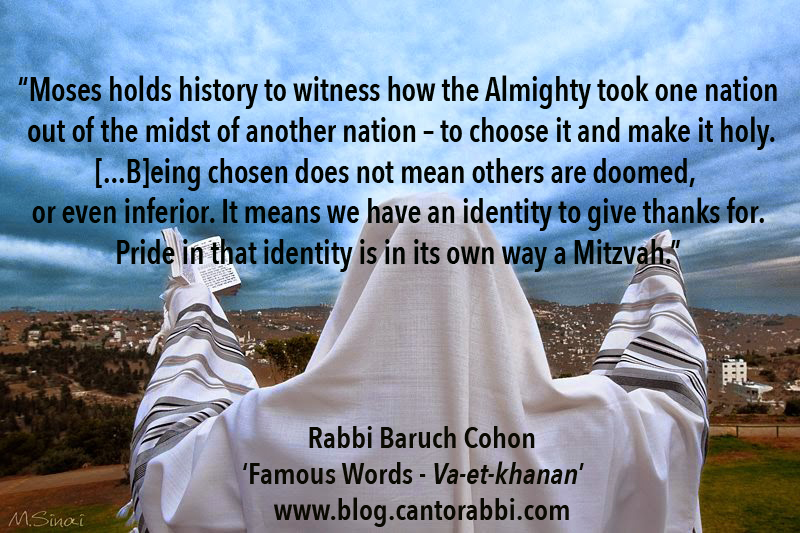
Moses holds history to witness how the Almighty took one nation out of the midst of another nation – to choose it and make it holy. Looking at our history from Moses’ time until now, we must face the fact that individually and collectively our people repeatedly proves its Divine choice. Despite our tragic losses as the “fewest,” we survive and we progress. Our current enemies may want to wipe us out, but they won’t. Nobel prizes, startup industries, topflight arts and literature, or sacred truths – you name it, we are there. No, being chosen does not mean others are doomed, or even inferior. It means we have an identity to give thanks for.

Pride in that identity is in its own way a Mitzvah. Let’s observe it.

Vaetkahanan

Posted in Jewish Blogs | Tagged , , , , , , , , , , , , , , , , , , , , , | Comments Off on FAMOUS WORDS – Va-et-khanan—Deut. 3:23–7:11, by Rabbi Baruch Cohon