LAUGHTER AND A LIE – Va-yey-ra – Gen. 18-22, by Rabbi Baruch Cohon

Screen Shot 2013-11-05 at 11.26.08 AM

LAUGHTER AND A LIE – Va-yey-ra – Gen. 18-22, by Rabbi Baruch Cohon

This week’s Torah story finds Abraham to be a gracious host, welcoming three strangers to his tent, and refreshing them with a midday meal, aided by his wife Sarah, and by their servant. The servant is not named in the text, just called “his boy” and might or might not refer to his son Ishmael who is 13 years old at this point.

The guests accept the invitation to rest and to eat. They eat cheese and milk, then a meal of freshly-slaughtered and cooked calf-meat – clearly a dinner for human beings, even though these guests are celestial. Yes, angels, bringing a message from Heaven. They dignify Abraham by accepting his hospitality, and then they deliver their message which is for both him and Sarah.

“Where is Sarah your wife?”

“She is here in the tent.”

“I will return at the proper time (literally “the time of life” – that is, 9 months) and Sarah will have a son.”

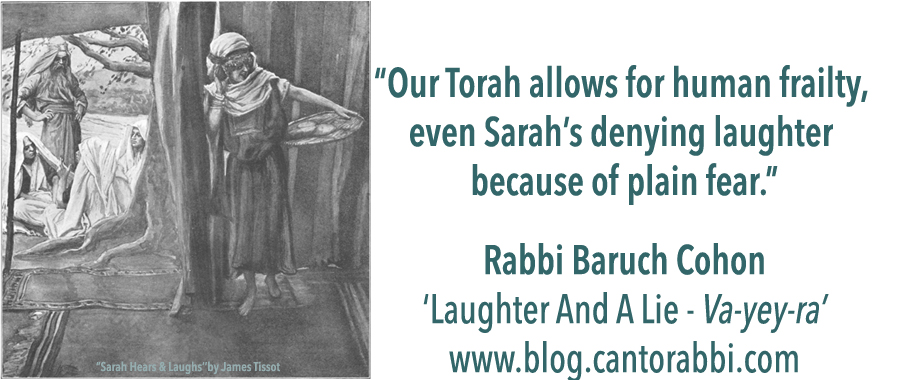
Well, Sarah doesn’t miss a word. She is right behind them in the entrance to the tent. Hearing this prediction, she laughs silently. She is pushing 90, and as the Torah tells us “Sarah no longer had the way of women,” in other words, no period for a long time now. In last week’s reading, Abraham also got the promise of a son by Sarah and it struck some laughter out loud from him – va-yitz-khak — since he was 99 and recovering from his self-inflicted circumcision, and could hardly accept the idea of becoming a new father.

The Heavenly guest doesn’t bring up the subject directly with Sarah, but he asks Abraham: “Why did Sarah laugh?… Is anything too hard for G-d?” At which Sarah speaks up – with a deliberate lie – because she is afraid:

“I didn’t laugh!”

Lo, kee tzakhakt — No, you did laugh.”

The word for laughter is unmistakable. And it becomes part of the name of the son neither parent expects. Isaac – Yitzkhak. Literally, “he will laugh.”

We will learn more about this long-awaited son in future chapters. His name, ever since then a name borne by countless Jewish men, still echoes his parents’ laughter. Significantly, however, nothing more is made of his mother’s lie. Yitzkhak – “he will laugh” – can still cheer the man who bears the name. But no one is named Y’khakhesh – “he will lie!” Our Torah allows for human frailty, even Sarah’s denying laughter because of plain fear. Sarah remains our honored mother, the first Jewish mother in history, and so symbolically the mother of all converts, the welcomed New Jews. We forgive her fear, and honor her name.
sarah-vayeyra

Posted in Jewish Blogs | Tagged , , , , , , , , , , , , , , , , | Comments Off on LAUGHTER AND A LIE – Va-yey-ra – Gen. 18-22, by Rabbi Baruch Cohon

LOTS OF “LOT”S – Ex. 12-17 – Lekh l’kha — by Rabbi Baruch Cohon

Screen Shot 2013-11-05 at 11.26.08 AM

LOTS OF “LOT”S – Ex. 12-17 – Lekh l’kha — by Rabbi Baruch Cohon

This week’s Torah reading includes parts of a story that is spread out over several chapters of the Book of Genesis. It is the story of Abraham’s relationship with his nephew Lot. Lot tagged along with Abraham and Sarah in their early travels to Canaan and Egypt and back. Along the way he shared in Abraham’s success, acquiring herds and flocks, to the point where a fight broke out between their shepherds because “the land could not support them to dwell together (Gen.13:6)”. So Abraham gives Lot a choice: “If you go to the left, I will go to the right, and if right I will go left. We are brothers.”

So Lot picks the fertile Jordan valley and settles in Sodom. Yes, the famous Sodom, the city that gave its name to one form of sexual perversion. That is not all. Next week we will read about other evils that condemned Sodom. But for now, Lot sees a chance for more prosperity and moves to it.

Then comes a war between nine of the ancient city-states – four local kings against five. One of those five was the king of Sodom. His side was losing. The Big Four captured his people – including Lot.

When Abraham hears the news, he assembles his forces and goes after the conquering tribesmen, vanquishes them and rescues Lot and all the captured prisoners and their possessions. At the victory party, the king of Sodom offers Abraham an unusual deal: “Give me the people and you take the spoils.” In other words, I’ll take Lot; you take the loot. Unexpected generosity, particularly in the Middle East, right? Well, Abraham turns him down. “I swore to the Creator of Heaven and Earth, that nothing from a thread to a shoe-string will I take from you. You will never be able to say ‘I made Abram rich.’” In fact he had already returned Lot and his people to their homes. That was his only objective.

What about Lot? Was he some kind of tzadik, some great character that inspired Abraham to risk life and fortune for his sake? Not hardly. Our commentators indicate that he never stopped his shepherds from stealing pastureland and property from farmers in their neighborhood; that’s why they got into trouble with Abraham’s men who were behaving honestly. And coming next week is the great episode of Lot’s adventures during and after the destruction of Sodom where he was living with his wife and two daughters. Remember that one?

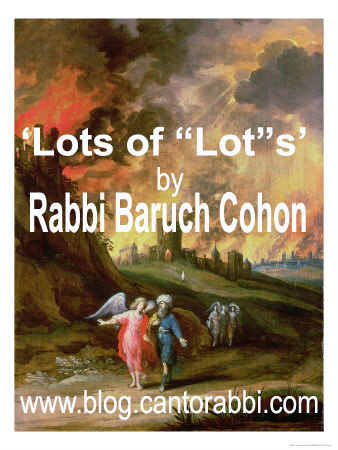
The Divine messengers arrive in Sodom to warn Lot of impending calamity. He invites them to spend the night at his house. That night a gang of Sodomites threatens to break down his door to get at the visitors, and Lot offers the gang his daughters instead. True, with Sodomites that probably wouldn’t appease them. But the Divine messengers step in and blind the gang members nearest the door, discouraging the attack. Then they spirit Lot and his family out of town. As they climb the nearest hill, Sodom is destroyed by what reads like a volcanic eruption – definitely a supernatural event since the Jordan valley is very short of volcanoes – and Lot’s wife disobeys orders and looks back to watch the fireworks. We never learn her name, but we do read her tragedy: she is turned into a pillar of salt! So far as we know, Lot does nothing to try to save her.

Afraid to stay in the nearby town of Zoar, Lot takes his daughters to the mountain and hides there. Their husbands never made it out of Sodom because, as we read, they didn’t believe destruction would come. So these two young women have no prospect of becoming mothers. What they do have is wine. So they feed their father enough wine to get him blotto, and proceed to engage in incest.

No, Lot was no great man. What he was, was Abraham’s nephew. As such, he merited Abraham’s concern and action – to care for him, to fight for him and rescue him, to pray for Divine help for him. In later Jewish history we developed the principle of pidyon sh’vuyim – redeeming prisoners – as a great mitzvah. We don’t judge them. They are our people. They could be in DP camps, or Ethiopian villages, or Iranian jails. They could be Talmud scholars or illiterate peasants. They could be observant Jews or godless Communists. We have a responsibility to help them.

If we don’t, who will?

LotBlog

Posted in Jewish Blogs | Tagged , , , , , , , , , , , , , , , , | Comments Off on LOTS OF “LOT”S – Ex. 12-17 – Lekh l’kha — by Rabbi Baruch Cohon

NOAH WHERE ARE YOU? — Sedrah Noach — Gen. 6 – 11, by Rabbi Baruch Cohon

Screen Shot 2013-11-05 at 11.26.08 AM
NOAH WHERE ARE YOU? — Sedrah Noach — Gen. 6 – 11, by Rabbi Baruch Cohon

“The end of all flesh is come before Me.” That is the Divine message Noah hears when he gets his mission to build an ark and save a future for selected living creatures. Severe climate change is coming. Why? Because Earth’s population is bringing it on. Evil is not limited to burning fossil fuel. Evil is so rampant as to condemn all who roam the planet to a tragic death. So someone needs to build an ark. This week’s reading bears the name of the builder of that ark, our friend Noah. He had to go way beyond finding different energy sources. He had to prepare for a worldwide deluge that would destroy all life on Earth. Only a gigantic lifeboat would do the job. A teyva – an ark.

The lower decks of the ark will hold seven pairs of each of the “clean animals,” those suitable to offer on the altar. Also a pair of each of the unclean animals who had no such qualifications. But apparently neither the clean nor the unclean were responsible for the evil that would soon be punished in the Flood. What about the humans on the top deck? Only Noah and his family will be saved. Noah was a “righteous and perfect man in his generation.” His wife and sons and daughters-in-law learned enough of his ways to merit a place on the ark. Everyone else will be drowned.

What was this evil that brought on universal destruction? Commentators like the Kli Yokor name three areas of human misconduct: idolatry, adultery and robbery. Put them in modern terms. Idolatry takes many forms. Denying G-d and worshipping false deities, false values, or vanity itself – those negative choices characterized the generation of the Flood, and somehow didn’t get washed away. Adultery, called gilui arroyos in Hebrew (literally “exposing nakedness”) gets expanded and remodeled in every generation, from infidelity to promiscuity to perversion, and curses and destroys social structures worldwide. And when it comes to robbery, that can be a streetcorner holdup or a mockery of justice. In fact, the Kli Yokor cites examples of officials who sell favors for a minimum price, not enough to draw punishment for each case, but enough cases to build a pattern — and a fortune. We call it corruption.

Do we have enough corruption in our world now to bring on the “end of all flesh?” Maybe we need another Noah. Maybe this time an ark will not be enough to rescue human and animal life. We surely seem to have our up-to-date versions of the Kli Yokor’s three prime offenses.

Isn’t Islamist terrorism a violent distortion of their faith, and therefore an extreme form of idolatry?

Doesn’t the step-by-step destruction of the family – basic unit of every society – through official support of invalid matings, illegitimate offspring and same-sex unions qualify as adultery?

And as for robbery, the ancients were pikers. Today, between excessive taxes and gouging prices, governments and corporations compete to milk our populations dry.

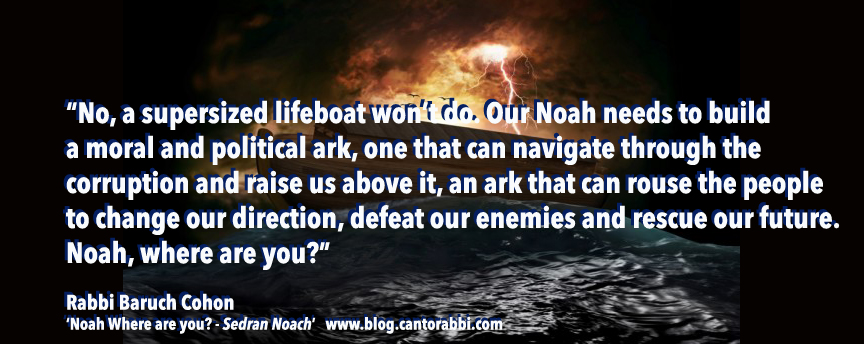
No, a supersized lifeboat won’t do. Our Noah needs to build a moral and political ark, one that can navigate through the corruption and raise us above it, an ark that can rouse the people to change our direction, defeat our enemies and rescue our future.

Noah, where are you?

noahsarkblog

Posted in Jewish Blogs | Tagged , , , , , , , , , , , , , , , , , | Comments Off on NOAH WHERE ARE YOU? — Sedrah Noach — Gen. 6 – 11, by Rabbi Baruch Cohon

DOCTRINE AND DISPUTE – B’reisheet – Genesis – by Rabbi Baruch Cohon

Screen Shot 2013-11-05 at 11.26.08 AM


DOCTRINE AND DISPUTE – B’reisheet – Genesis – by Rabbi Baruch Cohon

What did Charles Darwin discover? The doctrine of evolution; everyone knows that. And who am I to dispute with him? Many educated modern people will tell me that the universe we live in was not created in a week. It evolved over eons of time. And they are probably right.

Do I therefore discard the Biblical account of the origins of our reality? Do I reject it as fiction?

To no one’s surprise, my answer is No. I accept the Divine origin of the universe and of life itself.

Does that mean that I reject Darwin’s theory of evolution as fiction?

Here’s the surprise. My answer to that is also No. I respect scientific evidence of evolution. Dinosaurs evolved into birds. Cavemen evolved into – well, something more familiar if not superior… And it all took many many centuries.

So what about the story we read in this week’s Torah portion, the opening lines of the Bible: “In the beginning G-d created heaven and earth?” What about the account of darkness, then light, then “evening and morning, one day?” Did the planets materialize as they are now, in nearly the time it takes to tell it? One day? When the Hebrew calendar counts this as the year 5777 since Creation, can we moderns accept that number?

All right, let’s explore the dispute. To begin with, how long is “one day?” We think of it as 24 hours, and we observe it from sunrise to sunrise. When there was no sun, how long was a day? How many eons in human time did the Creator spend producing stars and planets? Taking note of the Biblical order of things, we read first about our own planet: “Earth was chaos, and darkness over depth. The spirit of G-d hovered on the face of the water.” Never mind the printed translations. They can be misleading. The message is simple: Creation precedes Evolution.

But evolution happens. It happens in Genesis, in the same order as in Darwin. Believe it or not. Life starts with vegetation, grass, herbs, trees. Next comes life in the water, from tiny fish to seagoing giants, presumably leading to amphibians. Followed by land animals, first birds and insects and reptiles (dinosaurs maybe?) then wild beasts. And finally on the 6th “day” humans arrive, endowed, says our Torah, with the Divine image. It’s all right there in Chapter 1. Humans, male and female, are given power to dominate the other creatures.

Granted, Genesis does not go into what ancient human beings looked like or how they acted. No Neanderthals here. At this point, evolutionists tend to concentrate on the physical while creationists stress the spiritual elements in human history.

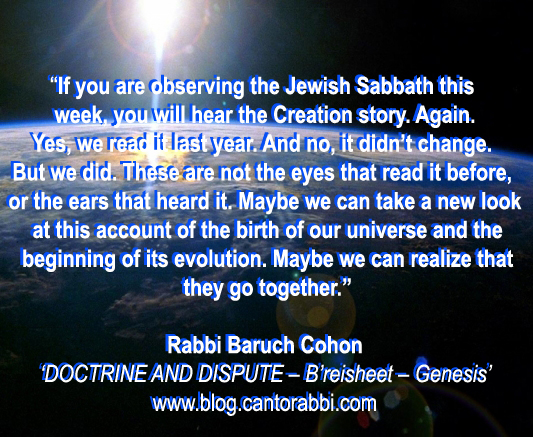
After those six super-days of Creation comes the Sabbath. Opening Chapter 2 is the Divine blessing on the 7th day, because “G-d rested” from the work of Creation. A new question: did the Creator put His image in us or are we putting our image on Him? Does G-d get tired and need a rest? No, says the Talmud. But the “Torah speaks in the language of people.” An achievement like Universal Creation calls for a Divine day of rest, just as surely as a week of tending crops, building homes, caring for children – or even writing blogs — calls for a human Sabbath. If you are observing the Jewish Sabbath this week, you will hear the Creation story. Again. Yes, we read it last year. And no, it didn’t change. But we did. These are not the eyes that read it before, or the ears that heard it. Maybe we can take a new look at this account of the birth of our universe and the beginning of its evolution. Maybe we can realize that they go together.

genesis

Posted in Jewish Blogs | Tagged , , , , , , , , , , , , | Comments Off on DOCTRINE AND DISPUTE – B’reisheet – Genesis – by Rabbi Baruch Cohon

BEGINNING AGAIN – Simhat Torah – by Rabbi Baruch Cohon

Screen Shot 2013-11-05 at 11.26.08 AM

BEGINNING AGAIN – Simhat Torah – by Rabbi Baruch Cohon

Monday night and Tuesday in traditional congregations outside Israel, or Sunday night and Monday in Israel and in Reform congregations, world Jewry will observe Simhat Torah of 5777. Once again we will march around the Synagogues carrying our Torah scrolls, singing and even dancing with them. Many services will provide an Aliya – an opportunity to bless the Torah – to every qualified male. And in some of those services each man so honored also gets a celebratory drink – a l’khyim – when he descends from the bema.

Larger congregations will conduct parallel Torah readings in different parts of the building in order to include all honorees. We should all have the opportunity to bless the Torah today. Even strict Orthodox shuls provide special alliyot for “all the women” and for “all the children.” And the Kohanim – Aaron’s descendants whose duty is to bless the people on all such holidays – usually do their dukhenen, pronouncing the blessings, during the Musaf ritual which follows Torah reading. But on this day they will do so during Shachrit which precedes that reading, for a very good reason. Jewish law requires that those who pronounce the blessing must be 100% sober! Better bless the people before you get that l’khyim.

What is the reason for all this elaborate festivity? This is the day we complete the annual reading of our Torah. Whether we combine it with the Eighth Day of Assembly – Shmini Atzeres which is the 8th day counting from the beginning of Succos – or observe it on the 9th day as yom tov sheyni shel galuyot (the “second-day holiday in exile,” to reconcile world calendars) – we will conclude the Book of Deuteronomy with its parting tribute to the one-and-only Moses, and the congregation will chant Khazak khazak v’nit’khazek – “Be strong, be strong, and we will strengthen each other!”

So what makes this holiday different from all other holidays? The distinguishing feature of Simhat Torah is that we don’t stop there. We immediately open another Torah scroll and read the story of Creation: B’reysheet – “In the beginning…”

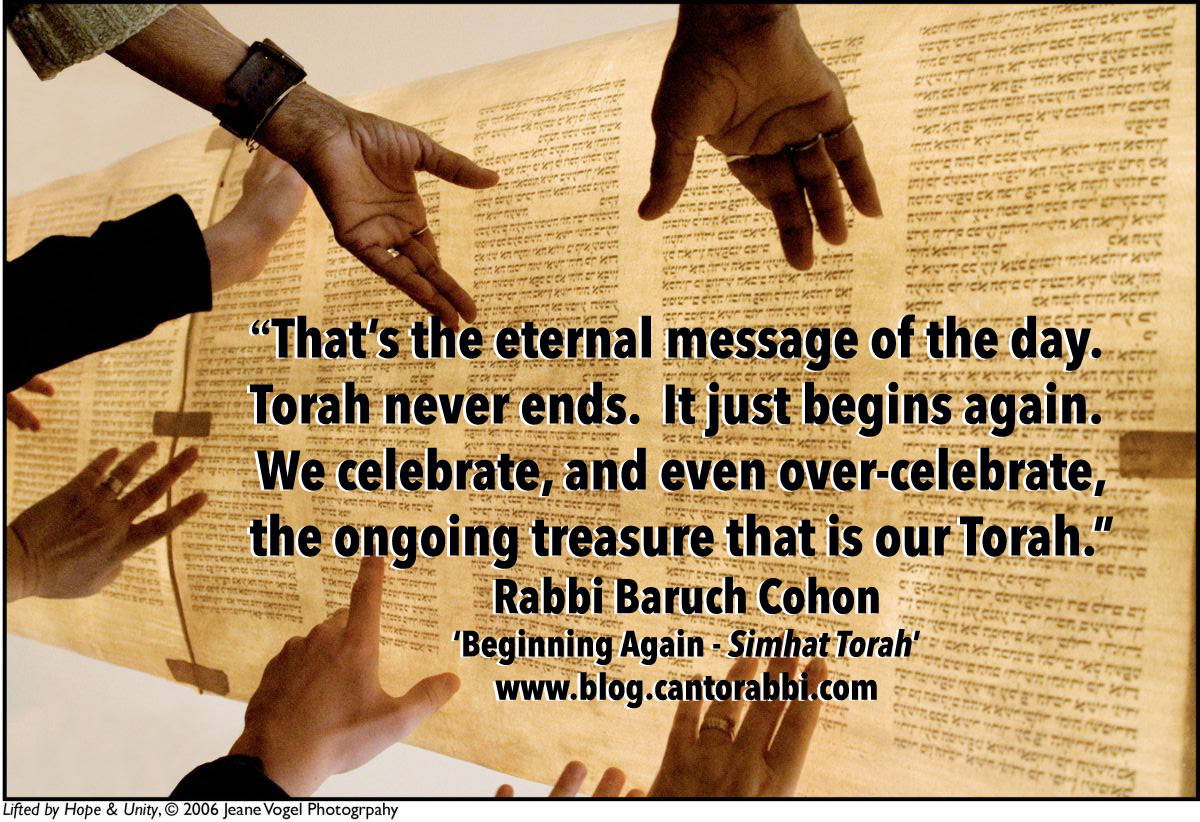
That’s the eternal message of the day. Torah never ends. It just begins again. We celebrate, and even over-celebrate, the ongoing treasure that is our Torah.

Enjoy this all-out festival, whichever day you celebrate, and let’s all join in the happy activity of Beginning Again! Khag sameyakh!

simhattorah5777

Posted in Jewish Blogs | Tagged , , , , , , , , , , , , , , , , , | Comments Off on BEGINNING AGAIN – Simhat Torah – by Rabbi Baruch Cohon