A GOOD SOUND for A GOOD DEED

DSCF6622a

A GOOD SOUND for A GOOD DEED

Actively engaged in composing and performing music, particularly Jewish music, for nearly ¾ of a century, I finally picked out my top tunes and put them in a book. Tara Publications issued it a few years ago. It’s called Songs for My People, and it includes music for the theater, the synagogue and the concert hall. Here you’ll find solos, duets and choral arrangements, complete with piano scores and/or guitar chords. Songs to celebrate the holidays of the Jewish year. And songs to dramatize some occasions in our lives and our history. More laughs than tears. 40 numbers for musicians both professional and amateur to browse through, to sing along with and enjoy. Music to raise the curtain – or to raise the soul. Some of the compositions in this book are already recorded. Others are available with permission. You can hear some samples on my personal website, http://cantorabbi.com .

In today’s market, any one of these compositions as sheet music would cost a few bucks. You can get all 40 for $18 and it’s all tax free! That’s because the books belong to the Cohon Memorial Foundation, and donations are fully deductible. Check out the Foundation on our website, www.cohonaward.com and you’ll see how you can do a good deed – and get a good sound!

Then to order Songs for My People, all you have to do is contact me at baruch.c.2011@gmail.com.

Screen Shot 2013-11-05 at 11.26.08 AM

Posted in Jewish Blogs | Tagged , , , , , , | Comments Off on A GOOD SOUND for A GOOD DEED

HEEL AND TOE – “EYKEV” – Deut. 7:12-11:25, by Rabbi Baruch Cohon

Screen Shot 2013-11-05 at 11.26.08 AM

HEEL AND TOE – “EYKEV” – Deut. 7:12-11:25, by Rabbi Baruch Cohon

The name of this week’s reading is EYKEV – meaning a result. “Eykev tishm’oon” it says – As a result of listening to the commandments and following them, you can expect to accomplish good things in your life. And if we don’t listen, and we don’t carry out the Divine will, we will suffer the consequences. Cause and effect. Interestingly enough, EYKEV also means Heel. The imagery is unique: just as surely as the heel follows the toe, so follow the results of our actions.

This is the message Moses gives the people during his farewell speeches at the end of his life. Every year we read it. And every year we wonder if it makes any impression.

Of course Moses was not the only leader who gave the people such messages. Just a few weeks ago we read in the Haftorah of Balak a message from the prophet Micah: “HIGID L’KHA ADAM MAH TOV – “He told you, man, what is good and what is required of you: to do justice, to love mercy and to walk humbly with your G-d.”

Down through the ages, lawgiver, prophet and sage keep trying to teach us basic values. Personally, this Shabos is very special for me, since I observe my father’s 55th Yortzite this week. My father z”l was a rabbi and a teacher of rabbis. The last sermon I ever heard him deliver was based on both of these texts. In fact, he contrasted them. Here, in effect, was his message:

Micah stresses three ideals: justice, mercy, humility. These make the character of a religious human being.

Moses also stresses three ideals. In Chapter 10 verse 12, he asks: “Now, Israel, what does G-d expect from you? To fear the L-rd your G-d, to love Him, and to serve Him with all your heart and soul.”

The parallels are not hard to draw. The Biblical concept of “fear of G-d” implies reverence. Not fright, but supreme respect. If we truly revere G-d we want to pattern our lives after the qualities we associate with Him. And justice is one primary attribute of Divinity, the MIDAS haDIN, the “quality of justice” that we recall with such drama on Yom Kippur. So, reverence for G-d – Moses’ first ideal – leads to doing justice – Micah’s first ideal.

“Love of G-d” is actualized by love of our fellow creatures. We believe that we all carry the Divine image in us. That image includes the MIDAS haRAKHAMIM, the quality of mercy. Even Shakespeare said it is “not strained.” Judaism teaches us to treat each other with kindness, to carry over some of the respect we feel for G-d into a mutual respect in dealing with people. Micah’s second ideal – loving mercy – is the clear result.

And serving G-d with total respect implies a type of attitude and a type of conduct: AVODAH is one of those Hebrew words that has two meanings – Work, and Worship. To worship G-d with sincerity requires an attitude of humility. You can’t pray honestly unless you feel a good deal less important than the Divinity you pray to. And you can’t strive to do better and better work unless you realize that you yourself are less than perfect. Unless you have some humility. When Micah said “walk humbly with G-d” he meant exactly that.

So Moses and Micah struck three parallel alerts.

Then my father went on to point out the difference between these two prophetic messages.

The difference comes in the very next sentence. Here Moses says “LISHMOR ES MITZVOS HASHEM – Keep G-d’s commandments!” That is the tool he gave us at Mount Sinai – the tool to carry out and accomplish these ideals.

Micah said nothing about Mitzvos. For a very good reason too. Micah was addressing the whole human race: ADAM – Mankind. Moses was addressing YISROEL – The Jewish people. For us, Mitzva is the key that unlocks the door of a better life.

All this, of course, is on the individual level. EYKEV covers the national level too. Moses reminds them of the chosenness of Israel: “RAK BAAVOTEKHA — Only your ancestors did G-d desire to be His beloved people” – and then he follows this section with a discussion of the land they are about to enter, and tells them that HaShem watches the land of Israel all year round.

Today we see our people in Israel dealing with attacks both violent and verbal. We pray for their survival, their success, their safety. We hear controversy about whether Mitzva-observant Jews should leave yeshiva training to serve in the army, and we also hear about military arrangements developed to facilitate that service. And we recall Moses’ promise to the IDF of his day, that they will triumph “IM SHOMOR TISHM’ROON – If indeed you will guard the Mitzvos” by learning and doing them, and guard again by reviewing them to prevent forgetting.

Does this mean that only observant Jews should fight for their country? Hardly. Certainly they are not the only ones who live there. So, try this basic interpretation. The policies of a nation produce some logical results. If Israel is a Jewish nation, we should expect it to follow Torah values, and indeed it does even in warfare, always striving to avoid civilian casualties, fighting clean. Essentially Israel follows the vision of EYKEV for ERETZ YISRAEL. We need to implement it for KLAL YISRAEL – for global Jewry. We have the tools to achieve it: LISHMOR ET HAMITZVOT – Keep the Mitzvos, as Rashi points out “LO L’KHINNOM ELLA L’TOV LOKH – Not for nothing, but for your own good.”

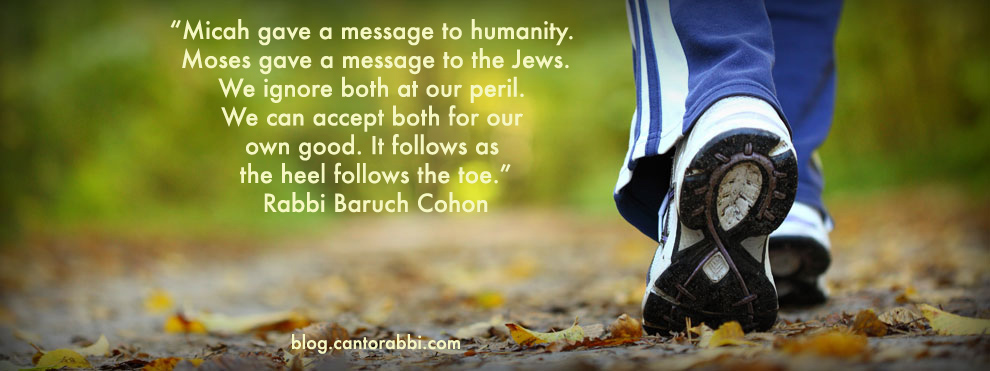
Micah gave a message to humanity. Moses gave a message to the Jews. We ignore both at our peril. We can accept both for our own good. It follows as the heel follows the toe.
HeelAndToeRBC

Posted in Jewish Blogs | Tagged , , , , , , , , , , , , , , | Comments Off on HEEL AND TOE – “EYKEV” – Deut. 7:12-11:25, by Rabbi Baruch Cohon

ALL IN ONE – Va-et-khanan – Deut. 3:23-7:11 – by Rabbi Baruch Cohon

Screen Shot 2013-11-05 at 11.26.08 AM

ALL IN ONE – Va-et-khanan – Deut. 3:23-7:11 – by Rabbi Baruch Cohon

Of all the weekly readings, this one ranks with the most memorable. Here Moses reminds his people of the Ten Commandments and enunciates the Sh’ma, the outstanding basic message of the Torah.

Hear, Israel, the L-rd is our G-d; the L-rd is One. No others. No patron saints. No intermediaries. Each human being can relate directly.

Both here and introducing the Big Ten, we should note that Moses gives the order to HEAR, and he addresses the people by the name ISRAEL. Not “Y’hudim – Jews,” for that would imply one tribe, Judah. Not the patronymic “b’ney Yaakov – children of Jacob,” for that would recall the personality of one rather conflicted patriarch. But “Israel,” the name Jacob earned by wrestling with the angel. Besides, Kabalah sages point out, G-d called him Israel even before the angel grappled with him. Because the letters in this name are all-inclusive:

Yud – Y – stands for Yitzhak and Yaakov, Isaac and Jacob.

Seen – S – for Sarah.

Resh – R – for Rebekah and Rachel.

Alelph – A – for Abraham.

Lamed – L – for Leah.

All seven patriarchs and matriarchs, all their combined strength and labor, all their inspiration – all joins in the identity that is the people Israel. All in one.

On this Shabat Nakh’mu, when we read the great Haftorah of consolation – “Comfort ye, comfort ye my people” – after the sad memorial of Tisha b’Av – let us pray for more than comfort. Let us pray for a renewal of the strength and the will to come together in unity to fulfill the name – ISRAEL!

Posted in Jewish Blogs | Tagged , , , , , , , , , , , , , , , , , , , , , , , , | Comments Off on ALL IN ONE – Va-et-khanan – Deut. 3:23-7:11 – by Rabbi Baruch Cohon

SABBATH OF VISION – D’varim – Deut. 1-3:22 – by Rabbi Baruch Cohon

Screen Shot 2013-11-05 at 11.26.08 AM

SABBATH OF VISION – D’varim – Deut. 1-3:22 – by Rabbi Baruch Cohon

This week we begin the Book of Deuteronomy, also called in Hebrew Mishneh Torah – “Torah repeated”—consisting of Moses addressing his people and reviewing what they did for the last 40 years and what they learned. Or should have learned. We were there, says Tradition, because our ancestors were there.

This Sabbath is also designated on the calendar as Shabat Khazon – the Sabbath of Vision. Specifically it is the vision of the prophet Isaiah, whose opening chapter forms the Haftorah this week. As our readings and our calendar progress, Moses’ speeches in Deuteronomy will be accompanied by Isaiah’s sermons in the Haftorah for the next six weeks. Who was he?

In his book “The Prophets,” my uncle of blessed memory, Rabbi Beryl D. Cohon, described him as the “prince of the prophets, who, perhaps more than any other of the inspired figures of Hebrew prophecy, brought the fire of Heaven down to Earth.” Living in chaotic and corrupt times, “unlike the Greek poets, Isaiah dreamed of a Golden Age in the days to come, not seeing it in the days that were. Towards it mankind is moving, slowly, haltingly, but surely.” A Messianic dream, to be sure, and one whose reality we can help bring.

This week, Isaiah’s opening chapter charges Israel with offenses that bring on and aggravate their suffering. “The ox knows his owner, and the donkey his master’s stall, but Israel does not know; My people does not understand.” He denounces sacrificial pageantry alongside corruption. Quoting G-d, he says: “What value to Me are your sacrifices?… When you spread your hands [in prayer] I will hide My eyes from you… Your hands are full of blood!” Coming as it does this year, the day before the fast of Tish’a b’Av – the 9th of the month Av, anniversary of two destructions of the Temple as well as other tragedies in Jewish history – it is traditional to chant whole sections of this Haftorah in the melody of Lamentations – Aikhah. Isaiah sets out his people’s misdeeds, and the resulting destruction, very dramatically. “Your princes are rebellious, friends of thieves. They all love bribes and chase pay-offs. They do not judge for the orphan, and the widow’s cause never comes before them. Therefore, says the L-rd, I will rid Myself of My foes. I will purge your dross… I will restore your judges as they were at first.”

Yet there is hope. Speaking in G-d’s name, Isaiah urges: “Come and let us reason together. If your sins were red like scarlet, they can be as white as snow. … Zion will be redeemed through justice, and her returnees with righteousness.” To which Rashi adds that the “returnees” include both those in Zion who return to justice, and those outside who return to Zion.

Ken y’hee ratzon – So may it be.

Posted in Jewish Blogs | Tagged , , , , , , , , , , , , , , , , | Comments Off on SABBATH OF VISION – D’varim – Deut. 1-3:22 – by Rabbi Baruch Cohon

WORD OF HONOR – Num. 30-36 – Matos-Mas’ey – by Rabbi Baruch Cohon

Screen Shot 2013-11-05 at 11.26.08 AM

WORD OF HONOR – Num. 30-36 – Matos-Mas’ey – by Rabbi Baruch Cohon

This is one of the double-header weeks when we will read two Torah portions. Subjects covered explore a wide variety. Responsibility for vows, the war against Midian, a review of the Israelite itinerary from Egypt to the border of the Promised Land, plans to assign territory there. We will read about the shepherds of Reuben and Gad obtaining permission to settle east of the Jordan on condition that they will first fight to help their fellow Israelites conquer the country. And finally a happy ending for the daughters of Zelophehad to establish women’s rights. Way too many topics for one commentary. So let’s concentrate on Number One.

Moses addresses the heads of the matos – the tribes. “This is what G-d commands,” he says. “When a man makes a vow or swears an oath to G-d, he must not break his word.” Basic honesty, right? Not a matter of public policy for the tribal princes to enforce, but a principle of personal practice. Teach your people to honor their words.

N’darim –Vows — can take many forms, of course. A positive vow can commit one to do something definite, whether that something involves physical work or a contribution – consecrating a sacrificial animal to the sanctuary, for example. A man might say “if I sell this field for the price I am asking, I will donate 10% to the Temple.” On the other hand, a negative vow can penalize the individual himself or someone else. “I hereby vow that you can get no benefit from me – or that I will take no benefit from you.” Conflicts between people are nothing new, we know.

Women also make vows. In biblical times their vows were contingent on approval by their father if they were young and single, or later by their husband. If the supervising male does not excuse them, the vow stands, and the pre-teen girl or the married lady must carry out her commitment.

The bottom line is that a neder is a sacred promise. Your word of honor. Violate it at your spiritual peril. Breaking the vow would also mean bringing a penalty sacrifice. No wonder the Talmud devotes an entire tractate to the subject of N’darim. As a matter of fact, this year the daily Talmud lesson – daf yomi – is covering this tractate now. Innumerable situations are discussed.

One who says he will not benefit from those who go to sea is permitted to deal with land dwellers. Or vice versa. And then the rabbis bring up the case of sailors who are really in the category of landlubbers because their voyages are so short, just from Akko to Jaffa – one day’s journey.

One who says he will not profit from Israelites, but we assume his suppliers and customers are Israelites, has to buy high and sell low. If he says Israelites will not profit from him, he must buy low and sell high. But nobody listens to him, says the Talmud. Because of his vow he would sell low and buy high? Let him do business with Gentiles.

One who vows he will not have pleasure with his wife, and then says that he really meant his first wife that he divorced? Quite a discussion on questions like that. If one makes a vow and then needs to cancel it, he must get help from an expert – mumkheh – who knows the laws very well.

A rather obvious case involves a man who vows not to have any benefit from his friend. He must not allow the friend to use his tools, nor may he use the friend’s tools. He must not lend him money or borrow from him. The sage Yosi son of Hanina comments that this is as if they foreswore any benefit from each other.

Vows don’t happen much any more, and these instances illustrate why that is true. When a Jew today declares his intention to do something, it is traditional to add the words b’lee neder – No vow intended. Over the centuries Judaism learned and honored the principle of keeping our word. We are still learning it. Hopefully, we honor it.

Posted in Jewish Blogs | Tagged , , , , , , , , , , , , , , , , , , , | Comments Off on WORD OF HONOR – Num. 30-36 – Matos-Mas’ey – by Rabbi Baruch Cohon