CAN WE STAND TOGETHER? Nitzavim – Deut. 29.9-30, by Rabbi Baruch Cohon

Screen Shot 2013-11-05 at 11.26.08 AM

CAN WE STAND TOGETHER? Nitzavim – Deut. 29.9-30, by Rabbi Baruch Cohon

Some years, this week’s reading is paired with the portion that follows it, but this year because of Rosh Hashanah not arriving until the beginning of next week, Nitzavim stands alone. Indeed this reading paints a symbolic picture for us all. We, the Jewish people, stand alone. Can we stand together?

Moses harangues us in these chapters: “You stand today, all of you, before the L-rd your G-d, your heads, your tribes, your elders and your officers, all the men of Israel, your children, your wives – and the stranger in your midst.” Yes, those not born Jewish who determined to join us, stood with our ancestors at Mount Sinai. “Your woodcutters and your water-drawers” are specified here – not to eliminate other vocations, but to illustrate that a humble worker had the same rights as a tribal leader when it comes to hearing the Divine Covenant.

What we were reading in earlier chapters of the Torah is good to remember this week. Those people standing at Mount Sinai included leaders and laborers, yes, and also included the children of rebels. Their fathers agitated against Moses, insisted they should forget about any Promised Land and should return to the “fleshpots of Egypt!” And now their children stand to receive the Torah?

Other witnesses to rebellion stand with them. Survivors of the calamity at Baal Peor, when idolatry combined with prostitution to produce an epidemic, halted only by the violent action of Pinchas – those memories are still with them. The Moabite girls were eager, and the Israelite men were ready to appease their enemies in exchange for those favors. Now those who resisted and survived stand to receive the Torah?

And what about the 10 spies and their bad report? It – and they – robbed the people of courage, so they were ready to give up. Run back, surrender, appease the enemy! They were ready to throw away the Land of Israel without even negotiating a nuclear deal! Should they receive the Torah?

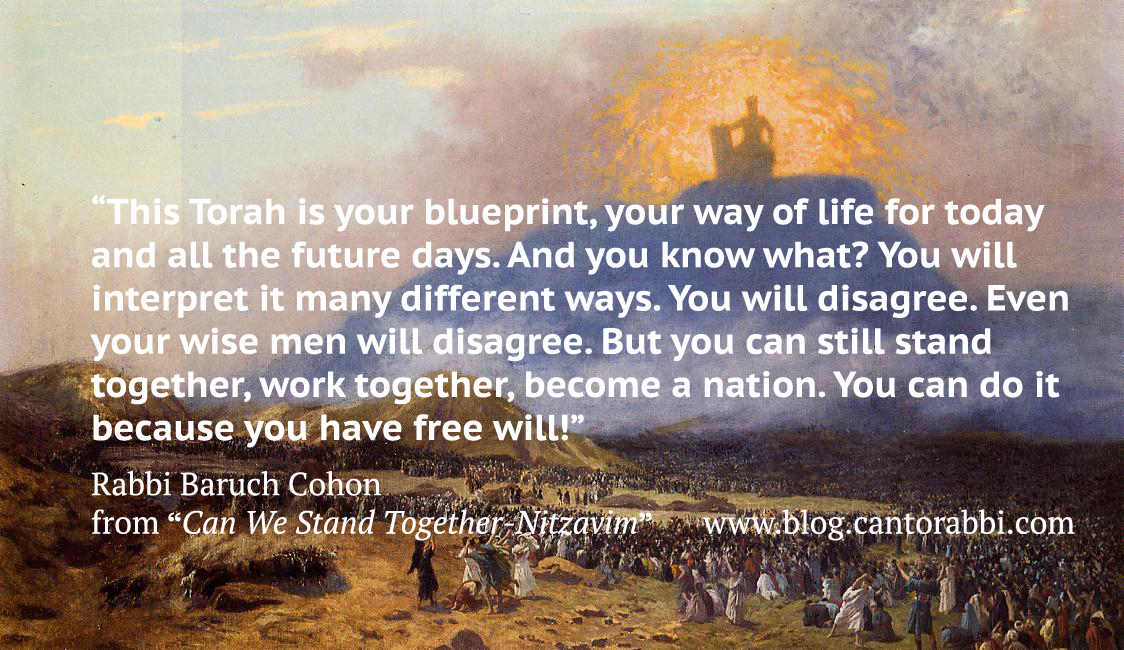
Yes, said Moses, you are here. Your officers and your followers, your right wing and your left wing, your judges and your workers, your families and your tribes – stand together now. This Torah is your blueprint, your way of life for today and all the future days. And you know what? You will interpret it many different ways. You will disagree. Even your wise men will disagree. But you can still stand together, work together, become a nation. You can do it because you have free will!

Maimonides, our great legal and critical teacher, called this the “pillar of the Law and of the Commandments.” When Moses reminds us, “Today I call Heaven and Earth to witness, I set before you life and death, the blessing and the curse. Choose life, so that you may live, you and your descendants,” he is just saying that we have a choice to make, that the Torah shows us what choice will bring us life, and make it worth living.

As we face a difficult New Year, let us hope and pray for the wisdom to stand together and make the right choices.
NitzavimRBC2015

Posted in Jewish Blogs | Tagged , , , , , , , , , , , , | 1 Comment

ENTERING THE LAND – Kee Tavo – Deut. 26.1—29.8, by Rabbi Baruch Cohon

Screen Shot 2013-11-05 at 11.26.08 AM

ENTERING THE LAND – Kee Tavo – Deut. 26.1—29.8, by Rabbi Baruch Cohon

This week’s reading continues Moses’ farewell addresses to the people on the east bank of the Jordan. Included, along with a review of other commandments, is the dramatic description of six tribes standing on each of two facing mountains enunciating a series of blessings and curses. The blessings are promises of rewards earned by following Divine guidelines and the curses detail tragic destruction as results of violating them. The famous tokhakha, as the fearful curses are called, is aptly described as second only to the actual suffering recorded in Jewish history.

At the beginning of this portion, however, we read of an offering which may seem odd to lead off with. It concerns bringing the first fruits of the harvest to the Temple as an offering. It says: “When you enter the land that G-d gives you to inherit, and you take possession and dwell there, take some of the first fruits of the earth that you take out of the land G-d gives you, and put it in a basket. Go to the place that G-d will choose for the Divine presence to dwell there, and bring the basket to the priest…” Wait, there’s more. The Torah gives the farmer a whole speech to say when delivering the fruit – which of course was limited to the crops native to the Land of Israel: wheat, barley, grapes, figs, pomegranates, olive oil and honey. The farmer then reviews ancestral history from Egypt on, culminating in acquiring “this land, a land flowing with milk and honey. And now, look, I brought the first fruit of this land that You, G-d, gave me.” To which the Torah adds: “Rejoice in all the good that G-d gave you and your family – you, and the Levite, and the stranger in your midst.” It is not enough to enjoy the bounty of the earth yourself, you must share it with those who do not have property of their own.

Note the words “take possession and dwell there.” Quoting the Talmud (in Tractate Kiddushin), Rashi notes that this commandment did not take effect until the people had conquered the land and divided it into family plots. To which the Klee Yokor commentary adds the fact that this is one of just two places where these terms “take possession and dwell there” occurs. Once they have possession and residence, Israel could “get fat and start kicking” as the prophet says, seeking areas of rulership like other nations. So this process of First Fruits has the purpose of bringing down the haughty attitude that could come with possession and residence, as if to say that this land is theirs because they acquired it with the sword, forgetting G-d. Just as the courage to conquer had a Divine source, so the blessing of residence involves responsibility – to carry out the Mitzvos.

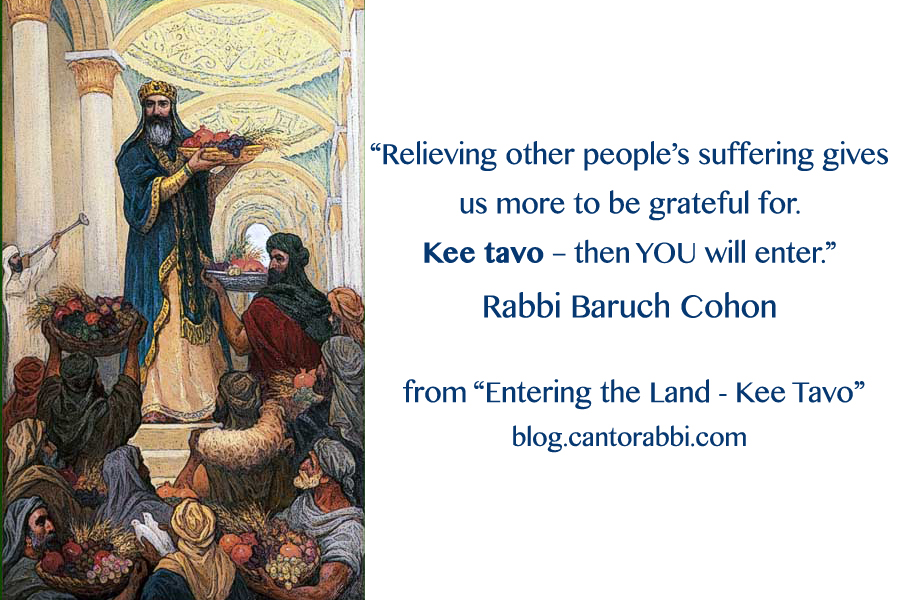
In fact, responsibility is the one condition that emerges from this whole discussion. The very opening sentence “When you enter the land” is phrased in the singular, treating the entire Israelite nation as an individual. And indeed, until the entire population was in the land, no Bikkurim – no First Fruit ceremony could take place. If even one Jew still remained outside, this national expression of gratitude for a homeland had to wait. The Lubavitcher Rebbe applies that example to today: “As long as there is a single Jew who is materially or spiritually deprived, the rest of us cannot experience complete joy. The plight of our fellow Jews – and through them the plight of all humanity and creation in general – should inspire us to action to remedy this situation.” Relieving other people’s suffering gives us more to be grateful for. Kee tavo – then YOU will enter. Something to think about this week.

BasketKeeTavo2015

Posted in Jewish Blogs | Tagged , , , , , , , , , , , , | Comments Off on ENTERING THE LAND – Kee Tavo – Deut. 26.1—29.8, by Rabbi Baruch Cohon

BETWEEN US HUMANS – “Kee teytzey” Deut. 21-25 by Rabbi Baruch Cohon

Screen Shot 2013-11-05 at 11.26.08 AM

BETWEEN US HUMANS – “Kee teytzey” Deut. 21-25 by Rabbi Baruch Cohon

This week’s reading will cover many principles of conduct between people, setting standards for how we can be expected to treat each other. From the respect toward a female war prisoner, to the care of the body of an executed criminal; from the fair treatment required to the child of an unloved wife, to the rule to pay a day laborer before the sun goes down; from the responsibility to return lost animals or articles to their owner, to the penalties for rape, and to the warning about keeping honest weights and measures to prevent cheating in business – and many more.

For this week, let’s select just two of these standards. Verse 5 of chapter 22 states: “A man’s clothes shall not be on a woman, and a man shall not wear a woman’s garment, because those who do so are an abomination to G-d.” Is this just a Politically Incorrect mitzvah? Now wait a minute. Consider local custom. I remember my Rebbe telling me about two villages facing each other in Israel. On one side of the road was a Hasidic community where the men wore 19th century type European shirts and trousers and the women wore long dresses. On the other side was an Eastern Sephardic village where the women wore pants and the men wore long desert robes. Was one or the other community violating this mitzvah? Of course not.

This prohibition really concerns sex roles. Clothing only dramatizes the issue. Judaism, from Torah times till today, values the family above much else. Confusing conduct within that structure can destroy the family, as we see happening too often now. What Moses reminded his people in this week’s reading is to maintain normal healthy relationships between men and women.

Even more applicable to our lives is the charge just before this, in verse 4: “Do not watch your brother’s donkey or ox falling down in the road and hide from them. Help him lift them up.” An overloaded animal, or a stalled car, the principle is the same. If it was yours, you would welcome help. You must do no less for your neighbor. And part of the principle is in the words “help him” – not just do it for him. Your neighbor should be right in there working with you, not leaving it to you. Whether it involves picking up a spilled load and putting it back on the vehicle, or sharing your hot-shot cable to restart his truck, don’t hide. Help. It’s a Mitzvah.

Posted in Jewish Blogs | Tagged , , , , , , , , , , , | 1 Comment

JUSTICE, JUSTICE – Shoftim – Deut. 16:18 – 21:9 – by Rabbi Baruch Cohon

Screen Shot 2013-11-05 at 11.26.08 AM

JUSTICE, JUSTICE – Shoftim – Deut. 16:18 – 21:9 – by Rabbi Baruch Cohon

This week we will read about the community structure Moses outlines for his people to establish in the Promised Land. He starts with law courts and judges and magistrates, then proceeds to religious practice, to crime and punishment, to the monarchy, and to the laws of warfare. Throughout, he delivers the message that Israel is to be ruled by law, not by the whims of human officers. And he enunciates some great principles. Sample a few:

“Tzedek tzedek tirdof — Justice, justice shall you pursue.” The very third sentence of this section sets a standard.

Uviarta ha-ra mikirbekha – Excise the evil from your midst.” No. not exercise. Excise – get rid of it! This line gets repeated, as it applies to more than one situation.

Lo yumas al pee aid ekhad – The condemned shall not die on the testimony of one witness.” Any capital crime required two eye witnesses for a conviction. No circumstantial evidence allowed. Even the accused got the benefit of the doubt.

Kee ha-adam aitz hasadeh? – Is the tree in the field a man?” When besieging an enemy city, don’t cut down fruit trees to build scaffolds over the city’s walls. The tree is not your enemy.

And of course, the most famous one: “A-yin takhas a-yin – An eye for an eye.” Particularly applied to a false witness, Moses specifies: “As he plotted to have done to his brother, so shall you do to him.”

The first of these quotes is unquestionably the dominant one. “Justice, justice…” Significantly, our commentators question the repetition. Certainly repetition is a familiar feature of human speech. Speakers – including rabbis and candidates – employ repetition for dramatic effect. Teachers use it to stress importance. When did Columbus discover America? 1492, 1492, say it again 1492 – and you never forgot it. It helped you remember when the Jews were expelled from Spain, too.

Cantors frequently used it for musical effect. I remember being quite surprised when the rabbi of one synagogue invited me to chant Musaf and added: “We don’t repeat words here.” Of course, Chabad congregations don’t let that interfere with the melody – when words run out, just sing Dy-de-dy-dy-dy!

Agitators and other politicians like to get demonstrators to echo their repeated slogans. Nothing new there either. One of them likely prompted Jeremiah to denounce those who shout “Shalom, shalom” and then he added, v’ain shalom – “Peace, peace” and there is no peace!

Repetitions enforce the meaning of the word. Sometimes they add new meaning.

In our Sedrah, why does Moses say “Justice, justice?” Isn’t one justice enough? The commentators conclude that justice is not open to any magistrate’s interpretation. Justice for the rich must be justice for the poor. Do not favor the poor out of sympathy, or pervert justice to honor the rich. (Or to reward campaign contributors.) Bachya ben Asher goes so far as to comment that this prohibits us from using unjust means to secure justice.

What we think of as “poetic justice” is strictly limited here. We are cautioned to apply the law strongly enough to “excise the evil.” Even though later generations took “an eye for eye” to mean the value of an eye, the principle remained. After all, putting out the guilty man’s eye is only an act of revenge; it really would not benefit his victim the way a sizeable payment would.

We might also take issue with those who talk about justice when their aims are questionable. Pursue justice, not advantage. Don’t manipulate the laws for your own benefit. Pursue justice, not convenience. Sure, the police would be more comfortable if they were the only ones armed. But owning a weapon is still legal. Pursue justice, not discrimination. An immigrant committed murder? Punish the killer, not all immigrants. We have a Divine command to pursue justice. In all its forms.

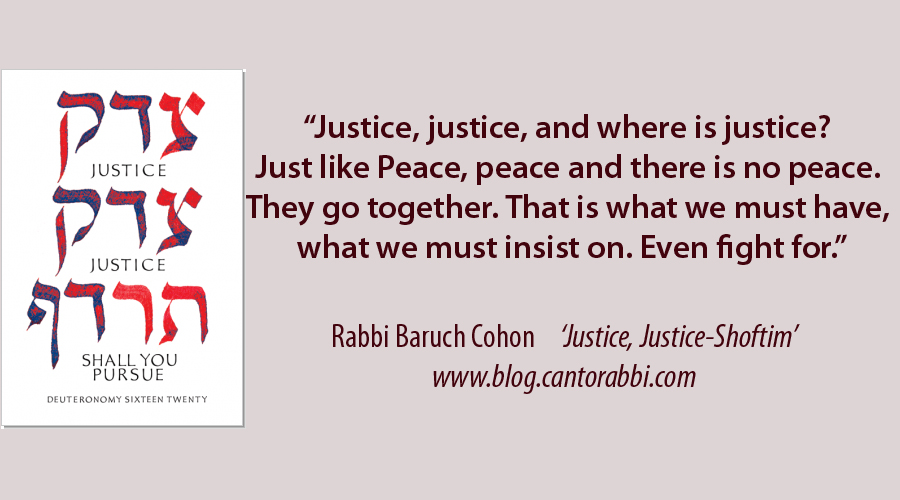
Justice, justice, and where is justice? Just like Peace, peace and there is no peace. They go together. That is what we must have, what we must insist on. Even fight for.

Justice in war is justice in peace.

And without justice, can we really have peace? In the Jewish vision of the Messianic future, they are inseparable. And now, as far as we may find ourselves from that future, we can still work to bring true justice into our lives, our communities, and hopefully our world. To the extent that we succeed in our pursuit of justice, we can build our prospects for lasting peace.

Ken y’hee ratzon. May this be G-d’s will. And ours.

Shoftim1

Posted in Jewish Blogs | Tagged , , , , , , , , , , , , | 1 Comment

LOYALTY OR ELSE? by Rabbi Baruch Cohon

Screen Shot 2013-11-05 at 11.26.08 AM
LOYALTY OR ELSE? by Rabbi Baruch Cohon

This week we will read a section called R’ey – “See” – in the Book of Deuteronomy chapters 11-16, comprising the second of Moses’ farewell speeches. He starts by telling his people: “See, I place before you today a blessing and a curse. The blessing if you follow G-d’s commandments that I give you, and the curse if you do not follow them but leave the path that I charged you to take.”

Moses implies a choice. We can opt for blessing, or we can go the other way. Does the Almighty just leave it to us? Indeed centuries later the great Rabbi Akiba stated simply: “All is foreseen, and free will is given.” G-d surely knows what we will do, but we are free to do it. Free will thus permits evil decisions, which this week’s commandments consider.

Among those commandments we find some warnings that we might call extreme. For example, how to treat a false prophet. How to react to a member of your own family who leaves the faith and invites you to come along. What to do about an entire city that decides to practice idolatry. In all such cases, the penalty is death.

Hardly sounds like a religion of love and justice, does it? It even reminds us of some current reports about fatal fatwas pronounced against prominent ex-Muslims. And who knows how many humble victims of similar fatwas we don’t hear about.

Torah commentators deal carefully with these commands to violence, as when Moses says “Your hand shall be first against him (the apostate) and finally the hand of all the people.” Rashi and others insist that the violator first had to stand trial, and only if found guilty would he be killed. Rabbi J. Hertz (former Chief Rabbi of England) points out that “Jewish history does not record a single instance of punishment for religious seduction by a false prophet or a member of one’s family.”

A similar case of Biblical justice applied – or not applied – concerns the pursuer. If you see one armed man chasing another man who is unarmed, and you assume the pursuer has murder in mind, it is your duty to stop him. But if the unarmed man runs inside a building and the pursuer follows him, and then the pursuer comes out the other side without his weapon, and you go in and find the fugitive dead and the weapon by his side? You have no case. It takes two eye witnesses to convict a murderer. You don’t know if the dead man wrestled the sword away from his attacker and then fell on it. You don’t know, so you cannot testify. And if there is no eye witness, there is no execution.

This type of case occurred a few years ago with the death of Israeli General Motta Gur, who was assumed to be a suicide. He died of a gunshot in his own back yard and was found with a pistol in his hand. Yet he received a funeral with all military honors. Some people asked how that could happen, when suicide is after all a terrible sin in Judaism. One answer detailed the law of two eye witnesses. Maybe someone jumped over the fence, killed Gur and placed the gun in his hand before escaping? Another answer, less legalistic, concerned his national value as an important leader in the Six Day War. No witnesses, so give him the benefit of the doubt.

Regarding a disloyal city, the Torah text itself warns the people who destroy that city to take no spoils. This is not to be a venture for profit. This is not the Inquisition which confiscated the property of its victims. And the Tosefta states: “The destruction of a whole community because of idolatry never occurred nor will it ever occur. The sole purpose of the warning is that it should be studied and one might receive a reward for such study.”

Study, indeed. If we studied our heritage more and understood it better, we might find ourselves more loyal to its message, and have fewer false prophets, fewer intimate seducers, and fewer rebel communities.

Perhaps we need to ask who are the real sufferers in cases of disloyalty to the faith and desertion from the community? Over and again we hear that while we lost 6 million in the Holocaust, we lost at least that many since then, to assimilation and conversion. Figures aside, we can see a decline in Jewish commitment and a weakening of interest in Jewish education. Given the advances in genetic science, we might predict a time when only your DNA will prove whether you have any connection to the Jewish people. Maybe the “idolaters” – or secularists or apostates or intermarrieds – among us are the real sufferers. And they don’t even know what they are missing – all the wonderful color and flavor of Jewish life.

They deprived themselves of the “blessing…if you follow the mitzvos that I command you today.”

No, no one will judge them and kill them. In fact, many of us stand ready to welcome them back. As the prophet Isaiah sang in this week’s Haftorah: “All your children shall be taught of the L-rd, and great shall be the peace of your children.”

LoyaltyorElse

Posted in Jewish Blogs | Tagged , , , , , , , , , , , , | 1 Comment