KORAKH 5776 – Num. 16-18 – by Rabbi Baruch Cohon

Screen Shot 2013-11-05 at 11.26.08 AM

KORAKH 5776 – Num. 16-18 – by Rabbi Baruch Cohon

This week, we will read the story of a revolution. A revolution that failed. Not the first such revolt in our history, it was nevertheless a threat to the leaders and the entire structure of the Israelite nation in the desert. Its leader, a Levite named Korakh, came a good deal closer to success than the most recent wouldbe revolutionary in our experience, one Bernie Sanders. Unlike him, although Korakh came to a dismal end, he earned a place in Jewish history that lasted all these centuries.

Korakh and Moses shared a grandfather, namely Kehas, the oldest son of Levi, Jacob’s third son. Also Korakh was wealthy, ambitious, and deeply jealous of his cousins Moses and Aaron. Why should they be the Leader and the High Priest? Why not he? Setting out to displace them, he gathered support among other ambitious and impatient tribesmen – some 250 of them, in fact. Included were not only fellow Levites but also three prominent members of the tribe of Reuben, who felt that as descendants of the oldest son of Jacob they should have the authority. These 250 rebels are described in the Torah as anshey shem – well known people. They did not consider themselves the disinherited, or the proletariat, or the downtrodden. These men already had some power. And wanted more.

Who else joined them? Their families. Wives, children, other relatives, all followed the lead of Korakh and his fellow Levites. First, they stage a protest. Gathering together to face Moses and Aaron publicly, they voice their challenge: “Rav lokhem – Enough for you! Aren’t we all holy people, with G-d among us? Why do you lift yourselves up?” In other words, do you have the right to be boss? At this point, Moses falls on his face as if to express a desperate hope for Divine guidance.

After all, this is fourth in a series of rebellions of one kind or another. Moses is out of patience. He puts Korakh and company to a test. Since they focus their rebellion on Aaron and the priesthood – as the religious symbol of authority – Moses uses tomorrow morning’s incense offering as the test.

“What is Aaron, that you murmur against him?” asks Moses. It’s easy to see that pagan peoples also offered incense. They had many idols, many altars, and hundreds of priests. The Israelites had one G-d, one altar, and one high priest. And here come 250 men who all want to be high priests! So the Midrash explains, Moses offers Korakh an attractive test: take the incense, the most prestigious of offerings. But bear in mind that this incense contains a deadly poison. This is the offering that already caused the death of two of Aaron’s sons. And recognize that Ho-ish asher yivkhar haShem hu hakadosh – “the one G-d chooses, he is holy.” Take warning that one offering will be accepted, and all whose offerings are not accepted will die. According to the Midrash, Korakh had advance knowledge that he would have important descendants, including the prophet Samuel, so he assumed that he would certainly be chosen. He accepts Moses’ conditions.

Now Moses sends for two of the Reubenite rebels, Dathan and Aviram, to negotiate with them. They refuse to come. They are stubborn enough to follow Korakh’s lead.

Originally there was a third Reubenite involved, named On ben Peles. He is suddenly out of the story. The Midrash supplies the reason: On did not continue with the rebellion, did not participate in the trial by fire, and he survived. Why? Because his wife convinced him to break away from Korakh. With a true Yiddishe kop, she points out that he would just be exchanging one boss, Moses, for another boss, Korakh. What does he need that for?

Morning comes, and the firepans are brought to the Tabernacle. Aaron brings his offering and it is accepted. Korakh and his followers approach, and suddenly fall into a huge crack in the ground – as if the earth opened its mouth “vativla osom v’es boteyhem — and swallowed them and their houses!” All the people take flight, hearing their cries as they dropped living into the pit!

Impossible? Couldn’t happen? Or could it? Do we see it on TV today, when sinkholes suddenly open without warning? Or when earthquakes crack and split the ground? Perhaps the most picturesque comment on the story of Korakh is another story told by Rabbah bar bar Khonnoh, a rabbi in the Talmud, known for his tall tales. He says: “I was travelling in the desert, and an Arab took me to a spot where there was a crack in the ground. I bent down and put my ear to the crack. And I heard the voices of Korakh and his followers, calling out: “Moses and his Torah are true, and we are liars!”

The rabbis of the Mishna contrast Korakh’s controversy with the later controversy of Hillel and Shammai. They agreed on almost nothing, yet their dispute had lasting value, because it was – not a revolution – a makhloket l’shem Shomayim, a “controversy for the sake of Heaven.” For a high purpose. Korakh’s controversy had no future, because it was built on jealousy and falsehood.

So that was the end of Korakh and his rebels.

But wait. What about the prophet Samuel, who supposedly descended from Korakh? And what about all the psalms that are assigned to the family of Korakh, and apparently they sang those psalms in Solomon’s Temple centuries later?

The answer to this dilemma comes in one sentence we won’t read until three weeks from now, in Sedrah Pinkhas: Uv’ney Korakh lo meysu – it simply says “the children of Korakh did not die.” So what happened to them? They were there with their father, weren’t they? In the Gemara Sanhedrin we read a teaching that they were reserved a special place in Gehinnom where they sat and sang. To which the Tosfos commentary adds: “The Holy One prepared a high spot for them, so they would not go deep into Gehinnom, and they did not die.” There they sat on a ledge, with the flames licking at their feet, singing psalms! As the Yiddish expression goes: Eykh mir a lebn – Some life!

But the important fact is: they survived. All the fanciful legends surrounding the descendants of Korakh add up to a marvelous message. Look at what his descendants lived to do:

Samuel the prophet crowned Saul the first king of Israel, as we will read in this week’s Haftorah, and actually completed the organization of the loosely connected tribes into a single nation. And the Levitic family of Korakh became the doorkeepers of the Holy Temple. They were responsible for eleven different psalms, singing of deeply felt religion – a thirst for G-d. They sang of human friendship, of Zion and the Temple itself, and they sang about individual life and death. They played instruments. They danced. The women took part. The Korakh family is repeatedly called Maskil – informed, competent, successful in their Levitic duties and their music.

All of this value from the family of the arch-rebel: Korakh, the rich ambitious envious rival of Moses and Aaron. Korakh the man who lost his cause and his life because he challenged authority for the wrong reasons. Selfish reasons. Indeed his children did not die. They lived, with difficulty at first, but they lived to prove their value for centuries to come. They transcended Korakh’s mistakes. They survived his failed rebellion. They made a better choice.

The pattern of Korakh and his descendants happened more than once in our history. In fact it is still happening. Look around, and you find families – we all know one or more families like this – where one generation rebelled against their Jewish heritage, chose assimilation, or Communism, or secular Humanism – and became lost, swallowed up by the world. And then their children, or perhaps their grandchildren, grow up and rediscover their Jewish roots. They find they enjoy brightening their table with Shabos candles… they find an intellectual excitement in learning Torah… they find great charm in Jewish music… they find a loving fulfillment in sharing Jewish ceremonies. They find exactly what the rebel ancestors threw away – still there, speaking to them loud and clear, as if those rebel ancestors were calling out to them: “Moses and his Torah are true, and we were wrong!”

Sometimes it doesn’t take two generations. Or even one. Sometimes it happens in one lifetime. Our Judaism can manage to survive all kinds of challenges. Rebellion can sometimes be valuable too, because it strengthens us. We can only hope that any controversy it produces will be l’shem shomayim – an argument in the name of Heaven. Then we have a chance to resolve it productively, for a Jewish future that can still sing our songs as the family of Korakh did.

Ken y’hee rotzon.
Korakh

Posted in Jewish Blogs | Tagged , , , , , , , , , , , , , , , , , , , , , | Comments Off on KORAKH 5776 – Num. 16-18 – by Rabbi Baruch Cohon

L.A.’s JEWISH FILM FESTIVAL, YEAR 11 Review by Rabbi Baruch Cohon

Screen Shot 2013-11-05 at 11.26.08 AM

L.A.’s JEWISH FILM FESTIVAL, YEAR 11 Review by Rabbi Baruch Cohon

Film festivals of all types entertain audiences throughout the world by now. In many ways, the Los Angeles Jewish Film Festival stands out as unique. One distinction is its international scope. The opening night gala on May 18th was co-sponsored by the Israeli Consulate. No surprise there; we saw Israeli films that night. But other shows were programmed differently. Just as the Jewish population occupies many different places, so do the films that document its life. Reflecting the Festival’s worldwide sources, on-screen thanks also went to the Consulates of Poland, France, Germany, Hungary, Italy and Austria.

Another distinguishing fact of this year’s festival is that it is not limited to theatrically released films. In fact, on opening night we saw a pair of segments from a current Israeli TV series called “False Flag,” or its more descriptive Hebrew title “Kfulim – Doubles.”

Already sold to a U.S. company for an American version, False Flag turned out to be a powerful kickoff choice for the 2016 series. Filmed in Hebrew, with English subtitles – and the subtitles appeared even when one of the cast members (an American olah) spoke in English! — the story concerns a group of five ordinary Israeli citizens who somehow get caught up in international espionage, when they are reported implicated in the Moscow kidnapping of an Iranian official. Opening the first segment is a Russian spokesman delivering his indictment. Then the Shin Bet gets involved, and all you-know-what breaks loose.

Writer Amit Cohen and director Oded Ruskin can be credited with creating some truly exciting experiences. The audience was riveted, and their applause was thunderous. From the bride who gets arrested and taken into custody from her wedding, to the bearded young man who ducks into an airliner’s restroom to apply an electric razor to his hair and beard, refusing knocks on the door and finally packaging the hair in a plastic bag and shoving it into a overhead baggage rack; from the interrogation where the accused is denied access to a lawyer, to the final sequence of that opening night, described below, we saw what international crime can do to innocent individuals.

That last sequence was memorable. One of the featured five Israelis is steering his boat through the harbor on his way to leave the country. He gets radio messages, call after call from Security, ordering him to return to the dock immediately. Ignoring them, he picks up speed, but the speedboats are after him. He proceeds to set up his alternate escape, and as the speedboats bear down, his boat is destroyed in a massive explosion – while he swims ashore underwater.

Throughout these suspenseful episodes, director Ruskin got totally believable performances from his cast. They came across as “real people, not actors” (you should pardon the expression. Always wondered when SAG will file suit against that ad!). Beyond the dialogue scenes, the action footage is guaranteed to keep you on edge. It will be truly interesting to see what a U.S. studio like Fox will do with this series.

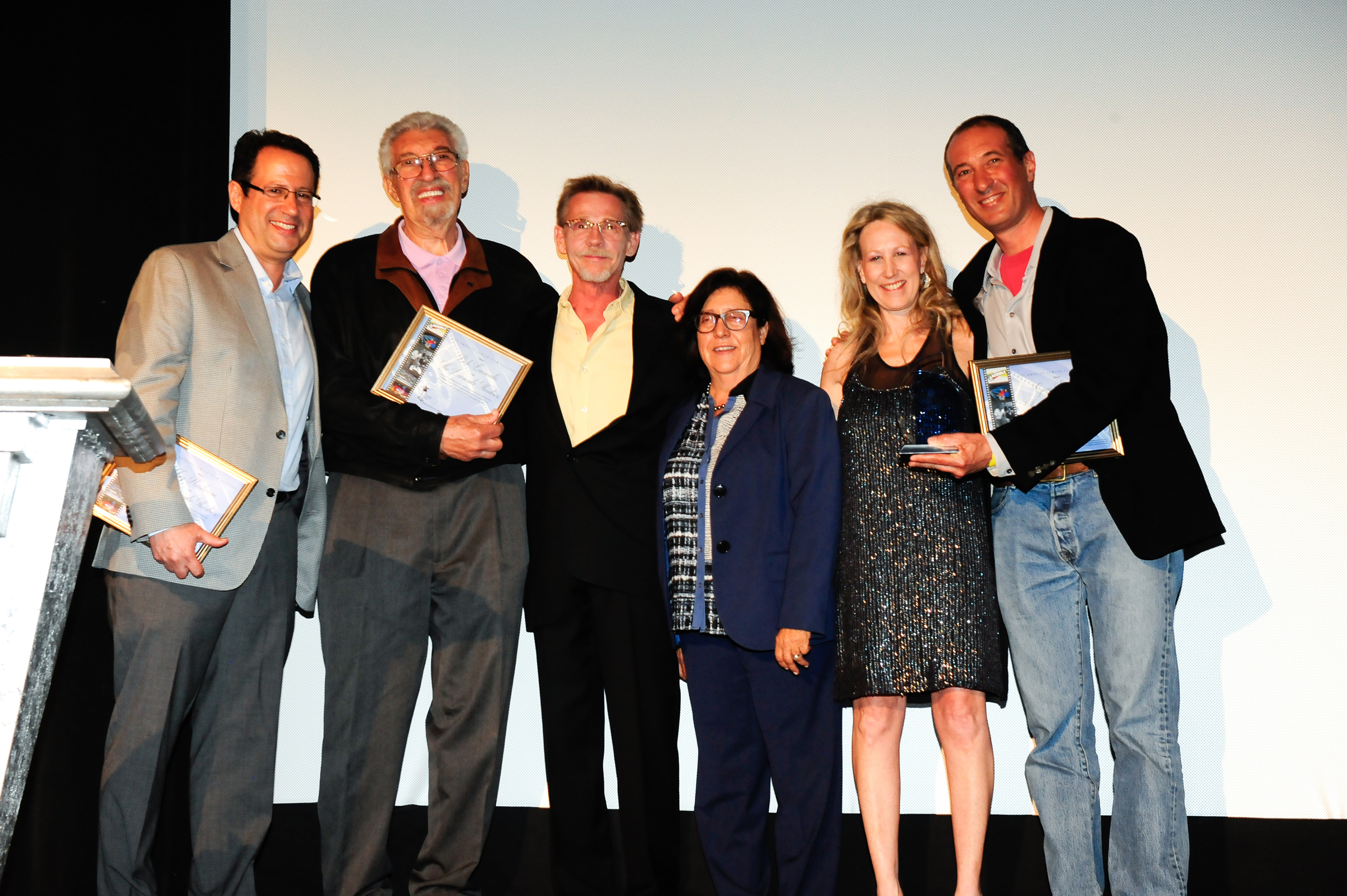
Opening night of this first show of the L.A. Jewish Film Festival’s second decade saw some special appearances by members of the Laemmle family, pictured below with Festival’s Hilary Helstein. Their theaters provide entertainment for all Southern California audiences. The Laemmles were suitably honored for their policy of showing motion pictures that are not only good but different, including archive films, some not available anywhere else. They take pride in their 75-year record of providing neighborhood theaters in a market where such experiences – the good old Mom ‘n Pop shop, popcorn chewing “let’s go to the movies” spirit – survives. An active Jewish family, they welcome the Festival generously.

Also addressing us enthusiastically was Beverly Hills mayor John Mirisch – another name with major importance in the motion picture industry, as the older generation’s Mirisch Brothers will be remembered for many major productions including the film versions of West Side Story and Fiddler on the Roof.

To conduct the program, Rabbi David Baron of the Temple of the Arts introduced the creator of the Festival, whom he aptly called a “one-woman dynamo,” Hilary Helstein. Still young and energetic, Hilary has indeed scored a valuable accomplishment for the Los Angeles Jewish community.

Interviewed after this year’s Festival finished, Hilary looked back happily on her first decade’s achievement. Since beginning the project in 2005, working out of the Valley Cities JCC to exhibit films in just 5 venues, she has expanded to cover greater Los Angeles. This year’s Festival included 14 venues, from Pasadena to Silver Lake to the West Valley to Santa Clarita, as well as central locations like Hollywood and Beverly Hills. A rough estimate of this year’s total audience comes to at least 5,000. This reviewer first met Hilary and her Festival when she was occupying a small office at Westside JCC, and building the event. Watching her progress since then, I have every expectation that its growth will continue. Noting some singular features of this year’s Festival, Hilary expressed special pleasure in the audience response to the documentary East LA Interchange, which pictured the oldest neighborhood in East Los Angeles, Boyle Heights. Its opening night took place at the Breed Street Shul, a spiritual home for so many Jewish Angelenos, and one that my one-time Bar Mitzvah student Steven Sass can claim credit for preserving and honoring. Treating the history of this suburb, the film told the stories of Latino, Russian, Japanese and Black residents, many of whom were in the audience along with representatives – and descendants – of what was once the largest Jewish community west of Chicago. To co-sponsor this event, Hilary brought in the Jewish Historical Society, the Latino Jewish Roundtable and Asian Jewish Initiative, and brought Congresswoman Roybal-Allard to participate in the question and answer session.

Another outstanding feature of this year’s series was the restored classic None Shall Escape, a Holocaust story starring Marsha Hunt, now only 98 years old! The Festival’s closing night welcomed Miss Hunt and presented her with the Marvin Paige Hollywood Legacy Award.

Another award, accompanying the showing of the classic Israeli musical comedy Shnei Kuni Lemel – The Flying Matchmaker honored favorite Israeli star Mike Burstyn with a Lifetime Achievement Award.

What lies ahead for Hilary Helstein and the L.A. Jewish Film Festival? For one thing, we don’t have to wait till 2017 to see the pictures she finds for us. She plans to exhibit one film per month during the year. Judging from her record, they should be well worth seeing. And we can expect the next Festival, Number 12, to outdo all the others. Save me a seat!

Laemmle receive award

L-R:
Jay Reisbaum (cousin), Bob Laemmle, actor Dennis Christopher, publicist Melody Korenbrot, Hilary Helstein (LAJFF Executive Director) and Greg Laemmle.

Posted in Jewish Blogs | Tagged , , , , , , , , | Comments Off on L.A.’s JEWISH FILM FESTIVAL, YEAR 11 Review by Rabbi Baruch Cohon

THE SELECTION PROCESS – Sh’lakh l’kha – Num. 13 – by Rabbi Baruch Cohon

Screen Shot 2013-11-05 at 11.26.08 AM

THE SELECTION PROCESS – Sh’lakh l’kha – Num. 13 – by Rabbi Baruch Cohon

If you are running a business, how do you decide on a branch manager? If you’re running a nation, how do you pick an ambassador? If you are looking for a medical breakthrough, how do you staff a lab? And if you are facing a military enemy, how do you qualify a scout to bring you advance intelligence? Difficult decisions, all of them. Yet they are important – even vital. And sooner or later, we all face similar challenges to our judgment.

In this week’s reading, Moses hears the Divine message: “Send out men for yourself, and let them explore the Land of Canaan.” Rashi and other commentators note the word l’kha – “for yourself.” They conclude that this apparently extra word is not superfluous at all, but indicates that the process of sending spies into Canaan is not a Divine commandment. It is merely a permission granted Moses to do something he and other Israelites were already thinking about doing. We know that some tribal chiefs were ready to give up the idea of getting a country of their own, and openly advocated choosing new leaders and going back to Egypt. Rather than leave it to them to make the choices, G-d gives Moses the go-ahead, as a step toward invading the Land.

The Klee Yokor offers two conflicting comments on this story. Noting that the selection of the spies follows immediately after Miriam’s punishment for badmouthing Moses and his wife, the text specifies “send out men.” The Talmud in Kidushin contains the statement: “Ten portions of conversation came into the world. Women took nine of them!” Since women tend to chatter and gossip, Miriam being a woman initiated the slander about Moses. Aaron was secondary to her. Therefore the message says “send out men,” because they will be less likely to slander the Land.

On the other hand, the Klee Yokor offers his own opinion. Citing the Yalkut to the effect that the men disliked the Land, the rebellious men even advocating return to slavery in Egypt, he underscores Rashi on a later story in Numbers where the seven daughters of Zelophehad ask for a possession in the Land of Israel. The women loved the Land. They would not report on it in such a way as to run it down. So in effect G-d is telling Moses: “All right, you want to send men? Go ahead. But I know it would be better to send women.”

Who gets selected? Twelve men, one for each tribe. These are not the tribal princes named in the Torah readings of the last 2 weeks. Those princes brought the 12 identical offerings that dedicated the altar. They led their tribes on the journey from Sinai to Paran. But none of them will be selected to explore Canaan. Apparently Moses decides he needs different qualities for this job. We do not know how he made his selections. All we read here are twelve new names. No, not twelve. Eleven. Because one of the spies, the one representing the tribe of Ephraim, is none other than Moses’ right hand man, Joshua. Here we learn his original name Hoshea, signifying the act of saving or rescuing, and Moses adds the letter yud making it Yehoshua – starting with the letters yud & hey, the two letters of a Divine name – indicating that G-d will save.

With all Moses’ wisdom we would expect him to select the right men for this key assignment. And yet, when they complete their exploration and return to camp with their load of fresh fruit harvested in the Land, they report that the natives there are giants, with impregnable defenses, and we cannot conquer them. Only two spies disagree, and insist that with Divine help the battle can be won. One of those two is Joshua; the other is Caleb from the tribe of Judah. Badly outnumbered in the report, they tear their clothes in mourning and insist that with G-d’s help the Land can be Israel’s. The people follow the majority of the spies, and revolt. Tragic consequences follow. Plague, a disastrous battle, the rebellion of Korach, and another 38 years in the desert. Couldn’t Moses have picked more positive spies?

Or is this the kind of result to be expected? Take away the inspiration of Mitzvah, and negative reports follow. Appoint explorers – of a country or of an idea – who dig in with vision and with faith in their effort, and you have a much better chance. We look for inspired men – or women – and sometimes we find them. Moses succeeded twice out of 12 tries. How many of us can do as well?

Success of any investigation also depends on another factor. Reconnaissance can only supply reports. If those receiving the reports have a negative mindset they will retreat. The boss, the president, the doctor, the general — whoever sends for the information – must maintain confidence in the possibility of success.

Our Haftorah tells a similar tale with a far different result. The 38 years have passed, and Joshua is now leading the people. He also sends spies. Just two, this time. One being Caleb, his one positive colleague from the first exploration. Now 80 years old, Caleb represents experience. The other spy is a youth of 18, the figure of courage. They don’t travel the country or harvest any grapes. They just spend a day and a night with a female innkeeper named Rahab, and learn enough to bring Joshua and the Israelite army to a victorious campaign against Jericho. Mitzvah was there, confidence was there. And a woman plays a key role too.

Let’s hope it will not take 38 years to deal with our challenges and realize true value from our own explorations. Whether the challenges are military, commercial, medical or diplomatic, we pray we can face them wisely and put our explorations to positive use. Ken y’hee rotzon.

SelectionProcessShlakhlkha

Posted in Jewish Blogs | Tagged , , , , , , , , , , , , , , , | Comments Off on THE SELECTION PROCESS – Sh’lakh l’kha – Num. 13 – by Rabbi Baruch Cohon

ONE GOLD BLOCK – B’ha’alot’kha – Num. 8-12, by Rabbi Baruch Cohon

Screen Shot 2013-11-05 at 11.26.08 AM

ONE GOLD BLOCK – B’ha’alot’kha – Num. 8-12, by Rabbi Baruch Cohon

This week’s Torah reading opens with instructions to Aaron the High Priest for lighting the Menorah, the sacred candelabrum. Perhaps the most universal symbol of Judaism, this 7-branched candlestick appears on buildings, products and stationery. It stands proudly in synagogues. It signifies victory, and with two added branches it becomes the trademark of Hanukkah.

It also appears on an arch in Rome to symbolize Israel’s defeat. Capturing the Menorah made the Romans believe they had indeed ended the Jewish nation. How wrong they were.

We honor the Star of David, but it won’t replace the Menorah. Not on Shabos, and certainly not on Hanukkah. In fact, this week’s Haftorah from the prophet Zechariah (“Sing and rejoice, daughter of Zion!”) is the same one we read on Hanukkah.

What is so special about this candlestick? One distinction is the way it is made. This was not put together piece by piece, a base, then attach a shaft and six branches. This, we learn in the text of the Book of Exodus and elaborated by the Talmud and the commentators, was formed from one block of gold. “Of beaten work shall the candlestick be made. Its base, its shaft, its cups, its knobs and its flowers shall be part of it.” One block of gold, beaten into shape. Three branches extended on each side, and one in the center. And the cups were shaped so as to project the light forward, not just straight up. The Menorah should spread Divine light to the world.

Truly, the Menorah represents our mission and our history. Spreading light, both spiritual and secular, continues even if some enemies deny it. It represents the Jewish people, all of us. And it all starts from that one block of gold – the Torah.

Today’s global Menorah might not be limited to 6 – or even 8 – branches. Haredim, Mizrahim, Chabad, Satmar, Modern Orthodox, Reform, Conservative, Reconstructionist, Renewal, Ykar – where do you stop? The one essential quality we all share, we need to treasure, to preserve, and do our best to extend, is our mutual source – that One Block of Gold. Interpretations vary – and how! – but the shared foundation lives. It lives, it gives us light, it enables us to spread light – to each other and to the world.

Aaron lit the original Menorah, and set the pattern. Now it’s our turn. Shine the light outward.

Before we can succeed in doing that, however, we must shine that light inward. We need to learn our heritage well, well enough to be comfortable with it. The principles and practices that define Jewish life, past and present, produce the fuel for the light that we can shine and share. Pick an area of Judaism that you want to make your own. Chances are you can find adult courses and discussion groups that explore it – whether in person or on line. Further possibilities can lead to other areas, a broader acquaintance. As the light grows, your opportunity grows with it. When you can kindle some light on the Calendar – or on Personal Identity – or Jerusalem in our history – you will know you are ready to start shining that light outward. Just remember the words that every observant Jewish woman pronounces on Sabbath and holiday evenings: “V’tzivonnu l’hadlik ner” – We are commanded to kindle a light.

Upward and outward, keep it burning.


Posted in Jewish Blogs | Tagged , , , , , , , , , , , , | 1 Comment

BLESSINGS SURVIVE – Naso – Num. 4:21—7, by Rabbi Baruch Cohon

Screen Shot 2013-11-05 at 11.26.08 AM

BLESSINGS SURVIVE – Naso – Num. 4:21—7, by Rabbi Baruch Cohon

Our reading this week recounts no less than five ancient practices that we no longer observe, no matter how pious we may be otherwise.

No longer do the Levi tribesmen carry the sacred objects – the holy Ark, the altar, etc. – on their shoulders from campsite to campsite. That duty applied only until they reached the Promised Land.

People who get ritually contaminated, as by contact with a dead body, are not quarantined outside the community. They can go to a Mikveh and bathe.

The Ordeal of Jealousy – including the singular “Sotah water” process – was discontinued many centuries ago.

Nazirites who dedicated their lives even temporarily to Divine service had to forego haircuts, alcoholic beverages and any ritual contamination, with some detailed instructions for handling whatever problems might interfere, as long as they remained Nazirites. This entire practice ceased with the destruction of the Temple.

And the identical offerings of the princes on dedicating the altar, while their details can still teach us a lesson in the equality of ritual responsibility, took place just once.

The exception to this list comes in Chapter 6, with a simple instruction to Moses: “Speak to Aaron and his sons, saying: Thus shall you bless the people of Israel.” And it dictates the famous three lines that appear in everyday synagogue services, and at every Jewish wedding, to this day. First, the 3-word sentence, translated “May G-d bless you and keep you.” What does “keep you” mean here? Our commentators interpret it as referring to whatever we may own. This is a physical blessing: Bless us with possessions, and make us safe from robbers. Certainly as valuable a blessing today as it ever was. Second comes the 5-word sentence meaning “May G-d shine the light of His presence on you and favor you.” This, say our commentators, is a spiritual blessing. The Midrash expands it to say “May G-d make your eyes bright with Divine light; let prophetic light brighten the souls of your children, and let the light of Torah illuminate your home.” And finally the 7-word sentence meaning “May G-d turn toward you and establish peace for you.” As the Hertz commentary points out, the last line does not say v’yiten – literally “give” you peace, as it is frequently translated. It says v’yasem – “establish” peace. A much more permanent blessing.

As a cohen, I have the hereditary responsibility to join other cohanim in pronouncing this blessing in the synagogue on festivals, and it is a privilege that resounds in our ears when we hear the congregation chanting Amen after each line – or in many synagogues Ken y’hi ratzon: “So may it be G-d’s will.” And when we do this dukhenen as it is called, we should always remember the very next sentence in this Torah reading: “They will put My name on the people of Israel and I will bless them.” We cohanim serve as mere agents, delivery men as it were. We do not originate the blessing, because it comes from the Almighty. In fact, the Chabad prayerbook includes a significant paragraph for each cohen to say privately after the ceremony, affirming “we have done what You decreed for us. Now deal with us as You promised. Look down from Your heavenly abode and bless Your people Israel….”

So may it be.

NasoBlessings

Posted in Jewish Blogs | Tagged , , , , , , , , , , , , , , , | 2 Comments