OUR SEASON OF JOY – the Succot week – by Rabbi Baruch Cohon

Screen Shot 2013-11-05 at 11.26.08 AM

OUR SEASON OF JOY – the Succot week – by Rabbi Baruch Cohon

As if we didn’t read enough contrasting Torah passages on the High Holidays, now comes Succot with daily readings, many of them detailing our complex calendar and its many different observances. We learn that this week we should “dwell in the Succah” to remind us that our ancestors used these humble huts for shelter on their way from Egypt to the Promised Land. And if your succah is big enough and you’re somewhat adventurous, you bring in a couch and sleep there. In fact, one Torah commandment states that every Israelite native – kol ezrakh b’Yisroel – shall dwell in the succah.

But of all the varied readings of this week, it is not until next week on Shmini Atzeres, the separate holiday at the end of the Succah week, that we learn a basic theme of this festival. V’samakhta b’khagekha – Rejoice in your holiday, says the Torah, for you have harvested your crops and can revel in the bounty that Nature and some hard work can provide. Share the holiday with those around you including the widow, the orphan and the resident alien. V’hayeeta akh sameyakh – “and just be happy!” A rhythmic Hebrew folk song dramatizes those two thematic quotes. In fact, when we make Kiddush, sanctifying our festive days, we identify each holiday. Passover is z’man kheyruteynu – the time of our freedom, the anniversary of our liberation from Egyptian slavey. Shavuot is z’man matan torateynu – the time of receiving our Torah, the event that made us an eternal nation. Vital historic occasions, both of them. Succot is called simply z’man simkhateynu – the time of our joy.

So as we join in blessing the Mitzvah of Succah – in our back yard or at the Synagogue, at a friend’s home or wherever we find it – and as we join in blessing the lulav v’esrog – the 4 species of new crops that we wave as we march around the Shul in our celebration, we give thanks for the bounties of Nature. And we rejoice that G-d has permitted us to see another season.

Given this positive light-hearted festive atmosphere, we may well wonder about another traditional reading associated with Succot. On the Sabbath during the Succot week, we read Kohelet, the Biblical Book of Ecclesiastes. Rember that? “Vanity of vanities… etc.” Why?

Tradition tells us that King Solomon wrote three of the Biblical books contained in the third section of the Hebrew Bible called K’tuvim – Writings. They are Song of Songs, Proverbs, and Ecclesiastes. We are told that he wrote Song of Songs as a young man, Proverbs in middle age, and Ecclesiastes when he got old. Comparing their subjects and their attitudes, that tradition certainly makes sense. Song of Songs is love poetry as only young lovers can express it. Proverbs reads like the voice of experience. Then comes Ecclesiastes. Facing an inevitable end, Kohelet describes one human activity after another, and concludes that each one is hevel – “vanity” – basically worthless. Along the way, of course, the royal writer recommends that we should “eat, drink and be merry,” having already established that tomorrow we might not be here. But he never gives up, and neither should we. His next-to-last sentence, traditionally repeated at the end of reading the book, expresses his real message: “The end of the matter, after all is heard, is to revere G-d and keep His commandments, for that completes humanity.” One of those commandments, the one we observe now, is “Rejoice in your festival….and just be happy!”

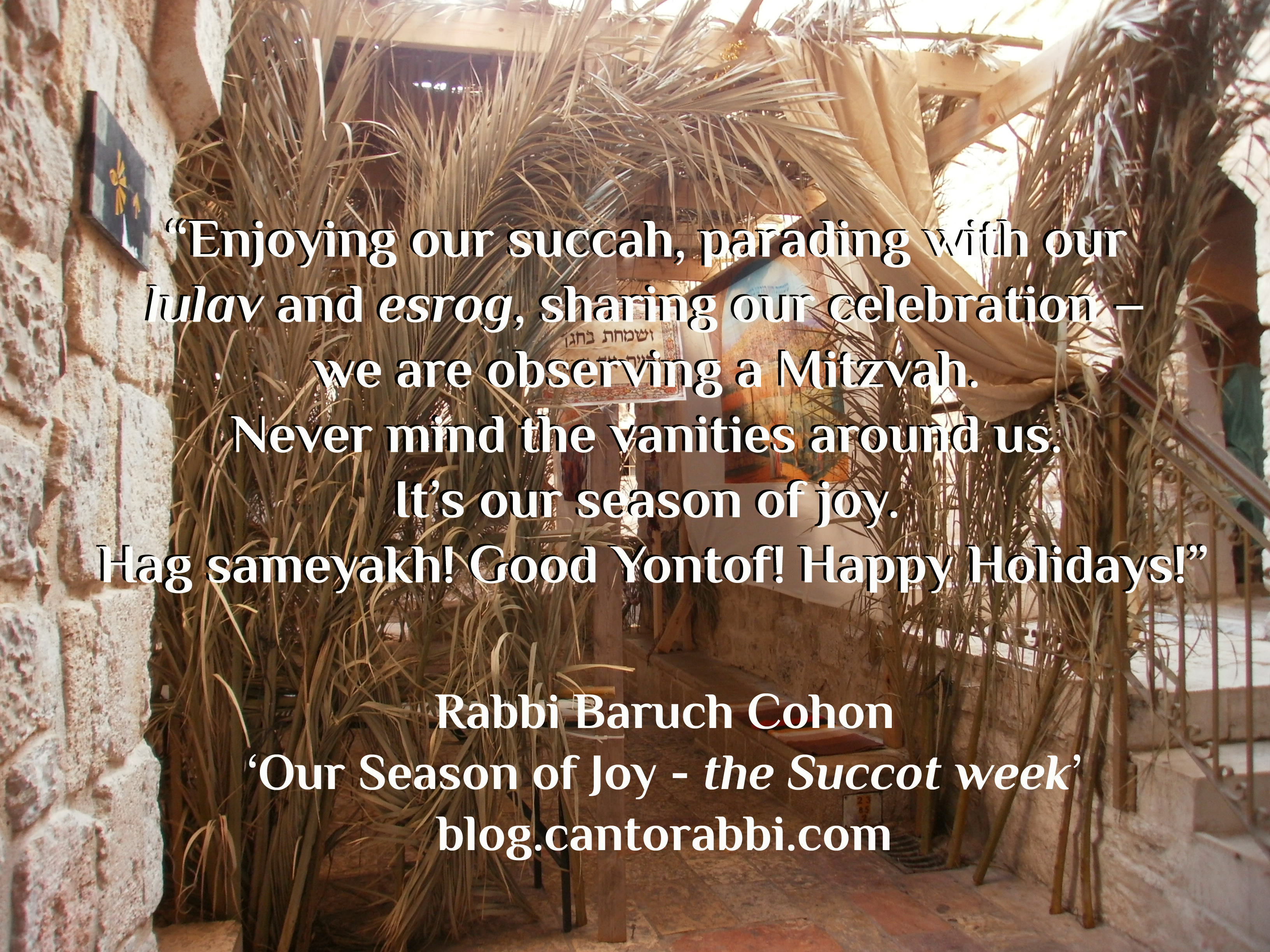
Enjoying our succah, parading with our lulav and esrog, sharing our celebration – we are observing a Mitzvah. Never mind the vanities around us. It’s our season of joy. Hag sameyakh! Good Yontof! Happy Holidays!
OLYMPUS DIGITAL CAMERA

Posted in Jewish Blogs | Tagged , , , , , , , , , , , , , , , , , , , , , , , , | Comments Off on OUR SEASON OF JOY – the Succot week – by Rabbi Baruch Cohon

ETERNAL WITNESS – Vayeylekh, Shabat Shuvah – Deut. 31, by Rabbi Baruch Cohon

Screen Shot 2013-11-05 at 11.26.08 AM

ETERNAL WITNESS – Vayeylekh, Shabat Shuvah – Deut. 31, by Rabbi Baruch Cohon

Moses our Teacher is delivering his last speech, exhorting his people to keep the Torah he helped them receive. Gain courage and wisdom from it, he urges. No longer will he be with them to lead them, teach them, judge them. “Today I am 120 years old,” he says. “I cannot go out and come in.” Follow Joshua now because he will be the one to lead the way across the Jordan into the Promised Land. But above all, Moses calls on his people to write these words. “Take this Sefer Torah – this Book of the Law – and place it by the Ark of the Covenant of G-d. There it will be your witness.” An eternal witness. Those Torah scrolls, standing silent in every synagogue ark, are still bearing witness.

Witness to what? A realist to the end, Moses predicts wrong behavior by his people. After all, they have free will. They can choose the wrong road. And they will. “I know that after I die you will wreak destruction, you will leave the path I commanded you to follow, and evil will befall you.” Was he predicting disaster immediately after his death? Not at all. Rashi points out that the people did not engage in treasonous destruction all the days of Joshua. From this we learn that a faithful student is as valuable as his teacher. The evil would come later. As we know too well, it came many times.

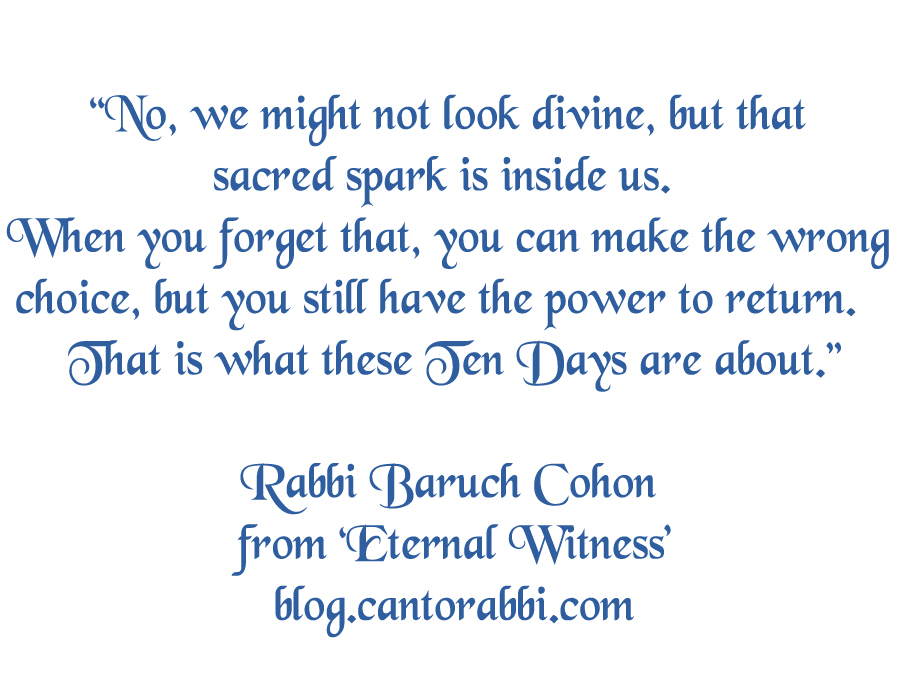
But with the aid of the Torah, said Moses, we can return. A few centuries later, the prophet Hosea sings in our Haftorah: “Return, Israel, to the L-rd your G-d, for you have stumbled.” And so we have the opportunity to return, every year. Our Sabbath, this Sabbath, takes its name from Hosea’s prophecy: Shabat Shuvah – the Sabbath of Return. Coming as it does during the Ten Days of Repentance, it gives a very special and uniquely Jewish quality to this whole season. Because the Hebrew word t’shuvah is usually translated “repentance,” we could lose track of the fact that it comes from the same root as shuvah – “return.” The root is Shuv: Go back. Return to where you came from. Every morning the Jew prays: “My G0d, the soul You gave me is pure.” Christianity holds that man is born in sin. So he needs someone else to die to redeem him. That’s not the Jewish view. Each one of us is endowed with tzelem Elokim – the Divine image. No, we might not look divine, but that sacred spark is inside us. When you forget that, you can make the wrong choice, but you still have the power to return. That is what these Ten Days are about. From the New Year through Yom Kippur, we can take a close look at our lives, and we can return to where we should be.

Did you take advantage of your neighbor? You can make it up to him. Did your neighbor insult you? You can forgive him. Restore your relationship to a positive point, the point where it once was.

Did you implement your Judaism in your community? And through your own observance? Or were you lax? You can return.

What about the family? Did you honor your parents or did you neglect them? Did you treat your mate as one “sanctified to you,” as a “helper beside you” or as someone to take for granted? Did you teach your children by example? Or did you overdo your authority and make them rebel? Or perhaps did you just let them run wild? Many choices, many roads to stray on. These ten days give us the chance to return.

All the penitential prayers, all the ceremonies of forgiving each other, all the buildup to the holy fast day – it’s all a spiritual journey of return. We were there once. We can go back. Back home. Back to the Torah. It is to the success of our journey that Hosea looks as he concludes his vision: “You will give truth to Jacob, kindness to Abraham, as You swore to our fathers in days of old.”

So may it for us on this Sabbath of Return.

EternalWitness

Posted in Jewish Blogs | Tagged , , , , , , , , , , , , , , , , , , | Comments Off on ETERNAL WITNESS – Vayeylekh, Shabat Shuvah – Deut. 31, by Rabbi Baruch Cohon

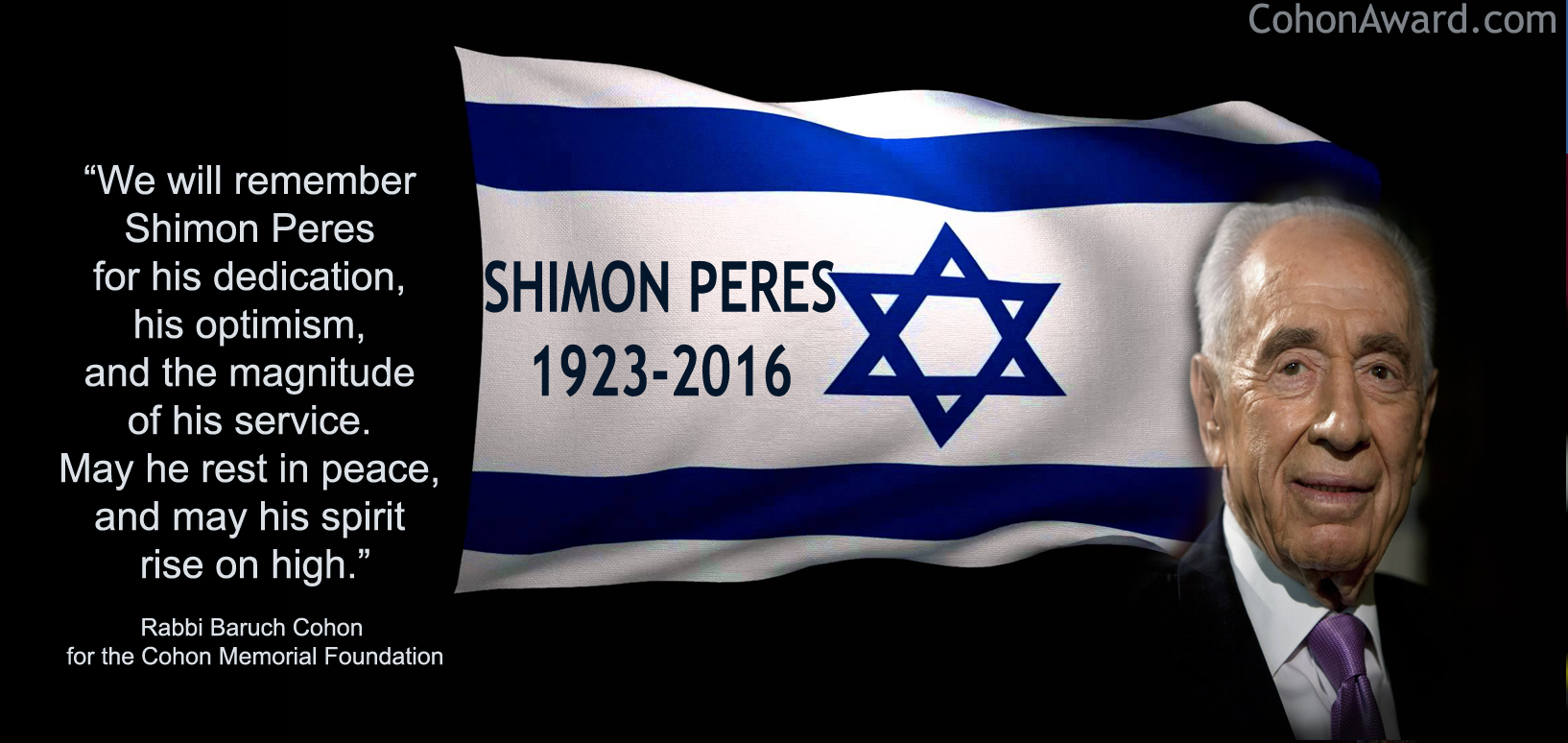
Shimon Peres 1923-2016

shimonperes

Will will remember Shimon Peres for his dedication, his optimism, and the magnitude of his service. May he rest in peace, and may his spirit rise on high.

Rabbi Baruch Cohon

Posted in Jewish Blogs | Tagged , , , , | Comments Off on Shimon Peres 1923-2016

HIDDEN OR REVEALED – Nitzavim – Deut. 29:9–30:20, by Rabbi Baruch Cohon

Screen Shot 2013-11-05 at 11.26.08 AM

HIDDEN OR REVEALED – Nitzavim – Deut. 29:9–30:20, by Rabbi Baruch Cohon

We always read this section of Moses’ final discourse at the end of our calendar year. Approaching Rosh Hashana, our yom ha-din – Day of Judgment – we review the principles and the warnings Moses gave us.

At the end of Chapter 29, he says: “What is hidden belongs to G-d, and what is revealed belongs to us and our children.” Both good and evil can be either Hidden or Revealed.

Commenting on this line, the Klee Yokor brings it down to cases. Quoting an earlier passage, he asks: If an individual takes the self-centered attitude “I’ll be all right, I’ll just follow my own stubbornness,” who knows what that mind is hiding? Only G-d knows. And if that individual’s stubborn actions bring destruction on his community – as the Torah says “sweeping away the wet with the dry” or, as Maimonides interprets it, “adding drunkenness to thirst” – G-d will punish the perpetrator.

On the other hand, should a family or an entire tribe commit sin, it cannot be hidden. The entire nation must deal with the offenders, carrying out the principle that “what is revealed belongs to us and our children forever.” If the offenders are not expelled from the land, judgment will fall on the nation, and all will be scattered because of the sins of that tribe.

Sins bring consequences, whether those sins are hidden or revealed.

What sins incur exile? Clearly, idolatry is one of the primary sins. What about denial of G-d? Sexual perversion? Political treason? For that matter, what about murder? Theft? Bearing false witness? They are all prohibited in the Torah, just like idolatry. Are we to look at our tragic and heroic history and conclude that we brought all the calamity on ourselves?

Certainly we and our ancestors had plenty of enemies to help bring on the calamities of exile and persecution and massacre. What we lacked then, and still lack again today, is the unity of a nation. We cannot join hands and punish or banish those whose actions threaten our communities. Many times, we cannot even agree on the danger of those actions. Is it right or wrong to erect settlements on land that another group wants – even if that land was conquered in a fair fight? Is it right or wrong to stage Gay Pride parades in a country that grants marriage authority exclusively to Orthodox rabbis?

Those are just some Israeli questions. Living in many other parts of the world as we do, local Jewish communities face all kinds of questions about positive or destructive conduct that can range from political activity to dealing with official rulings affecting Jewish life – whether circumcision or kashrut or the basic freedom to attend synagogues safely.

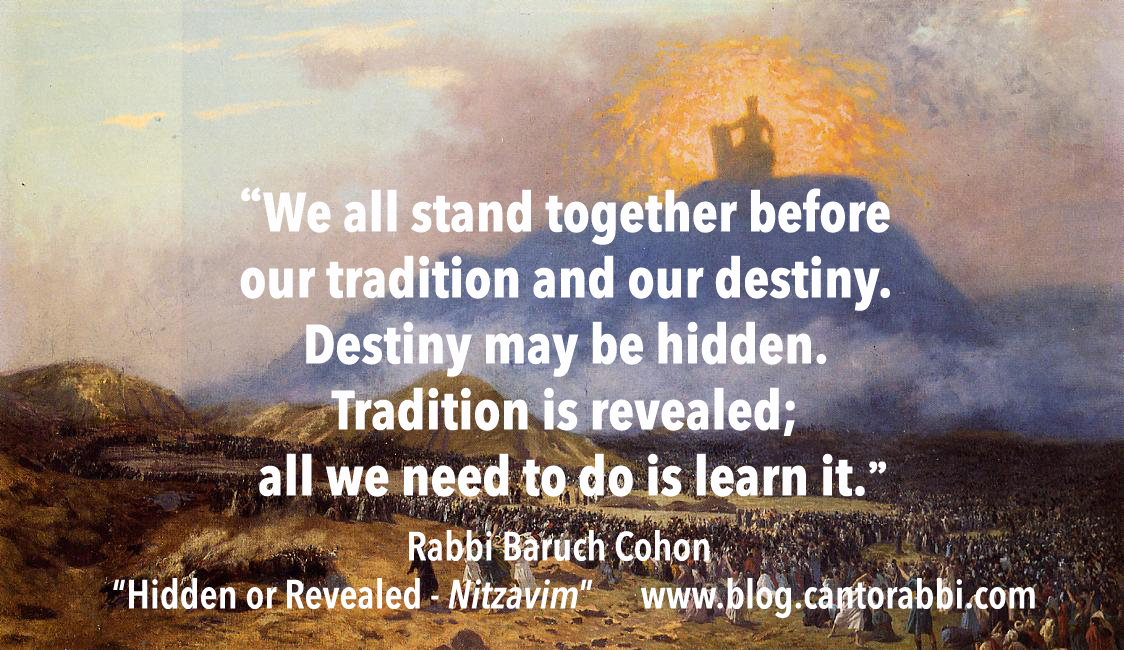
Again, Nitzavim offers an answer. Not always an easy answer, but a guiding principle. It gives us Moses’ injunction to his people: “Not with you alone do I make this covenant, but with all who are here with us today, and with those who are not here with us today.” Who was not there? Future generations, including us. We all stand together before our tradition and our destiny. Destiny may be hidden. Tradition is revealed; all we need to do is learn it.

Approaching a New Year, we must consider how we can stand together. Like Moses’ audience, we do many different things. We are “your heads, your tribes, your elders, your officers… your woodcutters and your water-drawers.” Your corporate executives, your scientists and technicians, your rabbis and teachers, your labor-union members and your journalists, your storekeepers and your artists. Your soldiers and your sailors, your intelligence officers and your students, your airline pilots and your taxi drivers, your shepherds and your entertainers. With all our differences, we share our Jewish identity, and we share something even more basic: we share our hope for the future. Tradition and destiny. Hidden and revealed.

Let’s stand together.

nitzavimrbc2016

Posted in Jewish Blogs | Tagged , , , , , , , , , , , , , , , , , , | Comments Off on HIDDEN OR REVEALED – Nitzavim – Deut. 29:9–30:20, by Rabbi Baruch Cohon

GOING OUT AND COMING IN – Kee Tavo – Deut. 26-29:8, by Rabbi Baruch Cohon

Screen Shot 2013-11-05 at 11.26.08 AM

GOING OUT AND COMING IN – Kee Tavo – Deut. 26-29:8, by Rabbi Baruch Cohon

Frequently our tradition uses the opening words of a Torah reading as the name of the week’s section. Last week it was “Kee Teitzei” about going out – in that case, to war. This week it is “Kee Tavo” about coming in – entering the Land of Israel. Not just entering it, in fact, but possessing it and taking responsibility for it. Here Moses gives his people a definite pattern for establishing a nation of residents and natives, united in a way of life that remembers and reveres its past, and applies its religious principles to its daily life.

Tithing their crops expresses the appreciation of Israelite farmers for their land, and provides some support for the Levites and Cohanim in the Temple. It was also the same farmer’s duty to bring the first fruits of his land to Jerusalem, and to share them with the Levites, and with others who had no land – “strangers” (otherwise known as resident aliens), and widows and orphans. Building a nation was no easy task for 12 tribes whose parents were slaves. For the purpose of making this nation more just and more worthy than the Egypt they once fled, Moses predicts the results of bad conduct, of corruption and idolatry. The list of curses we will read here could be calculated to scare people into better action. “Betroth a woman, and another man will violate her… Your sons and daughters will be given to another nation; you will see it, and long for them, but you will have no power… The stranger among you will rise higher and higher, and you will come down lower and lower… A savage nation speaking a strange language will invade and conquer you…“ Some familiar events there. Commentators indeed observe that these threatened sufferings – called the tokhakha – were exceeded only by the actual sufferings of Jewish history.

By contrast, the blessings this Sedrah envisions certainly are worth reaching for. “Be blessed in the city and blessed in the field… Your enemies will attack you and they will fall before you; they will invade on one road and flee from you on seven roads… G-d will make you the head, and not the tail. You will only rise up and not fall down, if you will just listen to the Mitzvos… “ That’s the challenge. Just listen to the Mitzvos – and do them.

Worth considering is the fact that the blessings listed in Chapter 28 of our reading cover just the first 14 sentences.

The curses cover the next 54 sentences. Quite a challenge.

Looking back over these messages about going out and coming in, we need to remember that both messages are stated in the singular. Whether we live in Israel or another country, whether we live under a government that is honest or corrupt, each one of us must take whatever responsibility we can for our own lives and the lives of our children. Sometimes we must go out to war, and do our best to be noble winners. And coming into our residences, we must be equally determined to achieve both prosperity and justice.

Despite the tyranny of Czars and Sultans and dictators, our ancestors managed to pass some great life lessons on to us. Whatever questionable politics may do to our own situation in the coming days, let’s remain committed to living the life that earns some of our Sedrah’s short list of blessings. “All these blessings [can] come to you and overtake you, because you will listen to the voice of G-d.”

Hallevai amen.

goingoutcominginkeetavo

Posted in Jewish Blogs | Tagged , , , , , , , , , , , , | Comments Off on GOING OUT AND COMING IN – Kee Tavo – Deut. 26-29:8, by Rabbi Baruch Cohon