

MIRIAM STARTED IT – B’haalot’kha – Num. 12—by Rabbi Baruch Cohon

Screen Shot 2013-11-05 at 11.26.08 AM

MIRIAM STARTED IT – B’haalot’kha – Num. 12—by Rabbi Baruch Cohon

First it was Miriam, then Aaron who spoke against their brother Moses, as the Torah tells us, “because of the Cushite wife he took.” And so opens a singular story of family friction, dismal punishment and recovery.

The word “Cushite” challenges the commentators. “Cush” is the Hebrew name of Ethiopia. Was this a new wife? A new black wife? Was Miriam racially prejudiced? No, says Ibn Ezra. In all his 120 years Moses only took one wife, namely Zipporah, daughter of Jethro the priest of Midian. And Ethiopia is many miles from Midian. So the Midianites are not Africans. But they are tent-dwellers in a hot country, and ”have no whiteness at all” but are tanned very dark. So what does Cushite mean? Both Rashi and the Midrash insist that Cushite refers to Zipporah’s beauty. One proof cited is from gimatria – which does not mean Geometry, it means Numerology. Every Hebrew letter is also a number, and the sum total of the letter-numbers in cusheet = 736, identical to the sum total of the letters in the words y’fat mareh – “beautiful appearance.”

Another proof states that everyone acknowledged Zipporah’s beauty just as they acknowledge that an Ethiopian is black. It was obvious. Not only did she have good looks; she also behaved beautifully. So what is Miriam’s beef?

Rashi says Miriam objected, not to Moses’ marrying Zipporah but to his sending her away. Just a few sentences earlier we read about two men named Eldad and Meydad “prophesying in the camp.” When this report came out, Miriam was with her sister-in-law, and heard Zipporah say: “Alas for the wives of these men. If they are moved to prophecy, they will separate from their wives the way my husband separated from me.”

Judging from this insight, Moses and his marriage experienced the familiar pattern of a man’s calling, his work, damaging or even destroying his family life. And Miriam’s action qualifies her as an ancient feminist. Indeed we have no record of Miriam herself ever marrying or raising a family. Her devotion to her birth-family is total. She guards the basket where her baby brother floats in the Nile. She convinces the Egyptian princess to let her take him to a Hebrew wetnurse – their mother. Later she is described as a prophetess at the Red Sea, leading the women in sacred song and dance. In her merit a well is said to accompany the Israelites on their desert trek. And now, when Miriam badmouths her brother Moses, she is struck with leprosy! A leper in Hebrew is m’tzora – which the rabbis parse as an abbreviation for motzi shem ra – “bringing out a bad name”, in other words slander. In Miriam’s case the punishment is physical and requires her to stay outside the camp for a week. It is brother Aaron who appeals to the leader Moses, who in his deep humility offers the most compact prayer – just five short words – for her recovery: El na r’fa na lah — “Please, G-d, please heal her!” And in respect for Miriam, the camp does not move until she is healed and returns.

No wonder that the strength and talent and devotion that characterized Miriam made hers a favorite name that Jews give their daughters all through history.
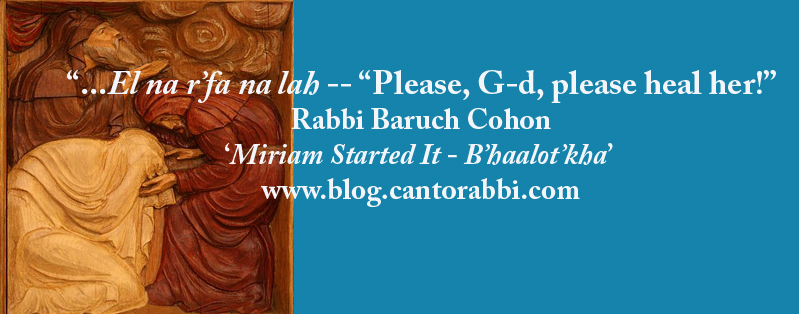

Miriamleporblog

Posted in Jewish Blogs | Tagged , , , , , , , , , , , , , , | 1 Comment

TRIAL BY WATER– Naso – Num. 4:21-7 – by Rabbi Baruch Cohon

Screen Shot 2013-11-05 at 11.26.08 AM

TRIAL BY WATER– Naso – Num. 4:21-7 – by Rabbi Baruch Cohon

Among other narratives and teachings, this week’s Torah reading contains what could be the strangest law of all, the Ordeal of Jealousy. It lays out a ritual by which a husband can determine if his wife was unfaithful. The procedure requires that if he has reason to suspect her, he must take her to the Temple where the priest accepts her meal-offering and puts her under oath. He takes an earthen vessel and fills it with holy water, throws in a handful of the meal offering and also puts some dust from the Temple floor into the water. Then he notifies her that if she is innocent the ordeal will not harm her, but if she is guilty her thigh will fall away and her belly will swell. She will be a shame to her people. And the woman must listen and answer Amen Amen. He writes the curses in a scroll and blots them into the water. Then she must drink.

Did this actually take place? Since the Torah describes it in such detail, we assume it did. But not since the destruction of the Temple. In fact it was the respected leader Rabbi Yochanan ben Zakai who discontinued it. Yet the Talmud considers it important enough to name an entire tractate Sotah after this practice, and discusses details of its conduct. First, we learn, the husband must warn the wife not to be alone with a certain man. And if she does so, there must be a witness to how long they were together. Generally Jewish law requires two witnesses in a criminal case. Here, the testimony of one witness is accepted. Also, the Talmud relates, the priest could not use indelible ink; it had to be washed off into the bitter water. The rabbis further observe that someone will not commit a serious crime unless a “spirit of folly” – ruakh shtus – enters him. So whose body does the spirit of folly enter? The suspected woman, or the jealous man?

So far, all this jealousy centers on the woman. What about the man? After all, we just read the Ten Commandments on Shavuos, including the famous Seventh one, “Do not commit adultery.” The Hebrew verb for adultery, tin’af, is in the masculine. Historically, of course, the adultery indicated there concerns having intercourse with another man’s wife. So, Reuven, stay away from Shimon’s wife. Don’t even covet her. But what if Reuven’s wife suspects him of infidelity? Is there a jealousy ordeal for a man? No, because polygamy was common in Biblical times. In fact, it remained acceptable until the Edict of Rabbainu Gershom in about the year 1,000 CE. As we know, some distant Jewish communities never heard about that, so when the modern State of Israel welcomed all who wanted to return, some Jews from Yemen arrived with 4 wives each. The Israeli government ruled that families would not be broken up; those who were already multi-married could stay that way, but future generations needed to abide by the laws of Rabbainu Gershom and the State of Israel.

In all these instances, sanctity of the family is paramount. Indeed, the Torah itself recounts the creation of Eve and her mating with Adam, and says “so will a man leave his father and his mother and cleave to his wife, and they will become one flesh.”(Gen.2:24) One man, one woman. Not until some 22 generations later does Jacob become the first of the patriarchs to marry two wives, with the ensuing bitter rivalry that colored their lives. It took many centuries for men to learn that one wife is plenty. Effectively, then, for the past millennium and more, Jewish families consist of one man, one woman and one or more children. Those children are marriage’s goal and reward. And fidelity is important. How important is it?

The Klee Yokor commentary offers a visual example. We usually see the Ten Commandments represented on the twin tablets, as two adjoining columns of five each. So #7, prohibiting adultery, appears exactly parallel to #2, prohibiting false gods. Not only is the violation equal, even the punishment is equal. The unfaithful wife has to drink the bitter water containing the ink spelling out her guilt. And the unfaithful Israelites in the desert had to drink water containing the ground-up fragments of the Golden Calf. Family solidarity bears equal importance to true faith.

What about today? More and more, we see family life weakened, even destroyed. Current trends can alarm us. What is wrecking the American family?

Changing roles for women sometimes get cited. Can a woman be a loving wife and mother and also a corporate executive? Maybe some can and some can’t. But look at the Haredi community, the most traditional of all Jewish groups, and see wives who are both homemakers and providers – storekeepers or wage earners – while their husbands spend full time in Torah learning. Those women, with all their responsibilities, manage to bear and raise more children than liberal wives are willing to have.

Deviant sex habits, and political acceptance of same-sex couples can be seen as a force against family life as we know it.

Whatever the cause, we see a falling birthrate, a rising divorce rate, and a prevalence of the practice of “living together,” generally a temporary arrangement. So, speaking of current trends, what are the causes?

Is Global Warming damaging human sex? Doubtful.

Are misguided movements and party politics destroying the American family? Yes they are. Just check the figures. Recent surveys find some 23% of white babies and 73% of black babies born out of wedlock. How many of those children will become wards of the state? How many will get adopted by same-sex couples, and carry a distorted experience of family life into adulthood? One predictable result: these children will grow up and vote. So chances of a political push to rebuild traditional marriage look pretty slim.

How important is the family? It is the basic unit of every human society, from tribal to industrial. Destroy the family, and the society crumbles. Face the danger. We need to deal with it.

Circumstances we see around us call for a dedicated educational effort by those who value the strength of the traditional family. Clearly, it took centuries to arrive at the formula of one man, one woman and their offspring. That pattern is worth keeping. Let’s keep it.

Posted in Jewish Blogs | Tagged , , , , , , , , , , , , , , , , , , | 2 Comments

TAPS ON SHAVUOS – by Rabbi Baruch Cohon

Shavuot

TAPS ON SHAVUOS – by Rabbi Baruch Cohon

This year puts the Hebrew and English calendars in rare contact. On Saturday night begins the festival of Shavuos, the Feast of Weeks, when we celebrate the anniversary of receiving the Torah at Mount Sinai. After our ancestors crossed the Red Sea to attain freedom from Egyptian slavery, and after seven weeks of a trying and dangerous march through the desert, they arrived at the mountain and accepted the Commandments that became our Constitution. And we became a nation. So in our synagogues on Sunday morning we will stand and listen once again to the Ten Commandments, or as they are called in Hebrew aseres ha-dibros – the ten statements, the eternal simple principles of right and wrong.

That’s not all there is to this festival, however. Like some other major holidays – Passover, Shmini Atzeres, Yom Kippur – Shavuos includes a memorial service, Yizkor. In traditional congregations, this takes place on the second day of the holiday, Monday morning. And this year, it coincides with Memorial Day when Americans honor those who gave their lives in battle for our country. This year, we may very well hear taps sounded on Shavuos.

For all of us, it offers a special opportunity to expand our solemn observance. Military tombstones include many Stars of David alongside crosses. And we can fly the flag on our homes in loyal respect, while we go to our congregations to say the Yizkor prayers.

Of course, Memorial Day continues after taps are played. Americans enjoy a national holiday. Maybe our neighbors would like to share our traditional dairy dishes this Shavuos. As we join in observing sacred memories, we can legitimately celebrate our two holidays together. After all, it doesn’t happen every year. Khag sameyakh!

Posted in Jewish Blogs | Tagged , , , , , , , , , , , , , , , | Comments Off on TAPS ON SHAVUOS – by Rabbi Baruch Cohon

COUNT ME IN, OR OUT –BAMIDBAR – Numbers 1:1—4:20, by Rabbi Baruch Cohon

Screen Shot 2013-11-05 at 11.26.08 AM

COUNT ME IN, OR OUT —BAMIDBAR – Numbers 1:1—4:20, by Rabbi Baruch Cohon

This week we will read about a census. Moses had to confirm the numbers of the people he led, specifically men over 20 who qualified for military service. He also had to assign tribal leaders, lay out the camp, and delegate tasks to the tribe of Levi, whose duties were not military but religious.

Did this census take place on some special holiday? Not at all. We learn that it was on the first day of the month of Iyyar in the second year out of Egypt. And we know they crossed the Red Sea on the 7th day of Passover, the 21st of Nisan. So we find a period of 12 months and 10 days between countings. When the Israelites left Egypt, their draft-age men numbered 603,550. They walked through the desert for six weeks, received the Torah at Mount Sinai, shlepped on some 11 more months — and how many are left? 603,550. No more, no less. Coincidence? For every older man who died on that trek, did one 19-year-old turn 20? Looks that way, because that census was not a documented process. It was poll tax. Each man brought half a shekel, and that’s how he got counted. Now, before designating where each tribe would camp, Moses had to be sure that camp would be defended.

Where did Moses have to do all this? Bamidbar – in the desert. That word, that barren location, identifies not only this week’s reading but this entire book of the Torah. “Desert” is the Hebrew name. “Numbers” in English. It identifies the climate of our story. Again we register. Again we report to leaders. Again we take orders. Again our people must count us – and count on us – to defend them from violent enemies. Kol yo-tzey tzava – All who go to the Army. All who go to the IDF. There, in the desert.

Did we ever leave the desert? Or did the desert ever leave us? Past enemies made deserts out of verdant countryside. Today’s enemies bring their desert and their desert way of life with them. We still need to be counted. Are we all registered? Do we have leaders ready to defend us? We may not be confined to the desert any more, but we should be able to count — on each other.

Polls and surveys publish all kinds of numbers about us. What percentage of which generation is religiously observant? How many American Jews support Israel? Is the world Jewish population rising or falling? We can find numbers everywhere. And when we look for each other we may realize we are in the desert, divided, confused, lost.

Bamidbor/Numbers can wake us to realize that we are in fact the same people who left Egypt so many centuries ago. Whether we are 603,550 or a few million, we face the same challenges and inherit the same duty. Wherever we live, we must count. On each other.

Kol yo-tzey tzava – All go out to take action.

Posted in Jewish Blogs | Tagged , , , , , , , , , , , , , | 1 Comment

YOUR BANKRUPT BROTHER – Behar/Bekhukosai — Lev.25-27 – by Rabbi Baruch Cohon

Screen Shot 2013-11-05 at 11.26.08 AM

YOUR BANKRUPT BROTHER – Behar/Bekhukosai — Lev.25-27 – by Rabbi Baruch Cohon

This week’s double reading covers the last three chapters in the Book of Leviticus, and also covers several subjects, so let’s single out just one. In 25:35 we read: “If your brother be waxen poor…” Waxen poor??? Well, that is the accepted Elizabethan English for the Hebrew word yamukh, which means a personal or economic downfall. More about that later. What we can learn initially from this section is how to treat that brother.

First the Torah tells us that if this poor loser comes to you for help, you are to strengthen him. If he is a native Jew, or a convert or, as Ibn Ezra includes, a resident alien, let him live. Help him live. Don’t let him starve. As the Hertz commentary points out, no other society had such rules. Not only in the days of the Torah over 3,000 years ago, but right up to the Roman emperor Constantine in the year 315. Even Constantine’s poor-relief legislation was repealed by Justinian a couple of centuries later. And notice that the Torah directs this rule to the individual, not the state. This is not a “stimulus package.” It is an Israelite’s duty to save a neighbor.

Secondly, we read that we are not to take interest or usury from him. Yes, he needs a loan. He needs money to feed himself and his family. He needs money to start over, to get back on his feet. If I want to charge him interest, don’t I have a right to it? No, says the Torah. “Revere G-d, and let your brother live with you.” Don’t try to profit from his loss. Both in Biblical and Rabbinic law, a fine line separates legitimate interest – neshekh — from exorbitant usury — tarbis. Here both are prohibited.

Ever been to a Jewish Free Loan office? Every Jewish community of any size has one. In Los Angeles where I live, the JFL lends for economic and medical emergencies, or to help a small enterprise get started, and its borrowers are not all Jews either. Of the thousands of loans on their books, they show a repayment record “in excess of 99%.” Not a bad record. That is Leviticus in action.

Now back to yamukh. Notice that the text specifies a downfall. This current condition was not necessarily always there; this fellow was not always broke. Maybe he was once as successful as you are. Maybe he just made some mistakes. Maybe he got robbed or cheated. Or maybe he is not very smart. This is not a condition he planned. No “entitlements” here. He is out of luck and out of money. Your job is to help him if you can. Of course we can ask “what if this fellow makes a racket out of his poverty? Do you still have to help him?” A legitimate question to be sure. The Book of Leviticus does not treat that possibility, but Talmudic justice would put it in the category of deceit. Last week we read commandments like “Do not deceive your neighbor or lie.” Using the shelter of bankruptcy to take advantage of other people’s generosity is also a form of deceit. Not worthy of help.

We are dealing with something more positive. The valuable message of this week’s reading is our personal responsibility to extend a helping hand in an emergency. The Klee Yokor commentary discusses the definite prohibition on taking interest for what you give. Whatever you give this down-and-outer is not a business loan. By contrast, if a rich man asks you for money, go ahead and charge interest. Says the Klee Yokor: “Whoever owns a business always looks for G-d’s help, because of the doubt: will he profit or not?” So he borrows money. The lender also takes a risk, so he is entitled to charge interest. “But,” says the commentary, “seek out the meaning here. The basic purpose [of this ruling] is to forbid usury.” Your unfortunate brother must not be your victim.

V’khai akhikha — Let your brother live.”

Posted in Jewish Blogs | Tagged , , , , , , , , , , | 1 Comment