
A SPEAR IN HIS HAND – Pinkhas – Num. 25:10-30:1 — by Rabbi Baruch Cohon

Screen Shot 2013-11-05 at 11.26.08 AM

A SPEAR IN HIS HAND – Pinkhas – Num. 25:10-30:1 — by Rabbi Baruch Cohon

At the end of last week’s Torah reading we saw a priest named Pinkhas take a spear in his hand and kill both an Israelite tribal prince and the Midianite sacred prostitute he was showing off – thus halting the orgies and the resulting epidemic that was raging in the camp.

This week’s reading opens with Moses receiving the Divine word to award Pinkhas “My covenant of peace. He and his progeny will have a covenant of eternal priesthood because he was jealous for his G-d and he atoned for the people of Israel.”

By his act of violence, does Pinkhas earn permanent High Priesthood for himself and his descendants? He was not carrying out a legal execution. The couple he killed, Zimri and the woman named Cozbi, never went to trial. They flaunted their violation. All the Israelites saw them enter the tent together. And all saw Pinkhas run them through, right through the tent.

Or did he? Psalm 106 tells the story a little differently. “Pinkhas stood and prayed,” says the Psalm, “and the plagued ceased.” Was King David taking liberties with the facts to elevate the reputation of Pinkhas? Is Pinkhas really such a hero? He killed two defenseless people.

Was it prayer or was it murder? Or was it something else, something unique? Maybe Pinkhas carried out an act of affirmation, a violent and shocking act to be sure, but an extreme act made vital by an extreme situation. Maybe he saw a need no one else could see, a need for a nation to be shocked. They did not seem to realize that Midian was their enemy, with the false prophet Balaam plotting their destruction and actually causing the infection and death of some 24,000 Israelite victims of the disease contracted from the Midianite women. Only next week will we read about the military campaign that defeated Midian and killed Balaam. Pinkhas is there too, but he is not the leader of the campaign. More like an enlisted man. His father Elazar is the army chaplain. But without Pinkhas and his spear, would the battle of Midian ever be fought?

An extreme story, yet one to remember. The goal of many a war is peace. World War 1 was supposed to make the world safe for democracy, so in World War 2 we used to wisecrack that we were fighting to make the world safe for peace. Sorry, folks. That didn’t happen. Ink on the peace treaties of 1945 was scarcely dry before Arab armies attacked the new State of Israel in ’48, Communist forces fought their way to ruling China in ’49, and other conflicts followed.

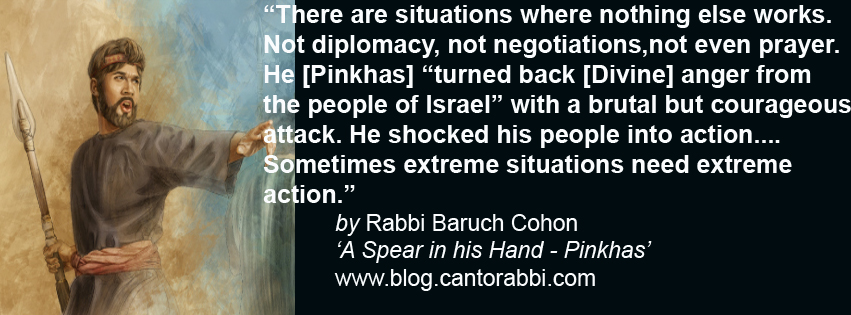
And yet, Pinkhas and his sudden violence did save his people from an immediate threat. There are situations where nothing else works. Not diplomacy, not negotiations, not even prayer. He “turned back [Divine] anger from the people of Israel” with a brutal but courageous attack. He shocked his people into action, and gave his name to this week’s Sedrah – as well as to countless Jewish boys throughout the centuries. We don’t name our sons Balaam, or Cain or Adonijah (David’s spoiled son). But young Pinky’s abound.

Sometimes extreme situations need extreme action.
Pinkhas

Posted in Jewish Blogs | Tagged , , , , , , , , , , , , , | 1 Comment

FOR ALL US TALKING DONKEYS – Numbers 22-31 – Balak – by Rabbi Baruch Cohon

Screen Shot 2013-11-05 at 11.26.08 AM

FOR ALL US TALKING DONKEYS – Numbers 22-31 – Balak – by Rabbi Baruch Cohon

You see your friend riding a bicycle too close to the lane of a fast moving truck, what do you do? You yell “Look out!” Right? But what if you lost your voice? Do you catch up with your friend and pull him away?

Such emergencies spice this week’s Torah reading, in the story of the soothsayer from P’tor, known in Jewish tradition as Bil’am harasha – Balaam the wicked.

Why wicked? Early in the story we might accept Balaam as a friend of Israel. After all, he declares his faith in the Jewish G-d, he apparently follows Divine orders, and he even gives Israel its most famous blessing in the words we repeat when we enter any synagogue: Mah tovu ohalekha Yaakov – “How goodly are your tents, Jacob.”

How does Balaam deserve the end he gets in Chapter 31 when the Israelites defeat the kings of Midian, and finding him there, “slay him with the sword?”

He gets warned, but rejects his warnings.

It starts when Balak, king of Moab, sends messengers to P’tor to ask this famous soothsayer to come and curse “this nation that came out of Egypt” and now frightens Moab. Balaam invites the messengers to stay overnight, while he communicates with G-d and is told not to go with them. “Do not curse this nation, for it is blessed.” So he stays home. Balak does not give up, however. He sends higher-ranking nobles, and promises great honor to Balaam, a kind of write-your-own-ticket deal. Again Balaam consults the Divine and gets this answer: “If they came to invite you, go. But only the words I put in your mouth may you say.” The next morning, Balaam saddles his donkey, takes his two servants with him and begins his journey with Balak’s representatives. No sooner are they on the road than the Torah tells us: “G-d was angry because Balaam went.”

What happened here? Did G-d change His mind? Not likely. The commentary called Or haKhayyim (“Light of Life”) explains the story. While Balaam refused the first invitation and told the messengers G-d would not permit him to go, he behaves differently now. He just picks himself up and goes. Not a word about Divine permission or about the limitations on it. He acts as if he is above all that, just doing what he wants to do. That is his first mistake. The Torah describes him confidently riding down the road, oblivious of a Divine angel – presumably the malach hamovves, the angel of death – standing in front of him with a drawn sword. His donkey sees the angel and veers off the road into a field to save Balaam’s life, whereupon he slaps the donkey.

Mistake #2 proceeds from there. Balaam decides that now that he is going to Balak, nothing – not even G-d — can keep him from damaging Israel. Sensing this, the angel with the sword intercepts Balaam at a narrow spot between two fences. Again the donkey swerves, and bruises Balaam’s leg against one wall. Again Balaam slaps the donkey.

Mistake #3 involves Balaam on the night before, relying on his own witchcraft to determine if this trip will really benefit him, and he decided that it will make him rich and powerful. So he ignored the first two warnings. He keeps riding. This time the angel of death blocks the road at a turn so narrow that there is no way to get around him. So the donkey sits down. Furious, Balaam takes a stick and starts beating the donkey.

Now comes “Look out!” G-d “opens the donkey’s mouth” to ask: “What did I do to you, to make you strike me three times?” Balaam rages: “You ridiculed me! If I had a sword in my hand I would kill you.” More reasonable than he is, the donkey pleads: “Am I not the same donkey you rode all your life? Did I ever do this before?” Balaam has to admit: “No.” Only then does he see the danger. He bows before the angel, who tells him that if not for the donkey’s alert action, “I would kill you, and keep her alive.” Her? For no apparent reason, Balaam’s donkey is female. Her warning is worth heeding.

Still Balaam does not change his mind. The Torah text traces his course. He reluctantly speaks the words of blessing that G-d puts in his mouth. So Balak withdraws his offer. Then Balaam, no longer trusting in his sorcery, sets out to destroy Israel another way. He organizes a campaign of seduction. “The men of Israel began to whore around with the daughters of Moab,” we will read in Chapter 25, resulting in an epidemic of idolatry and disease. The plague spread by Balaam’s sacred prostitutes kills 24,000. When the Israelite army conquers Midian, no talking donkey will warn Balaam this time. His evil life ends on a sword.

Most of us might not have the opportunity to grab our friend’s bicycle and pull it away from that truck. But we can yell “Look out!” And hope that the leaders take warning from us, the talking donkeys. We need to talk. Those who do, can be heroic – or mistaken. They can also be worth be worth listening to.

Was Edward Snowden a talking donkey?

Is a rabbi or minister who warns against measures that destroy the American family a talking donkey?

And what about Bibi Netanyahu? Another talking donkey?

Let’s learn from Balaam’s mistakes. Listen.

Posted in Jewish Blogs | Tagged , , , , , , , , , , | 1 Comment

KNOW THE LAW – AND UNDERSTAND IT? – Khukas – Numb.19:1—22:1 – by Rabbi Baruch Cohon

KNOW THE LAW – AND UNDERSTAND IT? – Khukas – Numb.19:1—22:1 – by Rabbi Baruch Cohon
Torah law comes in three varieties. One is called eydos – ordinances. A second one is called khukim – decrees. And the third is called mishpatim – judgments.

We define eydos as rules of life that would be obvious without even writing them down. Frequently they are compared to accepted customs that acquire the force of law. Wearing clothes, for example.

Mishpatim are logical conclusions from reality, formalized into law. The word mishpat means “justice.” To be fair, to be just, we must follow these laws. Like the Torah’s admonition that a murderer shall not be put to death until he stands trial. Make sure we have the right one.

Khukim – decrees, or statutes, present a different challenge. They seem to defy human intelligence. Since this week’s reading is called Khukas we have a perfect opportunity to explore some puzzling commandments. One which opens our reading describes the sacrifice of the Red Heifer, an offering which has no stated purpose but is described in full detail. We are told that this offering took place only nine times in all Jewish history, and we still don’t know why. But it is anticipated for the tenth (and last?) time when the Messiah arrives. Along with that sacrifice comes the law of tum’ah – contamination – applied to the priest who gathers the cow’s ashes. He sprinkles the sacrifice with holy water, thus purifying it. But he himself becomes contaminated – therefore unable to join in any normal activity – and remains so until nightfall. So this is a case where the same action “purifies the contaminated, and contaminates the pure.”

Tum’ah becomes more serious when a human being comes in contact not with a dead animal but a dead human body. Now it lasts a week. And if the death takes place in a tent, or if the body is brought into the tent, everything in the tent is contaminated and must be sprinkled with cleansing water, as of course the living humans too. In today’s Jewish world the mikvah substitutes for the ancient sprinkle. Proximity to death still contaminates, so a Jewish cemetery will have water faucets available for visitors to use. And returning from the funeral to enter a house of mourning, we prepare a pitcher and basin on the porch for our guests.

Yet the riddle remains. How do we explain the concept of ritual contamination? This law is not based on logic. Don’t argue. Just do it!

A decree or a statue, therefore, is a law passed down from above by absolute authority, whether human or Divine. In Chapter 30 we will read: “These are the decrees that G-d commanded Moses.” And later in the Book of Joshua we see how he signed a treaty with the people binding their agreement to dispose of all their idols, and ”made it a statute and a law.”

All through this reading we will find the imminence and effect of losing treasured people. First it is Miriam who dies. We read simply that she dies and gets buried. We don’t know who buried her, or what kind of mourning the people did. But we know they felt her loss. In her honor, says our Midrash, a miraculous well followed the Israelite people all through their 40 years in the desert. As soon as she died, they had no water to drink. That’s what they complained about.

Soon thereafter, they lose Aaron. He and his son Elazar climb the mountain, he gives Elazar his priestly robe, and his life ends. He is buried on the mountain, and the people mourn him for 30 days.

Why 30 days? Significantly, we will read no law about 30 days of mourning. Yet we still observe it. Granted, it is now just the first of 11 months of Kaddish, but the first month is the deepest, starting with the week of shiva when the mourners traditionally stay at home and refrain from work or other regular activities while they accept sympathy calls; and proceeding through the rest of the 30 days when it is customary not to visit the grave or to partake in entertainment. Aaron was a great man in our history, but memorializing him took no different form from how we honor each of our departed ever since. As we will read in Deuteronomy, Moses himself was also mourned by the entire people for 30 days.

We need these various kinds of laws – ordinances, judgments, decrees — to help us relate to each other. They teach us to respect those who live by those laws, to support those who teach and enforce those laws and to share an ordered society.

Dealing with death is different. No law we can write or even understand limits any one lifetime. Human beings live and die by a decree we cannot know. All we can do for those we love while they are with us, is to help them live. After that, we can honor good people’s memories as we have always done — from the heart.

Posted in Jewish Blogs | Tagged , , , , , , , , , , , , | 2 Comments

DEFY AND DENY – Korakh – Num. 16:1–17:15 –- by Rabbi Baruch Cohon

Screen Shot 2013-11-05 at 11.26.08 AM

DEFY AND DENY – Korakh – Num. 16:1–17:15 –- by Rabbi Baruch Cohon

The rebellion against Moses’ leadership and Aaron’s priesthood, led by a hitherto unknown man named Korakh, has to be one of the most difficult stories in the Torah. Coming right after the failed expedition of the spies, it recounts a fellow Levite’s challenge to the authority of the two men who led the Israelite people out of slavery. Accompanied by members of the tribe of Reuben who apparently were seeking to restore the status of their ancestor as the oldest son and therefore the heir of father Jacob, Korakh and his henchmen defy Moses and Aaron, deny their right to lead, and urge the people to depose them. The confrontation results in the kind of miraculous punishment that other rebels never got. The earth opens and devours Korakh and his followers. Only Moses’ prayer saves the rest of the people. And Aaron’s position is validated by a different kind of miracle, when his wooden staff, representing the tribe of Levi, was placed in the Tabernacle overnight along with staffs of the other 11 tribes. The next morning, all the staffs were still there exactly as they were the night before – except Aaron’s staff which had sprouted leaves, blossoms and almonds. The fruit of blessing!

Supernatural events, whether fatal or inspiring, are not all that make this story difficult. Considered from the vantage point of centuries of Jewish history, this is one extreme example of the disunity that plagues us. “Two Jews, three opinions” is no longer a joke. Sometimes we may wonder how the ancient kingdom of Israel managed to field a disciplined dedicated army to defeat its foes. Didn’t any of the soldiers object to taking orders? Just as well, how does the modern State of Israel marshal its martial forces? Should we expect some upstart lieutenant-colonel to proclaim himself a general and attempt to replace his commander? Or will we soon hear about the captain of a destroyer changing his ordered course and sailing off to Greece? If anything like that happened, there would likely be military penalties. But not a sudden sinkhole to wipe out the offender and all his crew. In our time, with the communications we have today, our enemies are doing their best to dig a much deeper sinkhole. A sinkhole for all the Jewish people. Jewish disunity only helps that effort.

If we take a real interest in our future – whether in America, Israel, Europe, Asia or anywhere else – we need to learn a lesson from the story of Korakh. Two significant lines underscore the message of the Korakh story.

One line comes in the prayer of Moses and Aaron: “Shall one man sin, and G-d turn in anger on the whole community?” We may be responsible for each other, we can and should support each other, but we are first responsible for our own actions. Korakh was the sinner; yet not all the people listened to him. We can disagree, and still share a great heritage and a great destiny.

The other line we will read three weeks from this Sabbath, in Parsha Pinkhas. In just four words, the Torah notes: “Uv’nai Korakh lo maisu — Korakh’s children did not die.” In fact, no less than 11 of the Psalms of David are credited to his descendants. They occupied a place in the Sanctuary as a Levitic family. And we still recite psalms today that begin with the words “A song of the Sons of Korakh.” We need not pass our mistakes along to future generations. Significantly, this message is exactly opposite to Shakespeare’s line: “The evil that men do lives after them; the good is oft interred with their bones.” Not in Judaism. Korakh’s children did not die. They do not share his guilt. We can learn from Korakh that we always have hope.

Ken y’hee rotzon.

Posted in Jewish Blogs | Tagged , , , , , , , , , | 2 Comments

THE SELECTION PROCESS – Sh’lakh l’kha – Num. 13 – by Rabbi Baruch Cohon

Screen Shot 2013-11-05 at 11.26.08 AM

THE SELECTION PROCESS – Sh’lakh l’kha – Num. 13 – by Rabbi Baruch Cohon

If you are running a business, how do you decide on a branch manager? If you’re running a nation, how do you pick an ambassador? If you are looking for a medical breakthrough, how do you staff a lab? And if you are facing a military enemy, how do you qualify a scout to bring you advance intelligence? Difficult decisions, all of them. Yet they are important – even vital. And sooner or later, we all face similar challenges to our judgment.

In this week’s reading, Moses hears the Divine message: “Send out men for yourself, and let them explore the Land of Canaan.” Rashi and other commentators note the word l’kha – “for yourself.” They conclude that this apparently extra word is not superfluous at all, but indicates that the process of sending spies into Canaan is not a Divine commandment. It is merely a permission granted Moses to do something he and other Israelites were already thinking about doing. We know that some tribal chiefs were ready to give up the idea of getting a country of their own, and openly advocated choosing new leaders and going back to Egypt. Rather than leave it to them to make the choices, G-d gives Moses the go-ahead, as a step toward invading the Land.

The Klee Yokor offers two conflicting comments on this story. Noting that the selection of the spies follows immediately after Miriam’s punishment for badmouthing Moses and his wife, the text specifies “send out men.” The Talmud in Kidushin contains the statement: “Ten portions of conversation came into the world. Women took nine of them!” Since women tend to chatter and gossip, Miriam being a woman initiated the slander about Moses. Aaron was secondary to her. Therefore the message says “send out men,” because they will be less likely to slander the Land.

On the other hand, the Klee Yokor offers his own opinion. Citing the Yalkut to the effect that the men disliked the Land, the rebellious men even advocating return to slavery in Egypt, he underscores Rashi on a later story in Numbers where the seven daughters of Zelophehad ask for a possession in the Land of Israel. The women loved the Land. They would not report on it in such a way as to run it down. So in effect G-d is telling Moses: “All right, you want to send men? Go ahead. But I know it would be better to send women.”

Who gets selected? Twelve men, one for each tribe. These are not the tribal princes named in the Torah readings of the last 2 weeks. Those princes brought the 12 identical offerings that dedicated the altar. They led their tribes on the journey from Sinai to Paran. But none of them will be selected to explore Canaan. Apparently Moses decides he needs different qualities for this job. We do not know how he made his selections. All we read here are twelve new names. No, not twelve. Eleven. Because one of the spies, the one representing the tribe of Ephraim, is none other than Moses’ right hand man, Joshua. Here we learn his original name Hoshea, signifying the act of saving or rescuing, and Moses adds the letter yud making it Yehoshua – starting with the letters yud & hey, the two letters of a Divine name – indicating that G-d will save.

With all Moses’ wisdom we would expect him to select the right men for this key assignment. And yet, when they complete their exploration and return to camp with their load of fresh fruit harvested in the Land, they report that the natives there are giants, with impregnable defenses, and we cannot conquer them. Only two spies disagree, and insist that with Divine help the battle can be won. One of those two is Joshua; the other is Caleb from the tribe of Judah. Badly outnumbered in the report, they tear their clothes in mourning and insist that with G-d’s help the Land can be Israel’s. The people follow the majority of the spies, and revolt. Tragic consequences follow. Plague, a disastrous battle, the rebellion of Korach, and another 38 years in the desert. Couldn’t Moses have picked more positive spies?

Or is this the kind of result to be expected? Take away the inspiration of Mitzvah, and negative reports follow. Appoint explorers – of a country or of an idea – who dig in with vision and with faith in their effort, and you have a much better chance. We look for inspired men – or women – and sometimes we find them. Moses succeeded twice out of 12 tries. How many of us can do as well?

Success of any investigation also depends on another factor. Reconnaissance can only supply reports. If those receiving the reports have a negative mindset they will retreat. The boss, the president, the doctor, the general — whoever sends for the information – must maintain confidence in the possibility of success.

Our Haftorah tells a similar tale with a far different result. The 38 years have passed, and Joshua is now leading the people. He also sends spies. Just two, this time. One being Caleb, his one positive colleague from the first exploration. Now 80 years old, Caleb represents experience. The other spy is a youth of 18, the figure of courage. They don’t travel the country or harvest any grapes. They just spend a day and a night with a female innkeeper named Rahab, and learn enough to bring Joshua and the Israelite army to a victorious campaign against Jericho. Mitzvah was there, confidence was there. And a woman plays a key role too.

Let’s hope it will not take 38 years to deal with our challenges and realize true value from our own explorations. Whether the challenges are military, commercial, medical or diplomatic, we pray we can face them wisely and put our explorations to positive use. Ken y’hee rotzon.

Posted in Jewish Blogs | Tagged , , , , , , , , , , , , , , , , , , , , , , , , , | Comments Off on THE SELECTION PROCESS – Sh’lakh l’kha – Num. 13 – by Rabbi Baruch Cohon