DRINK AND BURN – Shmini – Ex. 9-11, by Rabbi Baruch Cohon

Screen Shot 2013-11-05 at 11.26.08 AM

DRINK AND BURN – Shmini – Ex. 9-11, by Rabbi Baruch Cohon

This week we will read the tragic story of Aaron’s two oldest sons, Nadav and Avihu, their violation and their death. The Torah text is terse, stating only that these two men brought “strange fire” into the Tabernacle and a Divine fire consumed them fatally. Our commentators suggest many possible explanations, including (1) they used the wrong fire because they were drunk, since the very next message to Moses is to prohibit the priests from drinking wine or liquor before entering the sanctuary; (2) they were jealous of their father and their uncle, even asking “when will these old men die, so that we can lead the people?”; (3) they presumed to decide legal questions in place of Moses; (4) they were not married; (5) they had no children; (6) they did not wash their hands and feet upon entering the Tabernacle. Rabbinical writers also note that the fire that consumed Nadav and Avihu did not burn their clothes, implying it was truly fire from heaven – lightning.

Interesting suggestions, all. This week’s news could add another level to the discussion. When a pilot fails a breathalyzer test, minutes before he is to fly a passenger plane, a nation is stunned. Now we learn that airline rules require pilots to stay away from alcohol – not all the time, but for a certain definite period before and during flights.

Our Torah provides a religious precedent for those rules. After the shock of Nadav’s and Avihu’s death, Moses has to caution Aaron and his remaining sons not to drink wine or liquor “when they come into the Tent of Meeting.” In other words, don’t officiate while under the influence. What the Torah most definitely does not do, is ban alcoholic beverages completely. Not even for priests. No Prohibition law here. This distinction continued through Jewish history. Kiddush to this day involves a drink of wine. But note, the cantor chants the prayer and drinks the wine toward the end of the Sabbath or holiday evening service, when most of his officiating is over. And daytime Kiddush occurs after the synagogue service is finished. As for priests, Cohanim, they generally recite their blessing of the people during Musaf, the additional and concluding service of a festival morning. But there is an exception on Simchas Torah, the holiday of Rejoicing in the Torah. Many congregations accent the celebration by giving every man called to the Torah reading a schnapps. So on Simchas Torah the blessing of the Cohanim is moved to the Shakhris service – before Torah reading! And of course, since we just had Purim with its accent on partying, we can appreciate the perils of overindulgence.

No, we don’t prohibit alcohol, even for Cohanim. Any more than the airlines demand total sobriety from their pilots. What they – and the Torah – require, is good judgment. Take the time to sober up.

For some of us, that sobering is a process of years. Those of us who experience dependence on alcohol or drugs usually discover that recovery can go on indefinitely. Our tradition provides for that too. Remember that the blessing over grapejuice is exactly the same as the blessing over wine. That parallel goes for whiskey and coffee too. Hopefully, we made some progress since the days of Nadav and Avihu. No lightning needed.
Posted in Jewish Blogs | Tagged , , , , , , , , , , , , , | Comments Off on DRINK AND BURN – Shmini – Ex. 9-11, by Rabbi Baruch Cohon

IS FOOD SACRED? – Tzav – Lev. 6-8 — by Rabbi Baruch Cohon

Screen Shot 2013-11-05 at 11.26.08 AM

IS FOOD SACRED? – Tzav – Lev. 6-8 — by Rabbi Baruch Cohon

Part of the detailed description we will read this week of the inauguration of Aaron and his sons as priests is the provision that they will eat sections of the same sacrifice they offer on the altar. Toward the end of our Torah portion, Moses tells Aaron and his sons to “cook the meat at the entrance of the Tent of Meeting, and eat it there, together with the bread that is in the basket of inauguration offerings.”

The same meal – the same meat and the same bread – that constituted an offering to G-d, also fed the human beings who brought the offering. Commenting on this provision, the Lubavitcher Rebbe writes:

One of the unique qualities of a Jew is that he can elevate the process of eating food – a mundane act which even animals perform – to be an act of serving G-d.

We don’t burn sacrifices on an altar today; we don’t symbolize our spirits rising to heaven with the smoke. But we can serve G-d with a simple blessing before and after we eat. Sustaining our bodies becomes a sacred process, since it can also sustain our spirits.

People in other faiths adopted the Jewish practice of reciting a prayer of thanks for a meal. In effect, this week’s Torah reading is a source of that practice. Certainly anyone who ever experienced desperate hunger will tell you that at such a time food is sacred.

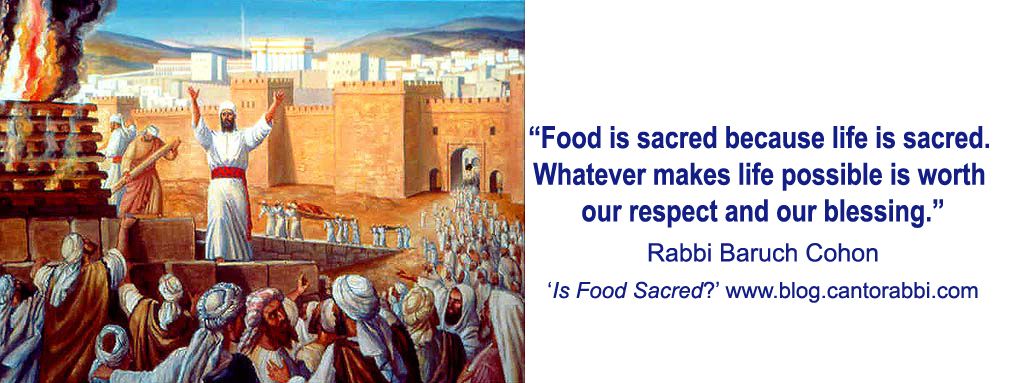
Food is sacred because life is sacred. Whatever makes life possible is worth our respect and our blessing. Just as Aaron blessed the Almighty by sending heavenward the smoke of the offering he burned on the altar, he also served his Creator by sustaining his own created life. For Aaron’s descendants, physical and spiritual, that sustenance at least partially retained a sacred quality.

For many a Jewish mother and grandmother, special food carried a special importance, as illustrated by the old quip “do we eat to live or do we live to eat?” But the humor can be as delicious as the kugel.

A childhood memory that still makes me smile is the day my mother took me to the zoo to see the trained gorilla, Susie, that was the Zoo’s main attraction. Her trainer had a table set in the cage, tablecloth and all, and proudly brought Susie in to sit on a chair and eat lunch. He handed her a roll, which she took a bite of. He then gave her a spoon and a fork and she picked up her potato and put in her mouth like a human being, to the applause of the visitors. At which point I turned to my mother and said “No Hamotzi!” At that age, my conditioning led me to expect Susie to say a brocha before she ate.

Not for gorillas, I learned, but for humans. Truly the haMotzi and the Birkas haMazon are daily witnesses that we do not take our food for granted. Our lives, sustained by food, are sacred. Acknowledge it.

TzavBlog

Posted in Jewish Blogs | Tagged , , , , , , , , , , | 1 Comment

A FEW PURIM THOUGHTS — by Rabbi Baruch Cohon

Screen Shot 2013-11-05 at 11.26.08 AM

A FEW PURIM THOUGHTS — by Rabbi Baruch Cohon

It was my freshman English class at the University of Cincinnati and the young professor was announcing that next week we would begin the study of the short story. He gave us an assignment to prepare us for this. “If you have a Bible at home,” he said, “go home and read the Book of Esther. It’s the most perfect short story ever written.” He was not Jewish, and I didn’t have to do the assignment. Why should I? I’d been reading the Book of Esther every Purim all my life. I knew it and loved it.

Of all the holidays of the Jewish year, Purim stands out as the most light-hearted, high-spirited, almost frivolous of celebrations. Wear funny costumes with crazy hats. Have a party. Yes, it’s a mitzvah to hear the Megillah – the Book of Esther – read in the synagogue, but when you hear the name of the villain Haman you twirl those noisemakers to drown it out. Above all, have a drink.

That’s right, have a drink. And not just a formal l’hyyim. The Talmud even recommends that a man should imbibe on Purim until he cannot distinguish between the words “bless Mordecai” and “curse Haman!” The Hebrew for not distinguishing is ad d’lo yada – literally “until he does not know” – and that became the name of an annual Israeli event, the Adloyada Purim parade.

Like other such times of letting it all hang out, that experience can backfire. Of course, every Hebrew letter has a numerical value. Alef = 1, bet=2, gimel=3… yod=10…kuf=100, etc. Add up the value of the letters that spell out “bless Mordecai – baruch Mordechai,” then the value of the letters in “curse Haman – arur Haman” and you will come up with two identical totals: 502. That’s right, the number for a drunk driving violation!

So much for driving on Purim. Have that party at home!

On another track, Purim celebrates a miracle, the one time when a threatened destruction of Jewry did not happen. One time when the Jews were alerted to defend themselves, and they succeeded. All because one young Jewish woman named Esther risked her life to plead the cause of her people to an unpredictable potentate. As the Megillah tells us, Mordecai urges her to take the chance, because as he says “Don’t think you will escape this danger in the king’s house. If you keep silent at a time like this, relief and rescue can come to the Jews from somewhere else, but you and your family will perish, and who knows if just for such a time you arrived at royalty!”

Esther bites her lip and decides to face the king, but she charges Mordecai: “Go and gather all the Jews in Shushan, and fast for me and pray for me for three days. I and my maids will fast too. Then I will go to the king, and if I perish, I perish.” So Mordecai went and carried out what Esther asked him to do.

Want to know what the real miracle of Purim was? That was it. She said gather all the Jews. And he was able to do it. She didn’t say gather all the Orthodox Jews. Nor all the Reform Jews. She didn’t say gather all the Litvaks. Or the Galitzianer. She didn’t say gather all the B’nai B’rith members. Or the Ladies of Hadassah. She said gather all the Jews. And he did.

Now that’s a miracle worth celebrating any time. Happy Purim!

purimthoughts

Posted in Jewish Blogs | Tagged , , , , , , , , , , | 3 Comments

REMEMBER AMALEK – by Rabbi Baruch Cohon

REMEMBER AMALEK – by Rabbi Baruch Cohon

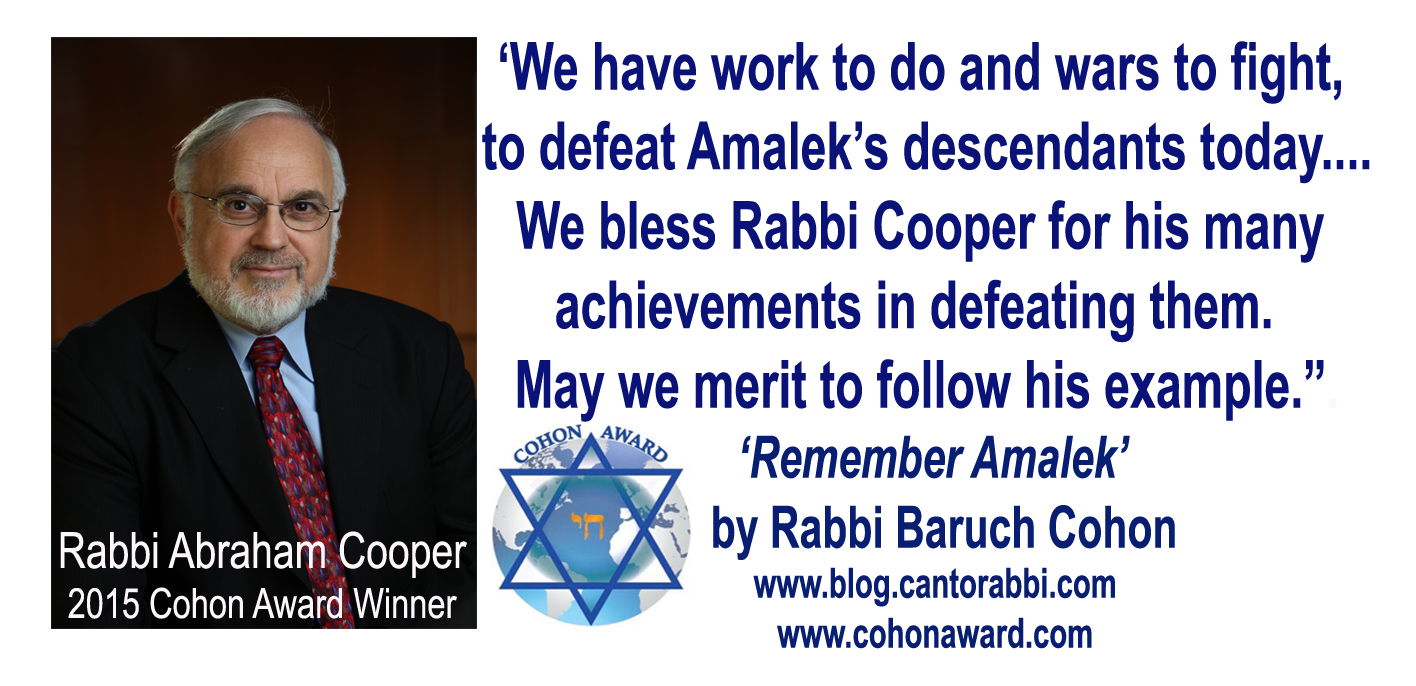
“Remember Amalek,” says this week’s special Torah reading for Shabat Zakhor, the Sabbath of Remembrance, preceding Purim. Our ancestors deliberately remembered brutal and crafty enemies like Amalek, and our sages linked them to subsequent threats like Haman, whose downfall we will commemorate on Purim. Appropriately, the Cohon Memorial Foundation will take this Sabbath to honor a man whose career involves remembering and recognizing enemies of the Jewish people, past and present, and working to defeat them today. That man is Rabbi Abraham Cooper, Associate Dean of the Simon Wiesenthal Center. He is the winner of the 2015 Cohon Award. This annual cash award, named for my parents, Rabbi Samuel S. and A. Irma Cohon, honors individuals for outstanding service that benefits Klal Yisrael – the entire Jewish People. Rabbi Cooper will be honored in a special ceremony during Friday evening services at Temple Emanu-el in Tucson Arizona. Previous winners have qualified in one of four areas: Unity, Education/Information, Creative Arts, and Rescue. This year, the winner qualifies in all four. Let me tell you about him.

From his headquarters at the Simon Wiesenthal Center in Los Angeles, Rabbi Cooper’s work takes him all over the world. Among his accomplishments are his Rescue efforts for Soviet Jewry in the ’70s, and his nearly 30 years work with the late Simon Wiesenthal himself, probably the most influential survivor of the Holocaust. Along with the Dean Rabbi Marvin Hier he established the Museum of Tolerance in Los Angeles, which hosts hundreds of young students every weekday, as well as thousands of adult visitors through the year. He is now building a companion museum in Jerusalem. Other Informational and Educational efforts of Rabbi Cooper’s include co-producing live exhibitions and film documentaries on Anne Frank and other Holocaust subjects, his editorship of Response Magazine, and his editorials in leading newspapers in America, Europe and Asia. Frequently he is in the news for his negotiations with heads of state and with UN officials. Just recently at the Vatican, he opened a UNESCO exhibit which he designed, a Creative display of Jewish history, values and connection to the Land of Israel, commemorating 50 years of positive Catholic-Jewish relations.

Cited by Newsweek magazine in 2007 among the topmost influential rabbis in the United States, Rabbi Cooper also travelled to Khartoum in 2004 to meet with Sudan’s president, and has met with the king of Jordan, president of Indonesia, and former Grand Mufti of Egypt. In Asia he helped counter negative stereotypes and opened new dialogues in Japan, South Korea, China and India. As the Cohon Foundation honors those whose work benefits the Jewish people of the world, not limited to national residence or religious affiliation, Rabbi Cooper offers a prime example of that work. An ordained Orthodox rabbi, he fights for all his people, from the most secular to the most pious. Unity is certainly a goal of his.

Yes, he remembers Amalek. Remembering is not enough, though. Not for him and not for us. We have work to do and wars to fight, to defeat Amalek’s descendants today. Our Purim tradition reminds us that Haman was one of those descendants. So were Tormquemada, Chmelnitzky, Hitler, Arafat. And some current enemies join that list. We bless Rabbi Cooper for his many achievements in defeating them. May we merit to follow his example.

RabbiCooper

Posted in Jewish Blogs | Tagged , , , , , , , , , , , , , , , , , | Comments Off on REMEMBER AMALEK – by Rabbi Baruch Cohon

BE STRONG – Hazak, hazak – Sedra Pikudey – by Rabbi Baruch Cohon

Screen Shot 2013-11-05 at 11.26.08 AM

BE STRONG – Hazak, hazakSedra Pikudey – by Rabbi Baruch Cohon

In addition to its other contents, this week’s Torah reading concludes the Book of Exodus. The final verses describe the sacred cloud that hung over the Tabernacle in their camp in the desert, and lifted only when they were to move on. That cloud, signifying the Divine presence in their midst, effectively guided them on their 40-year journey to the Promised Land, and we leave this book with the vision of that cloud.

As we do when we finish every book of the Torah, we sing a special farewell. The Torah reader chants the closing words to a dramatic melody, and the congregation echoes his melody with the words Hazak hazak v’nis-kha-zek – “Be strong, be strong, and let us strengthen one another!” This week the closing words describe the cloud that sanctified their Tabernacle by day and the fire that lit it by night, “in the sight of all the house of Israel, throughout all their journeys.” We stand to hear those words when they are read in the synagogue, and remain standing to chant the triumphal Hazak, hazak!

Final passages offer us a sequence of basic importance in our history.

Genesis, the first book, ends with the death of Joseph and recounts how his body was placed in a coffin in Egypt. So concludes the epic of the sons of Jacob and the slavery and redemption of their descendants in Egypt. Hazak, hazak!

Leviticus, the book that follows this week’s, sums up the Mitzvos that our ancestors were taught at Mount Sinai. Hazak, hazak!

Numbers concludes the Mitzvos Israel received “by the Jordan at Jericho.” Learning our sacred responsibilities was not a one-time experience. Hazak, hazak!

And Deuteronomy closes the Torah with an epitaph for Moses, the unequaled leader, prophet and sage. Even on such a joyful holiday as Simchas Torah we will close the reading remembering “the mighty hand and the great awe that Moses wrought in the sight of all Israel.”

And just as we will do this week, once again we will stand and sing out those words of courage: Hazak hazak v’nis-kha-zek – “Be strong, be strong, and let us strengthen one another!”

Our Torah’s standing ovation reminds us of the strength it gave us through all the hard and bitter centuries. May we continue to draw strength from it in the centuries to come. This week and every week, whether we sing it or just feel it — Hazak, hazak!

SedraPikudey

Posted in Jewish Blogs | Tagged , , , , , , , , , , , , , , , | Comments Off on BE STRONG – Hazak, hazak – Sedra Pikudey – by Rabbi Baruch Cohon